
152 Followers
184 Following
86 Posts
Tech Lead at (but not speaking for) the V&A
Web & Data Wrangler, IIIF & Linked Art Herder.
Favourite Biscuits: Mikado (Irish) - Anytime, Lebkuchen (German) - Christmas
Some #BFINationalArchive work profiled for World Digital Preservation Day #wdpd2024 - first our Netflix #digipres featuring important acronyms like IMF, IMP, SMPTE, MXF… https://www.bfi.org.uk/features/archiving-netflix-bfi-national-archive
Archiving Netflix: how and what we preserve from the streamer’s programming

In 2022, the BFI National Archive announced a partnership with Netflix for a selection of their shows to be preserved as part of the national collection. Two years on, we look at highlights from the selections so far, and the technology behind preserving them.
BFI

News from the British Newspaper Archive on twitter:

'We’re delighted to announce that in partnership with the @britishlibrary, we have released over 1 million more free to view newspapers pages on The Archive, bringing our total of free to view pages to over 4 million. Find out more: https://blog.britishnewspaperarchive.co.uk/2024/09/19/one-million-new-free-to-view-newspaper-pages/ ' #FreeToViewNewspapers

Explore Over One Million New Free to View Newspaper Pages

In March 2025, the RUNIP project @ruhr-uni-bochum.de will host the conference “Words in Numbers – Data-Driven Approaches to Texts in the Humanities and Social Sciences.” Keynote speakers include @jerielizabeth and Jo Guldi 🙌. The call for papers is now open, inviting especially early career researchers to submit proposals for short talks or posters. Check it out and join us! https://runip-projekt.ruhr-uni-bochum.de/words_in_numbers.html (English CfP is in the linked PDF at the end) #TextAsData #DigitalHumanities
Some other obvious issues I need to fix on colours changing between charts, consistency of naming, treemaps not interactive, archives stats approach, cataloguing progress more clear, donut charts purpose. Apart from all that, hopefully interesting!
I think it broadly follows the top level numbers set out in the Towards a National Collection digital collections audit by Gosling K., McKenna G. and Cooper A., although as they note, the size of some collections does overwhelm the stats. https://museumdata.uk/wp-content/uploads/2023/11/Digital-Audit.pdf
The numbers are from my personal interpretation of an institutions website (where available) or annual report (where available), and the classifications likewise are my opinions, undoubtedly it will have errors so happy to update if anyone wants to get in touch.
Totally unofficially and very work in progress (don't read too much into any of the 'spurious accuracy' numbers), some notebooks attempting to visualise what a UK National Collection (of heritage artefacts) looks like in numbers (and cataloguing progress): https://atiro.github.io/national-collection-visualisation/intro.html
UK National Collections Dashboard — Cultural Heritage Collections Data Infrastructure

The Access and mediation working group of the Society of Swiss Archivists has just published a whitepaper on the benefits and opportunities of machine learning for improving access to archives.
It's available in English here: https://vsa-aas.ch/wp-content/uploads/2024/08/MachineLearning_im_Archiv_Whitepaper_2024-08-08_en.pdf

Check out @nick_performant 's blog post in the @dhtech_group about the new tool for creating digital critical editions and archives, #EditionCrafter https://dh-tech.github.io/blog/2024/08/30/edition-crafter-dh2024/

#DigitalHumanities

EditionCrafter at DH Inside Out

At the DH Inside Out Workshop at DH2024, Performant Software Solutions LLC presented EditionCrafter, a tool for creating digital critical editions and archives.

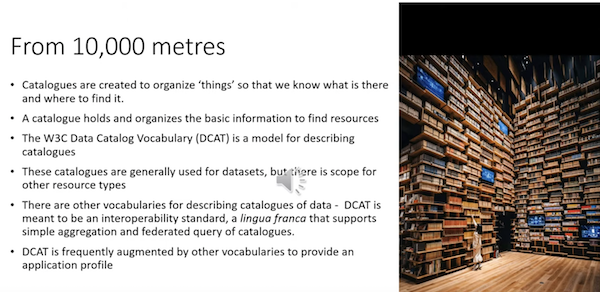
Congrats to editors Riccardo Albertoni, David Browning, Simon J D Cox, Alejandra Gonzalez Beltran, @aperego and Peter Winstanley for the newly published @w3c #WebStandard "Data Catalog Vocabulary (DCAT) - 3"
▶️ https://www.w3.org/TR/vocab-dcat-3/ #timetoadopt

DCAT is an #RDF vocabulary that improves #interoperability by standardizing dataset and data service descriptions, simplifying #metadata sharing across web-based catalogs. DCAT3 preserves backward compatibility with DCAT2

🎬 https://youtu.be/lbzMShQIvwU

Data Catalog Vocabulary (DCAT) - Version 3

DCAT is an RDF vocabulary designed to facilitate interoperability between data catalogs published on the Web. This document defines the schema and provides examples for its use.