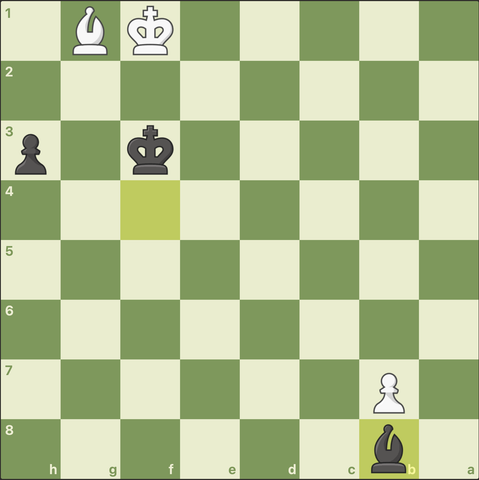
I just played Bb8 (I'm Black) and celebrated my victory but White has a way to draw!
#chess
#chess

Streaming chess at http://twitch.tv/pepellou
Coding at chessable.com
Teaching at eaganchess.com
he/him
#chess #languages #code #learning
| chess.com | https://www.chess.com/member/pepe_chessable |
| github | https://github.com/pepellou |
| chessable | https://www.chessable.com/profile/pepellou |
@zaunkoenig exactly!
Except I'm Black so it's Bh2 Bxh2 b8Q Bxb8 Kg1
My opponent did not find Bh2 in the game so luckily I won 🙃
This week, the Galician #Chess Federation (local federation under national federation under international federation) published the whole calendar of events for 2024, while the International #Chess Federation just published the schedule for the World Rapid and Blitz Championship on the next month...
Good luck to all the players around the world getting their visas to travel to Uzbekistan.
#chess Petrov Defense is boring... oh wait
https://www.chess.com/events/2023-qatar-masters/04/Gukesh_D-Yilmazyerli_Mert
I will need a whole week to study the subtleties of yesterday's #chess endgame between WGM A Pourkashiyan and WGM G Tokhirjonova.
@pontulo there's of course no best answer - many good options and an infinite field to study...
But I'll try my best at giving a tip here. I like to recommend studying concrete openings first, that is openings with direct threats (ex: 1. e4 as White with direct Bc4 lines, even going for Fried Liver and so...; Scandi or Alekhine as Black against e4, maybe even Budapest against d4; etc) rather than more flexible openings (London System, Sicilian Defense, Kings Indian, etc).
Concrete openings are maybe not the best long-term, but they narrow down the options you have to study. Ex: Scandi against 1. e4, White only has one good option (exd5) and you'll always get the same pawn structure. That means it's a great choice to later on study other more flexible options such as Caro-Kann, French, etc with that same p structure plus other possible p structures.
But all that being said, again there's no single answer and I'd say study whatever attract you most anyway :)
I can't believe I did the same mistake again for the 99th time 🤦♂️
Pretty sure on the 100th I'll remember to avoid long-side defense when setting up Lucena.
#chess is hard 🤷

@SCampbell I really don't know (it's been decades since I was a beginner), but I'd suggest to stay away from openings books. They're only useful after you get certain experience.
A common tip for beginners is to just play, analyze and do puzzles. A book can only teach you so much and never replaces the learning you get with practice. That been said, I'm pretty sure there are many great books for beginners that I don't know, so I hope someone else gives you a better answer 🙂
Hey #chess and #languages lovers. I have a doubt about the use of "still" in the sentence:
- The game is still close to even, but you lost your winning advantage.
It refers to a mistake where you had an advantage and after that you don't, but you're not losing. So "still" has the meaning of "it could be worse" or "you still have a chance".
My problem is I'm too literal and to me "still close to even" only makes sense if it was "close to even" before, but it wasn't.
I understand "but still" is a common construct in English to show a concession so this would make more sense to me:
- You lost your winning advantage, but still the game is close to even.
Or maybe better with "and yet":
- You lost your winning advantage, and yet the game is close to even.
Am I too crazy/literal or is there some logic to my thinking? 🤔
@SCampbell never trust new accounts, they could be strong or experienced players just creating a fresh account 😬
Next step is to get mated in more than 10 moves 🙃 Chess is hard, take it easy 🤷♂️

