Orit Peleg

@oritpeleg
293 Followers
187 Following
76 Posts
Physical computation in insect swarms | Assoc. Prof. Computer Science & BioFrontiers Inst., CU-Boulder | Nat Geo Explorer | Ext. Faculty, Santa Fe Inst. | She/her
LAB WEBSITEwww.peleglab.com
SCHOLARhttps://scholar.google.com/citations?user=xH5Ryy4AAAAJ&hl=en

Excited to share a new paper on the flash pattern variability of fireflies! ⚡

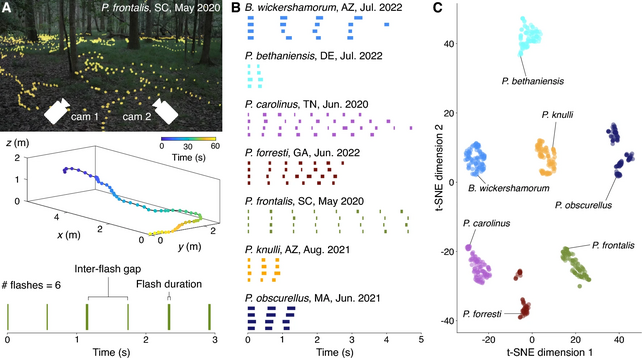
Our work, led by Owen Martin and Chantal Nguyen, in collab with Ryan Layer’s lab, offers new insights into species identification through ML data analysis:
https://www.nature.com/articles/s41598-024-53671-3

Embracing firefly flash pattern variability with data-driven species classification - Scientific Reports

Many nocturnally active fireflies use precisely timed bioluminescent patterns to identify mates, making them especially vulnerable to light pollution. As urbanization continues to brighten the night sky, firefly populations are under constant stress, and close to half of the species are now threatened. Ensuring the survival of firefly biodiversity depends on a large-scale conservation effort to monitor and protect thousands of populations. While species can be identified by their flash patterns, current methods require expert measurement and manual classification and are infeasible given the number and geographic distribution of fireflies. Here we present the application of a recurrent neural network (RNN) for accurate automated firefly flash pattern classification. Using recordings from commodity cameras, we can extract flash trajectories of individuals within a swarm and classify their species with an accuracy of approximately seventy percent. In addition to its potential in population monitoring, automated classification provides the means to study firefly behavior at the population level. We employ the classifier to measure and characterize the variability within and between swarms, unlocking a new dimension of their behavior. Our method is open source, and deployment in community science applications could revolutionize our ability to monitor and understand firefly populations.


Nature
🎙️ ✨ I had a lovely conversation with Sean Brady on the Simplifying Complexity podcast about firefly synchronization and complex systems. Listen here: https://podcasts.apple.com/au/podcast/how-do-fireflies-synchronise/id1651582236?i=1000625138276
‎Simplifying Complexity: How do fireflies synchronise? on Apple Podcasts

‎Show Simplifying Complexity, Ep How do fireflies synchronise? - 21 Aug 2023

Apple Podcasts

I periodically re-post this article I wrote about Nikolai Vavilov, not because he was a brilliant scientist (he was), not because he was an extraordinary human being (he was), not because he was courageous beyond measure (he was) but because Vavilov’s story is a warning buoy for what happens when political ideology trumps science.

https://nautil.us/the-botanist-who-defied-stalin-2-238393/

The Botanist Who Defied Stalin

His dream of feeding the world died in prison. His dream of a seed bank lives on.

Nautilus
@ottiswimmers thanks! We usually use goPros for crowdsourcing, but mobile phones could work too. Here's a movie I took last night with my iPhone, and you can see lots of little twinkling lights :-)
@kristinmbranson thank you so much ❤️ ❤️

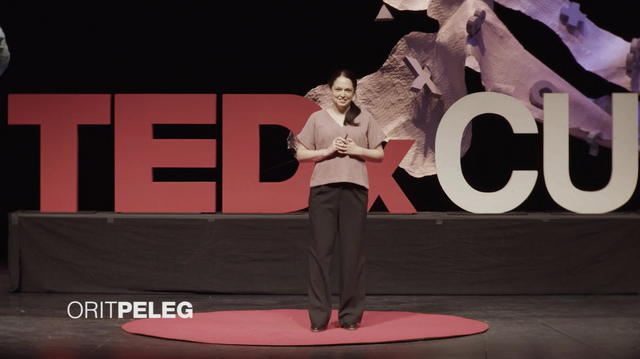
Exciting news! ✨ My TEDx talk is finally online! Join me in the mesmerizing world of firefly communication and synchronization!

Hope you enjoy watching it: https://lnkd.in/gS3cQRPH ❤️

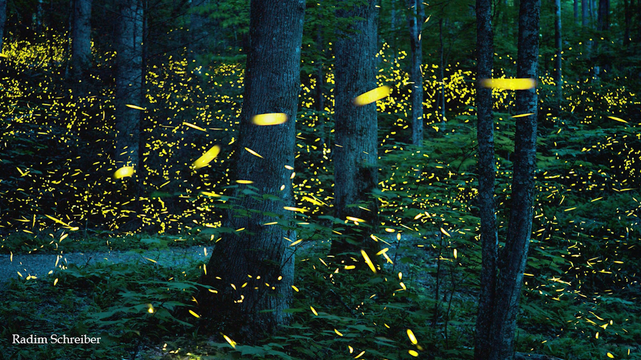
Huge thanks to the talented photographers Radim Photo, Pete Mauney, and Mac Stone for graciously allowing me to showcase their stunning footage 💛 💚 💙

#tedx #fireflies #communication #synchronization #complexity

How fireflies communicate | Orit Peleg | TEDxCU

YouTube
@photocyte Fantastic, thank you Tim! Any chance you'd be willing to introduce me to Larry Buschman? 🙏 😬
Thanks @c_dan4th :-) If you are willing to help and haven't seen fireflies around, we'd be happy to point you to a few locations where they have been seen before! Signup, and we'll get in touch.

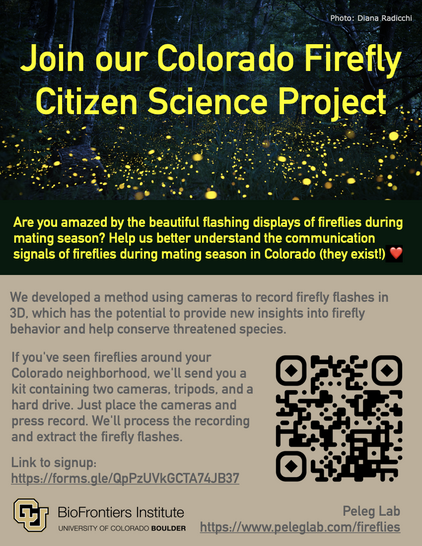
🔬✨Attention Coloradoans✨🔬

We need help with our Colorado Firefly Project & gather data on firefly flash patterns to train our code & ID species. Sign up at the link below and be a part of our mission! #citizenscience #fireflies #colorado

https://forms.gle/QpPzUVkGCTA74JB37

Pls help us spread the word 🙏👇

Help us Record Firefly Flashes ✨

Firefly flashes are amazing ❤️ During mating season, fireflies gather in groups and flash their species-specific flash pattern. To better understand these communication signals, we developed a method to record flash displays in three dimensions, using pairs of cameras with 360 degrees of view (stereo-recoding, more info at www.peleglab.com). Our method has the potential to provide new insights into firefly behavior (see recent Quanta Magazine story), and serve as a monitoring tool for firefly conservation (see IUCN red-list of threatened firefly species). And, you can help! Have you seen fireflies around your neighborhood? If you are willing to go back to that spot, we will send you a kit (two cameras, tripods, and a hard drive*), and ask you to upload the data to the hard drive. The method is easy - you just need to go out to the fireflies, place the two cameras and press record! 💪We will take care of the rest (process the recording and extracting firefly flashes). *Pending availability

Google Docs

RT @[email protected]

With the help of a wonderful team @[email protected], I recently had the chance to try to explain how mathematicians think about infinity at five levels of increasing complexity. You can see our conversations at the link below: https://twitter.com/WIRED/status/1620195277456941061

🐦🔗: https://twitter.com/emilyriehl/status/1620217772486840320

WIRED on Twitter

“To infinity and...beyond? While the concept of infinity may seem mysterious, mathematicians have developed processes to reason the strange properties of infinity. Mathematician @emilyriehl has been challenged to explain infinity in 5 levels; from child to expert.”

Twitter