Milos Foreman was there for the #PragueSpring so this is more than just sentimentality. And Twyla Tharp is a genius. And Renn Woods is tremendous.
You should watch the breathtaking opening of HAIR (1979) again:


"I don't know how to run a newspaper, Mr. Thatcher. I just try everything I can think of."
Linktree: https://linktr.ee/nealromanek
| SKIES OF VENUS (novel) | https://www.amazon.co.uk/dp/1945462388 |
| BOUDICCA (graphic novel) | https://getbook.at/BOUDICCAHB |
| https://www.instagram.com/nealromanek | |
| The Avian Empire | https://www.twitter.com/rabbitandcrow |
Milos Foreman was there for the #PragueSpring so this is more than just sentimentality. And Twyla Tharp is a genius. And Renn Woods is tremendous.
You should watch the breathtaking opening of HAIR (1979) again:
Regardless of how many loanwords it may have absorbed, however, English is still a Germanic language in its logical underpinnings. It has a three-gender system (he/she/it) whereas Romance ones have dual gender (he/she) and it still preserves extremely Germanic verb forms such as “sing/sang/sung" and “swim/swam/swum”. It places adjectives before the noun (“red house”) whereas Romance languages generally place them after (“casa roja”)
https://cohost.org/0xabad1dea/post/843350-english-is-not-desce

I wanted to explain why one of the most common misconceptions about the English language is exactly that: completely misconceived. Let me begin by saying please don’t feel bad if you thought English was descended from Latin. This is often repeated by teachers and religious authority figures, and it certainly seems to be true, because English is full of words that clearly come from Latin. So if English is not descended from Latin (and I can't emphasize this enough: it’s not), then why is so much of our vocabulary similar to Latin? There's two separate, equally important factors: first, English and Latin are distant cousins which share a common ancestor language several steps up the family tree, which means there would be broad, vague similarities between them even if the Romans had all migrated to the moon two thousand years ago and had no further contact with other humans whatsoever. Second, technical terms are highly transmissible by cultural contact; new technologies, art forms and religions bring their words with them. Several different languages around the world have become linguistic origin points that radiate outwards into large numbers of adjacent cultures: Latin, Greek, Arabic, Persian and Chinese are prominent examples and now English is also taking this role. For the Romans themselves, Greek was that language. Greek words have been hitching a ride with Latin ones around the world ever since. Most languages spoken in Europe today, as well as many in the Middle East and India, are descended from a single ancestor language spoken several thousand years ago. We don’t know what speakers of this language called themselves, so we refer to it as Proto-Indo-European, or PIE. There is no direct evidence of this language in written form, but we can reconstruct a close approximation of it by comparing the oldest written documents in different languages and seeing what they have in common to triangulate one step backwards. Their original homeland was probably somewhere around Ukraine, and the modern languages that are most similar to reconstructed PIE are Lithuanian and Latvian. Different tribes split off from the PIE culture at different times and migrated in different directions. A combination of losing contact with the mother culture and encountering new languages in their new homes inevitably changed every tribe’s language until it was no longer mutually intelligible with PIE, each one acquiring a distinct flavor. Over time, almost all of those indigenous languages were absorbed into the cultures of the incoming Indo-Europeans, and in modern Europe only a handful of languages around the edges are still independent, most notably Basque, Finnish, Estonian and Hungarian. (And yes, all of these languages have loanwords of Latin origin!) I want to note that while violence and even genocide undoubtedly played a role in the disappearance of native languages in favor of Indo-European ones, this was demonstrably not always the case. For example, the Romans never made an intentional effort to extinguish the Etruscan language; it faded out naturally over a few hundred years as the Etruscans became more integrated with Latin culture, and there came a point where every single Etruscan spoke Latin at least as well as Etruscan. The language quietly winked out of existence, though it did leave a trace of loanwords in Latin that still persist to this day: it is believed that “satellite” ultimately comes from the Etruscan term for the sort of bodyguard that hovers ominously around his client. One group of PIE descendants became the Italic languages, spoken around Italy, and eventually these were all consolidated into Latin due to Roman dominance. Latin then later re-splintered into several daughter languages, such as Italian, Spanish, Portuguese, French and Romanian; we call these the Romance languages. In a completely separate, parallel process, another group of descendants developed a very different language that we call Proto-Germanic (again, because we’re not sure what they called themselves, but it was an ancestor of German among others). Latin documents frequently mention encounters with foreigners who presumably spoke something from the Proto-Germanic cluster. Eventually, a Germanic culture called the Goths clearly emerged in documented history, and the oldest existing long-form document written in a Germanic language (and hence a language closely related to English) is the Gothic translation of the New Testament written in the fourth century CE. Gothic has gone extinct, but many other Germanic languages survive: German, Dutch and its daughter Afrikaans, Swedish, Danish, Norwegian, Icelandic, and yes, English. These two threads reconverge with the Norman Conquest of the eleventh century CE. The change of leadership in England caused a huge amount of French vocabulary (in turn derived from Latin) to flood everyday English usage. Up until that point, English had been extremely similar to Dutch and Frisian (a minority language of the Netherlands) but they rapidly drifted apart. A modern English-speaker will have vastly more difficulty with the English of a thousand years ago than most other Germanic language speakers will with their own. Regardless of how many loanwords it may have absorbed, however, English is still a Germanic language in its logical underpinnings. It has a three-gender system (he/she/it) whereas Romance ones have dual gender (he/she) and it still preserves extremely Germanic verb forms such as “sing/sang/sung" and “swim/swam/swum”. It places adjectives before the noun (“red house”) whereas Romance languages generally place them after (“casa roja”). Spend some time with Dutch and French and you will inevitably come to the conclusion that English's overall structure is much more akin to the prior. So in conclusion: English is not descended from Latin, but it is related in a way you can't really sum up in one sentence. (Bonus misconception: Shakespeare did not speak capital-o Old English; Modern English is defined as beginning shortly before he was born, his own work being considered a major solidifier of it, and there was a Middle English in the middle there. The fact that you can make any sense of him at all means it’s Modern. If you want to distinguish him from literally-right-now English, then the latter is “contemporary” or “present-day”.)
For New Year's Eve #SauropodSaturday, I've always liked these portrait head studies of Camarasaurus by Erwin S. Christman. Definitely in the early-20th century "Sauropods as bulky elephantine lizards" mode, but still making it look like a plausible animal.
And writing the text description is making me think he at least partly had giant tortoises in mind as the model?
Originally published in this article by Osborn and Mook, and the original drawings are in the AMNH: https://www.jstor.org/stable/984263#metadata_info_tab_contents
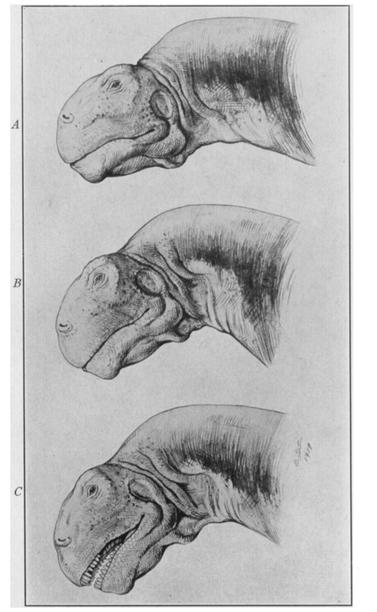
Henry Fairfield Osborn, Charles Craig Mook, Characters and Restoration of the Sauropod Genus Camarasaurus Cope. From Type Material in the Cope Collection in the American Museum of Natural History, Proceedings of the American Philosophical Society, Vol. 58, No. 6 (1919), pp. 386-396
I got in a pretty bad arguemnt with a lepidopterist once and he said that I was "just spewing pro-ant propaganda"
and that was the funniest thing I've ever been called so I changed my handle to myrmepropagandist.
I mean "pro-ant" like we all need to take a stance on ants. (Like there was any other possible correct stance to take. If you're anti-ant you're just ... nothing. )
Do you know of any folk tales that feature ants? I keep a collection of such stories and Always excited to find new ones:
1. Grasshopper & the Ants
2. The bit in the Bible about how you should be like ants.
3. King Solomon talks to an ant (she talks back!)
4. Hopi Ant People save the human race during an Apocalypse
5. Ho Kwan dreams of ants and silver
6. The ants of Senegal are a metaphor for getting rid of colonialism. (ironically enough)
What old #ant stories do you know?
Instead of saying "come to mastodon" link the person to a thread here where they would totally want to jump in and join the conversation.
"we were just talking about this here: ***link*** -- could really. use a perspective like yours."
It gives people a starting point and some people who are active and who they'd want to follow.
Sure, I'm an art-loving, movie-grovelling, climate-panicking writer of phantasmagoriae. But I'm also editorial director of #media tech magazine #FEED.
FEED just celebrated its 5th birthday - and 40th issue. We deliver case studies, interviews, analyses & top tips to help everyone from #ReedHastings to your #YouTuber nephew improve their video business & better serve audiences.
FEED comes in a print quarterly, but you can read every issue online too. Check it out:

This is the new paper by James Hansen & Makiko Sato, "Global Warming In The Pipeline"
"7-10°C #globalwarming is the eventual response if today’s level of GHGs is fixed and the aerosol amount is somewhere between its year 2000 amount and preindustrial amount."
Here is the pre-meeting video Marshall Vandruff did for his previous #HeinrichKley class. This might get you excited. First session is this Saturday.
https://youtube.com/watch?v=Wjh44YoW4zw
#art #artists #drawing #penandink #fantasy #fantasyart #scifiart

 HandgunYoga (he/him/his)
 Chris Manias
 myrmepropagandist