2K Followers
0 Following
62 Posts
Real-time tracking of pathogen evolution
Websitehttps://nextstrain.org
Twitterhttps://twitter.com/nextstrain
Githubhttps://github.com/nextstrain

Nextstrain is happy to announce a major update to our tuberculosis analysis, making it our first real-time (continually updated) analysis for a bacterial pathogen. Please see our new blog post for details:

https://nextstrain.org/blog/2025-11-17-tuberculosis-resources

Nextstrain: New Resources for Tuberculosis

Nextstrain blog post from 2025-11-17; author(s): Kim Andrews, James Hadfield, Victor Lin, Jover Lee, Jennifer Chang

Nextstrain

Full blog post explaining situation and background is available here:

https://nextstrain.org/blog/2025-11-06-gisaid-based-ncov-analyses

Nextstrain: Interruption to GISAID-based SARS-CoV-2 sequence analyses

Nextstrain blog post from 2025-11-06; author(s): Trevor Bedford, Richard Neher and the Nextstrain team

Nextstrain
Closing these public analyses puts the world more in the dark and concretely harms surveillance as it becomes more difficult for variant spotters to contribute to global situational awareness. 4/5
Tools like Nextstrain, CoV-Spectrum, UShER and http://outbreak.info facilitate a global community of experts to keep close tabs on the ongoing evolution of SARS-CoV-2. Support for http://outbreak.info ended in Jan 2025 and CoV-Spectrum hasn't been updated for >3 weeks. 3/5
outbreak.info SARS-CoV-2 data explorer

We strive to credit labs collecting specimens and generating sequence data prominently. But credit for data contributions is not zero sum – surfacing of data in popular tools generates visibility and does not infringe on future publications by the data generators. 2/5
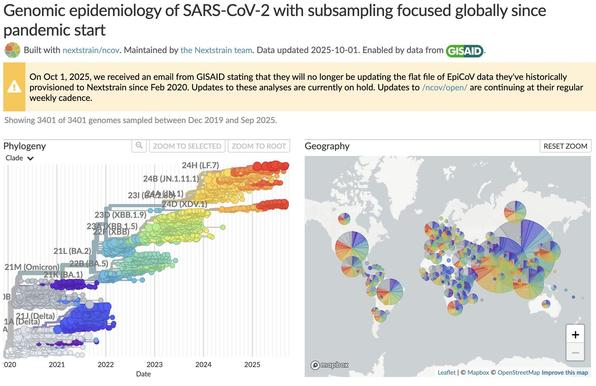
On Oct 1, 2025, GISAID informed us that they had ended updates to the flat file of SARS-CoV-2 genomic sequences and associated metadata that we had used to update Nextstrain analyses since Feb 2020. GISAID's stated rationale was that their "resources are limited". 1/5

Nextstrain is happy to announce the availability of new resources for mumps, as described in our recent blog post. We welcome any feedback on these new resources!

https://nextstrain.org/blog/2025-09-24-mumps-resources

Nextstrain: New Resources for Mumps

Nextstrain blog post from 2025-09-24; author(s): Jennifer Chang, Richard Neher, Jover Lee, Kim Andrews

Nextstrain

Nextstrain is happy to announce the availability of a Rubella dataset — please see our new blog post for details. We welcome feedback from Rubella researchers on these new resources!

https://nextstrain.org/blog/2025-07-24-rubella-resources

Nextstrain: New Resources for Rubella

Nextstrain blog post from 2025-07-24; author(s): John SJ Anderson

Nextstrain

The Nextstrain team has updated our core pathogen workflows to be compatible with Snakemake v8 or higher and has updated the Nextstrain runtimes to include Snakemake v9. Please see our new blog post for more details:

https://nextstrain.org/blog/2025-07-17-snakemake-v9-update

Nextstrain: Upgrade to Snakemake v9

Nextstrain blog post from 2025-07-17; author(s): The Nextstrain team

Nextstrain

Happy Friday! We've got a new blog post all about a new feature that was recently added to the Nextstrain CLI: `nextstrain run`

This is a foundational component for a new, easier way to re-use Nextstrain workflows, take a look!

https://nextstrain.org/blog/2025-06-13-introducing-nextstrain-run

Nextstrain: Introducing `nextstrain run`

Nextstrain blog post from 2025-06-13; author(s): Thomas Sibley

Nextstrain