Matthew Salganik

30 Followers
26 Following
8 Posts
Prof of Sociology @Princeton, AY 22-23 sabbatical
@the_IAS, Co-founder http://sicss.io, Author of Bit by Bit: Social Research in the Digital Age: http://bitbybitbook.com
Steering AI for the public good: A dialogue for the future. Panel discussion at the Institute for Advanced Study Tuesday, June 6 5:30pm ET. Register for in person or remote access. https://www.ias.edu/events/steering-ai-public-good-dialogue-future
Steering AI for the Public Good: A Dialogue for the Future

  Steering AI for the Public Good: A Dialogue for the Future 

Institute for Advanced Study

The web is badly in need of better governance, or even governance at all for that matter. Changing the few institutions we have could be a great first step.

The W3C is looking for a CEO — could that be you?
https://candidates.perrettlaver.com/vacancies/3565/

Perrett Laver: CEO

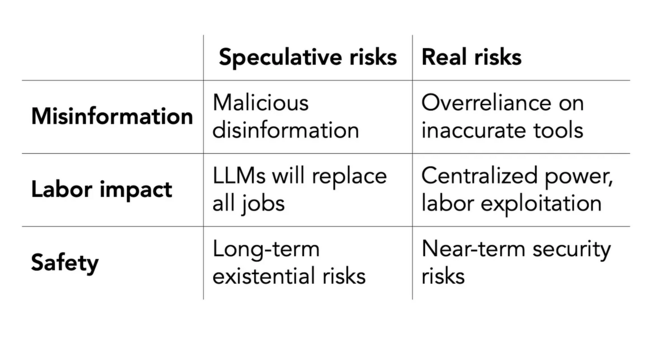
The AI moratorium letter only fuels AI hype. It repeatedly presents speculative, futuristic risks, ignoring the version of the problems that are already harming people. It distracts from the real issues and makes it harder to address them. The letter has a containment mindset analogous to nuclear risk, but that’s a poor fit for AI. It plays right into the hands of the companies it seeks to regulate. By @sayashk and me. https://aisnakeoil.substack.com/p/a-misleading-open-letter-about-sci
A misleading open letter about sci-fi AI dangers ignores the real risks

Misinformation, labor impact, and safety are all risks. But not in the way the letter implies.

AI Snake Oil
Friends in Oxford, I'm looking forward to my talk on Monday. Hope to see you there! https://talks.ox.ac.uk/talks/id/a72b782c-6cb9-42f4-9cb9-a9ed3b4eace7/
The Unpredictability of Life Outcomes

Researchers have long theorised about the processes through which family background and childhood experiences shape life outcomes. However, statistical models that use data on family background and childhood experiences to predict life outcomes often have poor predictive performance. In this talk, we present results from three interrelated studies of the predictability of life outcomes: a scientific mass collaboration involving hundreds of participants, a high-throughput study using hundreds of machine learning pipelines to predict hundreds of life outcomes, and a qualitative study involving in-depth interviews with 40 families. Collectively these studies help to assess and understand the limits to predictability of life outcomes, which has implications for social science theory and for algorithmic decision-making in high-stakes settings.

Congratulation Chris and Matt on your wonderful new book!
Friends in NYC, I'll be giving a talk at Columbia Business School (Management Department) on the unpredictability of life outcomes. Tuesday, March 28 12:15-1:45pm in Kravis 820. More information: https://business.columbia.edu/faculty/divisions/management/seminars
Seminars | Columbia Business School

Sage is hosting a webinar on teaching computational social science. Thursday, March 23 6 PM GMT. Free and open to everyone. Panelists are Matti Nelimarkka & Friedolin Merhout. More info: https://sagepub.zoom.us/webinar/register/WN_fuvHH2FqRJ-XjvsUjgjhNA
Welcome! You are invited to join a webinar: Teaching Computational Social Science. After registering, you will receive a confirmation email about joining the webinar.

Join us for a lively SAGE Methodspace webinar, Teaching Computational Social Science. This webinar will offer practical tips to improve your instructional practice or guidance with student researchers. Dr. Janet Salmons, Research Community Manager for SAGE Methodspace will moderate the discussion, so bring your questions and join the conversation! Panelists are: · Dr. Matti Nelimarkka, author of the new book Computational Thinking and Social Science: Combining Programming, Methodologies and Fundamental Concepts, and university lecturer at the University of Helsinki, and Aalto University, Finland. · Dr. Friedolin Merhout, assistant professor at the Sociologisk Institut at the University of Copenhagen, Denmark. He is the Director of Graduate Studies for the interdisciplinary MSc in Social Data Science. Nelimarkka and Merhout will discuss strategies for engaging with students and building the skills needed to design, plan, and conduct studies using computational social science methods. They will offer examples from their own experience in course design and teaching – including how to work past problems students sometimes have when trying to learn these complex concepts.

Zoom
I used ChatGPT to help me write a peer review. It didn't help at all. There is a big difference between being really cool and being a useful tool. This experience provides some lessons for how we should evaluate LLMs and other new AI. https://freedom-to-tinker.com/2023/03/08/can-chatgpt-and-its-successors-go-from-cool-to-tool/
Can ChatGPT—and its successors—go from cool to tool?

Anyone reading Freedom to Tinker has seen examples of ChatGPT doing cool things.  One of my favorites is its amazing answer to this prompt: “write a

Freedom to Tinker