| pronouns | they, (he) |
| languages | de, en, fr, (ja), (es), (pt) |
| Matrix | @mkl:woof.rip |
| Signal | https://signal.me/#eu/MLXhzA73Y5tS6gztQZ2O87eWhz9_K7XpO5Hj3ex3JBzWfvpKFWdJB4rlsNqP9pUa |
| emotional support pet | https://florp.social/snaki |
| pronouns | they, (he) |
| languages | de, en, fr, (ja), (es), (pt) |
| Matrix | @mkl:woof.rip |
| Signal | https://signal.me/#eu/MLXhzA73Y5tS6gztQZ2O87eWhz9_K7XpO5Hj3ex3JBzWfvpKFWdJB4rlsNqP9pUa |
| emotional support pet | https://florp.social/snaki |
the UNIX v4 tape reminded me of this story by Ali Akurgal about Turkish bureaucracy:
Do you know what the unit of software is? A meter! Do you know why? In 1992, we did our first software export at Netaş. We wrote the software, pressed a button, and via the satellite dish on the roof, at the incredible speed of 128 kb/s, we sent it to England. We sent the invoice by postal mail. $2M arrived at the bank. 3-4 months passed, and tax inspectors came. They said, “You sent an invoice for $2M?” “Yes,” we said. “This money has been paid?” they asked. “Yes,” we said. “But there is no goods export; this is fictitious export,” they said! So we took the tax inspectors to R&D and sat them in front of a computer. “Would you press this ‘Enter’ key?” we asked. One of them pressed it, then asked, “What happened?” “You just made a $300k export, and we’ll send its invoice too, and that will be paid as well,” we said. The man felt terrible because he had become an accomplice! Then we explained how software is written, what a satellite connection is, and how much this is worth. They said, “We understand, but there has to be a physical goods export; that’s what the regulations require.” So we said: “Let’s record this software onto tape (there were no CDs back then—nor cassettes; we used ½-inch tapes) and send that.” Happy to have found a solution, they said, “Okay, record it and send it.” The software filled two reels, which were handed to a customs broker, who took them to customs and started the export procedure. The customs officer processed things and at one point asked, “Where are the trucks?” The broker said, “There are no trucks—this is all there is,” and pointed to the tape reels on the desk. The customs officer said, “These two envelopes can’t be worth $2M; I can’t process this.” We went to court, an expert committee examined whether the two reels were worth $2M. Fortunately, they ruled that they were, and we were saved from the charge of fictitious export. The same broker took the same two reels to the same customs officer, with the court ruling, and restarted the procedure. However, during the process, the unit price, quantity, and total price of the exported goods had to be entered—as per the regulations. To avoid dragging things out further, they looked at the envelope, saw that it contained tape, estimated how many meters of tape there are on one reel, and concluded that we had exported 1k to 2k meters of software. So the unit of software became the meter.

Here's the document release you were waiting for today!
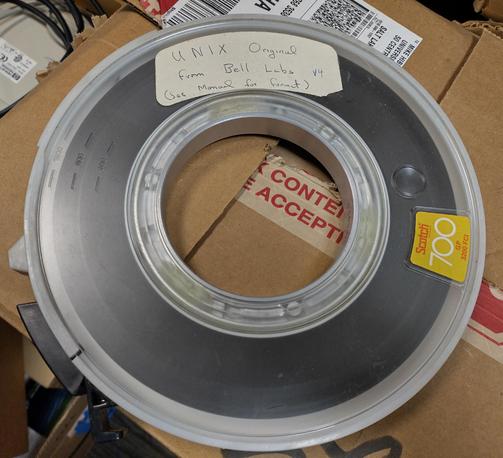
The UNIX V4 tape!
https://archive.org/details/utah_unix_v4_raw
Credits:
* Jay Lepreau for holding on to this tape
* Aleksander Maricq for finding it
* Jon Duerig for driving it to the Computer History Museum
* Thalia Archibald for doing a huge amount of research into the tape, its history, and file formats, and the upload
* Al Kossow for the tape-reading equipment and doing the actual read
* Len Shustek for the lab where the read was done and the software used to decode it

UNIX V4 tape from the University of Utah, received by Martin Newell circa June 1974 around when he modeled the Utah Teapot.This is the raw analog waveform and...
While cleaning a storage room, our staff found this tape containing #UNIX v4 from Bell Labs, circa 1973
Apparently no other complete copies are known to exist: https://gunkies.org/wiki/UNIX_Fourth_Edition
We have arranged to deliver it to the Computer History Museum
Sehr interessantes Rechtsgutachten über @fragdenstaat veröffentlicht. Uns begegnet oft die Frage, wie sich der Cloud Act etc. eigentlich auf die Sicherheit von US-Clouds auswirkt. Hier ist es fundiert aufgearbeitet.
Kurzantwort:
US-amerikanische Sicherheitsbehörden verfügen weitreichende Herausgabe- und Zugriffsrechte auf Kommunikationsdaten sowie in Clouds gespeicherte Informationen. Der Zugriff auf solche Informationen ist sehr umfassend, wenn sich die Server auf US-Territorium befinden. Aber auch ausländische Server und Cloud-Betreiber können der Herausgabepflicht unterworfen sein. Nicht in allen Fällen muss dafür ein gerichtlicher Durchsuchungsbeschluss vorliegen.
Die Rechtschutzmöglichkeiten gegen eine Herausgabeanordnung sind für europäische Unternehmen eingeschränkt. Darüber hinaus können amerikanische Geheimdienste unter Voraussetzungen, die nicht öffentlich bekannt sind, auf im Ausland gespeicherte Daten auch ohne die Mitwirkung von Cloud-Anbietern zugreifen.
Zum kompletten Gutachten bei Frag den Staat:

Gegenwärtig wird im Zusammenhang mit Digitalisierungsvorhaben in Europa viel über das Thema digitale Souveränität diskutiert. Dabei werden regelmäßig auch die Zugriffsbefugnisse von US-Behörden auf in Europa gespeicherte Daten, etwa in Rechenzentren europäischer Tochtergesellschaften amerikanischer Unternehmen, thematisiert. In der aktuellen Ausgabe der "Zeitschrift für Datenschutzrecht - ZD" wurde ein Beitrag zu diesem Thema veröffentlicht, der auf einem Gutachten im Auftrag eines Bundesministeriums beruht. Die entsprechenden Einschätzungen sind von erheblichem öffentlichen Interesse. Ich beantrage daher, die Übersendung des entsprechenden Gutachtens zu dem Thema Zugriffsmöglichkeiten von US-amerikanischer Sicherheitsbehörden auf in Europa gespeicherte Daten. Zudem beantrage ich die Übermittlung weiterer Gutachten, Vermerke und sonstiger amtlichen Informationen Ihrer Behörde, die sich mit dem Thema Zugriffsmöglichkeiten von US-amerikanischer Sicherheitsbehörden und deren rechtliche Auswirkungen auf Digitalisierungsprojekte öffentlicher Stellen und deutscher sowie europäischer Unternehmen befassen. Ich danke Ihnen vielmals.