Minsuk Chang

110 Followers
139 Following
22 Posts

https://bsky.app/profile/minsuk.bsky.social

Research Scientist at Google Deepmind
minsukchang.com

The 2nd #In2Writing workshop will be at #CHI2023!

This year we invite 🔥2-page position papers🔥 that portray thoughts on writing assistants (see CFP). Submit a paper to join the in-person event!

🗓️Submission Deadline: 2/23
🗓️Workshop Date: 4/23 (Sun)

🔗http://in2writing.glitch.me

@minalee @windx0303 @johnr0hol @katyilonka @vipulraheja
Dongyeop Kang (not on mastodon yet)

in2writing

The First Workshop on Intelligent and Interactive Writing Assistants

Happy new year!!🍾

Inverse scaling law where I didn't expect it

Stronger LMs care less about the context of quantifiers (e.g. predict nuts for both a,c in the fig)

https://arxiv.org/pdf/2212.08700.pdf
@[email protected] Benjamin K. Bergen
@[email protected] @[email protected]

I often give a "one class" intro to accessibility for HCI ppl -- here's what I did last time:

- ability assumptions are baked into HCI
- accessibility is *broad*, many examples of people w/ disabilities
- ~5 youtubes of ppl using access tech, talked through impact on the interaction
- group activity to create a slidedeck of accessibility examples in students' lives
- built simple web-based screen reader (demystify in only a few lines of JS, ground up way to motivate accessibility metadata)

Google Colaboratory

The spiritual successor of our RL-based language model alignment is currently at #NeurIPS: https://arxiv.org/abs/2205.13636

Two frameworks for using RL to tune language models have recently been released for those who want to get into RL-based fine-tuning of LMs:
1. RL4LM: https://github.com/allenai/RL4LMs by @rajammanabrolu
2. TRLX: https://github.com/CarperAI/trlx by Louis Castricato et al at EleutherAI

Both are by former members of my research team

Quark: Controllable Text Generation with Reinforced Unlearning

Large-scale language models often learn behaviors that are misaligned with user expectations. Generated text may contain offensive or toxic language, contain significant repetition, or be of a different sentiment than desired by the user. We consider the task of unlearning these misalignments by fine-tuning the language model on signals of what not to do. We introduce Quantized Reward Konditioning (Quark), an algorithm for optimizing a reward function that quantifies an (un)wanted property, while not straying too far from the original model. Quark alternates between (i) collecting samples with the current language model, (ii) sorting them into quantiles based on reward, with each quantile identified by a reward token prepended to the language model's input, and (iii) using a standard language modeling loss on samples from each quantile conditioned on its reward token, while remaining nearby the original language model via a KL-divergence penalty. By conditioning on a high-reward token at generation time, the model generates text that exhibits less of the unwanted property. For unlearning toxicity, negative sentiment, and repetition, our experiments show that Quark outperforms both strong baselines and state-of-the-art reinforcement learning methods like PPO (Schulman et al. 2017), while relying only on standard language modeling primitives.

arXiv.org

We had such an exciting and insightful talk today from @[email protected]

And to think that we are only half way in!
keep an eye out for more exciting events on the agenda.

RT @[email protected]

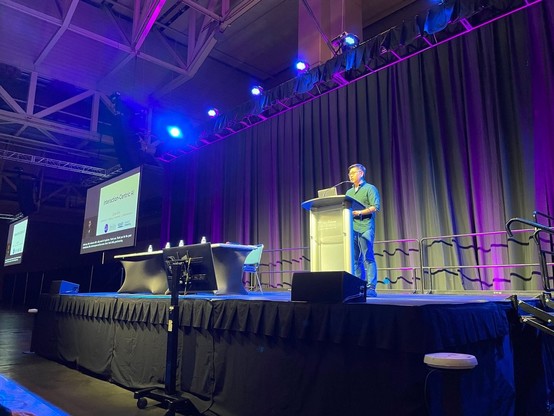
Join us today for the invited talk by Juho Kim (@[email protected])
Interaction-Centric AI
Wed, 30 Nov 9:30 am CST in Hall H

🐦🔗: https://twitter.com/NeurIPSConf/status/1597946045094187010

NeurIPS Conference on Twitter

“Join us today for the invited talk by Juho Kim (@imjuhokim) Interaction-Centric AI Wed, 30 Nov 9:30 am CST in Hall H”

Twitter

New blog post on the NeurIPS'21 experiment re authors' perceptions of their own papers!

https://blog.ml.cmu.edu/2022/11/22/neurips2021-author-perception-experiment/

Key findings:

1) Authors significantly overestimate their papers' chances of acceptance. By like a LOT.

>

How do Authors' Perceptions about their Papers Compare with Co-authors’ Perceptions and Peer-review Decisions?

Alina Beygelzimer, Yann N. Dauphin, Percy Liang, Jennifer Wortman Vaughan(NeurIPS 2021 Program Chairs) Charvi Rastogi, Ivan Stelmakh, Zhenyu Xue, Hal Daumé III, Emma Pierson, and Nihar B. Shah There is a considerable body of research on peer review. Within the machine learning community, there

Machine Learning Blog | ML@CMU | Carnegie Mellon University
I worry that a lot of the discussion on #Galactica is too focused on classic academic fraud (plagiarism, falsifying data, etc.) We already have ways of dealing with that. I’m *much* more worried about how a more creative bad actor could use LLMs for a DDoS amplification task on volunteer peer review. How many fake papers would need to get past desk reject to bring CHI to its knees? Even just in units of characters typed, prompts are way shorter than the 4 reviews needed to reject the work.

🔖Reviewing has so many faults📖
Finally, there is a dataset of reviews, edits and everything else!

5 venues 5K papers 11K reviews
Enjoy!

https://arxiv.org/abs/2211.06651
@[email protected] @[email protected] @[email protected]

NLPeer: A Unified Resource for the Computational Study of Peer Review

Peer review is a core component of scholarly publishing, yet it is time-consuming, requires considerable expertise, and is prone to error. The applications of NLP for peer reviewing assistance aim to mitigate those issues, but the lack of clearly licensed datasets and multi-domain corpora prevent the systematic study of NLP for peer review. To remedy this, we introduce NLPeer -- the first ethically sourced multidomain corpus of more than 5k papers and 11k review reports from five different venues. In addition to the new datasets of paper drafts, camera-ready versions and peer reviews from the NLP community, we establish a unified data representation, and augment previous peer review datasets to include parsed, structured paper representations, rich metadata and versioning information. Our work paves the path towards systematic, multi-faceted, evidence-based study of peer review in NLP and beyond. We make NLPeer publicly available.

arXiv.org