Meta Cramer

174 Followers
158 Following
12 Posts
Sociologist | Postdoc at @hu_rmz Humboldt-Universität zu Berlin | interested in global inequalities and the governing of science @metacramer.bsky.social
metacramer.owlstown.net (she/her)
ORCIDhttps://orcid.org/0000-0002-5262-7732
Websitehttps://metacramer.owlstown.net

RE: https://sciences.social/@metacramer/114528483059091862

Very excited that our article on the governing of science is now published in Minerva (OA)! @MartinReinhart and I reflect on the politics of research evaluation (i.a. metrics-based performance measurement) and argue for a global research approach accounting for transnational and discursive dynamics.
https://link.springer.com/article/10.1007/s11024-026-09633-2

We are excited to kick off our Jour Fixe series for the winter semester next week with a talk by @greiffenhagen.bsky.social on "Judging importance before checking correctness: quick opinions in mathematical peer review"
https://www.rmz.hu-berlin.de/de/termine/rmz-jour-fixe-judging-importance-before-checking-correctness-quick-opinions-in-mathematical-peer-review
15.10.25, 11 CET, join us in person/ via zoom (link on website)!
@IBI_HU
RMZ Jour fixe/ Judging importance before checking correctness: quick opinions in mathematical peer review

Christian Greiffenhagen (The Hong Kong Polytechnic University, Hong Kong)

Robert K. Merton-Zentrum für Wissenschaftsforschung

On my way to Helsinki to co-present a conceptual argument on research evaluation systems from a global perspective at #RESSH2025 with @MartinReinhart: we think about who steers science through evaluation, the role of transnationality and governmentality. Looking forward to the discussion, preprint available here: https://zenodo.org/records/14961710

This is the first argument we developed in the recently started collaborative project on global publishing cultures https://www.rmz.hu-berlin.de/en/research/publishing/publishing?set_language=en

Understanding the Governance of Science from a global Perspective: A heuristic of Research Evaluation Regimes

The article presents a heuristic distinguishing research evaluation regimes along four axes of characteristics – the constellation of actors (1), procedures (2), functions (3), and programmes and values (4) – to better understand the governance of science through evaluation from a transnational perspective. We start by showing that existing literature can be characterised by a methodological nationalism, excluding regional or transnational constellations, secondly, focuses on operative and technical aspects of research evaluation systems, such as procedures, tools and indicators of metrics-based measurement, as well as its role for funding allocation, and lastly, does not systematically acknowledge the diverse constellations of evaluating and evaluated actors and non-centralised research evaluation regimes. Based on this, we argue to account for the diversity of evaluating and evaluated actors and their logics as well as normative and performative aspects of research evaluation regimes. Building on insights in the sociology of valuation, we critically reframe accounts of centralised research evaluation systems with one core evaluating body by describing the constellation of evaluating and funding actors as heterarchical. In addition, by drawing on Power’s seminal work on the ‘audit society’, we account for normative aspects of evaluation regimes in considering the role of political programmes and evaluative cultures as discussed in research on the relationship of science and society. The heuristic is presented as a starting point to conduct context-sensitive, comparative studies of research evaluation regimes from a transnational perspective to promote a more nuanced understanding of the power constellations of evaluation regimes and related ways of governing science.

Zenodo
Good morning Fediverse!
We at RMZ Berlin analyse how scientific knowledge is produced and how science is embedded in social processes.
We will post about events, contributions of our team etc. on this platform and look forward to meet the communities here!
since I am starting a Postdoc position soon and it's conference season, I’ve got myself a tiny little website :) https://metacramer.owlstown.net
I will post more about the job when the project starts in September: it’s in global science studies, and I am really looking forward!
Meta Cramer

Hi, I am Meta, an interdisciplinary trained sociologist interested in the sociology of (social) sciences and social theory from a critical global perspective...

und so beginnt es ..

Bei einem Pegel von 3 Metern über dem NAP (Normal-Pegel) in #Rotterdam, schließt die etwa 660 Millionen Euro teure Holland-Sperre automatisch.

Dies geschah nun erstmals.

NFO: https://de.wikipedia.org/wiki/Maeslant-Sperrwerk

Maeslant-Sperrwerk – Wikipedia

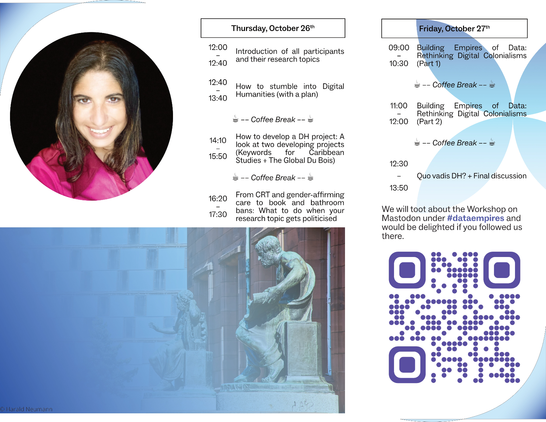
In our RTG, we are incredibly excited about our upcoming workshop with @roopikarisam. It is an excellent opportunity for our PhD students to have a renowned scholar in the field of #DigitalHumanities and #DigitalColonialism here in Freiburg to work with them.

We will post updates on the event using #empiresofdata.

The workshop is planned and co-organised by Professor Risam (Dartmouth College) and @SchnDa (ALU Freiburg).

#DH #empires #empire @empires @unifreiburg @ManuelaBoatca @metacramer

In a comparative analysis of contributions by the colonial office and #CLRJames & #Wynter, I show that British imperial policies that were constraining knowledge production in the West Indies were seen as facilitating anti‐colonial awareness & work in London by Caribbean actors.
Overall, the article tries to analyse epistemic and material factors - intellectual & institutional history - together and explore their interrelation.

Happy to share that my article on the interrelation of Caribbean intellectuals' work in London and the institutionalisation of research and higher education in the West Indies in the mid-20th century has been published (open access) https://onlinelibrary.wiley.com/doi/full/10.1111/johs.12417

The article brings together the fascinating #intellectualhistory of #Caribbean social thought and the institutional history of colonial science policies and interprets the case as one of paradoxical politics of academic knowledge production.

“The number of publications with terms like “Global South” in STS journals has been growing exponentially since the beginning of the last decade (e.g., Silva, 2019). Then why is it that the more I heard about the Global South, the more I was rereading Latour, Foucault, Deleuze, and other established Euro-American scholars?” @4Sweb #STS https://www.4sonline.org/the-south-as-a-laboratory-again-dealing-with-calls-for-alternatives-in-the-north/
The South as a laboratory (again)? Dealing with calls for “alternatives” in the North - Society for Social Studies of Science

In this piece, Guilherme Cavalcante Silva reflects on the use of the Global South as both a virtue and a laboratory in Global North institutions through his experience as a first-year PhD student in STS in North America.

Society for Social Studies of Science -