
Matthias M. M. Meier

@matthiasmmmeier
10 Followers
60 Following
8 Posts
Meteorites, Museums, Mars, Mountains and many more things. Director of the Natural History Museum of St.Gallen, Switzerland. Opinions are my own. 🇨🇭🇸🇪🇲🇫🇺🇸🇺🇦
ORCIDhttps://orcid.org/0000-0002-7179-4173
Webhttps://www.matthiasmmmeier.com

I love that the Moon still holds so many mysteries.

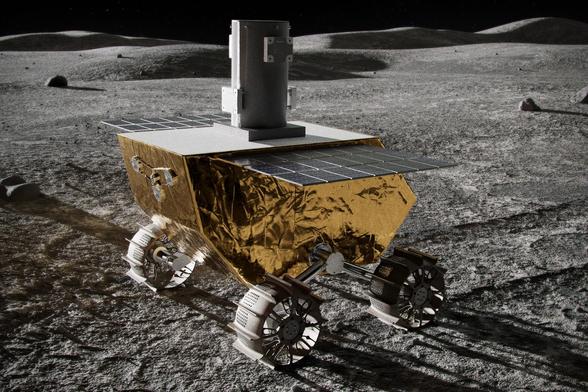
Next year, the Lunar Vertex mission will send a little rover driving across Reiner Gamma -- the most prominent of the lunar swirls -- to figure out what the heck is going on there.

https://www.jhuapl.edu/destinations/missions/lunar-vertex #science #space #astronomy #astrodon

Lunar Vertex

Lunar Vertex will be the first mission to carry out a comprehensive study of lunar magnetic anomaly and the associated swirl and mini-magnetosphere.

Johns Hopkins University Applied Physics Laboratory

A Mars-size #planet transiting the nearby M dwarf GJ 238.

This is one of the smallest #exoplanets currently known.

It really is amazing how we are routinely detecting exoplanets the size of Mars around the nearest stars.

#Astronomy really has come a long way since the early discoveries in the 1990s.

https://iopscience.iop.org/article/10.3847/1538-3881/ad3df1

Radware Bot Manager Captcha

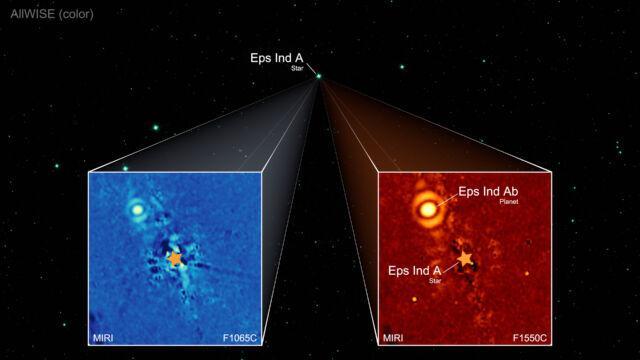
Webb directly images giant exoplanet that isn’t where it should be

Six times bigger than Jupiter, the planet is the oldest and coldest yet imaged.

https://arstechnica.com/science/2024/07/webb-directly-images-giant-exoplanet-that-isnt-where-it-should-be/?utm_brand=arstechnica&utm_social-type=owned&utm_source=mastodon&utm_medium=social

Webb directly images giant exoplanet that isn’t where it should be

Six times bigger than Jupiter, the planet is the oldest and coldest yet imaged.

Ars Technica
A Trillion Rogue Planets and Not One Sun to Shine on Them https://spectrum.ieee.org/rogue-planet
A Trillion Rogue Planets and Not One Sun to Shine on Them

<p>Inside the race to track down our galaxy’s hidden, untethered worlds</p>

IEEE Spectrum

A large decline of the land #carbon sink in 2023.

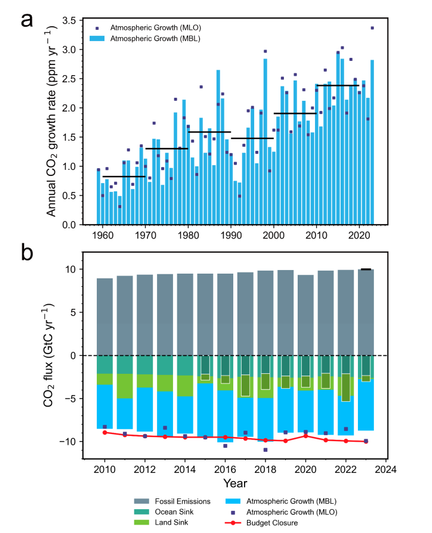
In 2023, the carbon dioxide growth rate was 3.37 ppm at Mauna Loa, 86% above the previous year, and hitting a record high since observations began in 1958.

Land regions exposed to extreme heat in 2023 contributed a gross carbon loss of 1.73 GtC/yr, indicating that record warming in 2023 had a strong negative impact on the capacity of terrestrial ecosystems to mitigate #climate change.

https://arxiv.org/abs/2407.12447

Low latency carbon budget analysis reveals a large decline of the land carbon sink in 2023

In 2023, the CO2 growth rate was 3.37 +/- 0.11 ppm at Mauna Loa, 86% above the previous year, and hitting a record high since observations began in 1958, while global fossil fuel CO2 emissions only increased by 0.6 +/- 0.5%. This implies an unprecedented weakening of land and ocean sinks, and raises the question of where and why this reduction happened. Here we show a global net land CO2 sink of 0.44 +/- 0.21 GtC yr-1, the weakest since 2003. We used dynamic global vegetation models, satellites fire emissions, an atmospheric inversion based on OCO-2 measurements, and emulators of ocean biogeochemical and data driven models to deliver a fast-track carbon budget in 2023. Those models ensured consistency with previous carbon budgets. Regional flux anomalies from 2015-2022 are consistent between top-down and bottom-up approaches, with the largest abnormal carbon loss in the Amazon during the drought in the second half of 2023 (0.31 +/- 0.19 GtC yr-1), extreme fire emissions of 0.58 +/- 0.10 GtC yr-1 in Canada and a loss in South-East Asia (0.13 +/- 0.12 GtC yr-1). Since 2015, land CO2 uptake north of 20 degree N declined by half to 1.13 +/- 0.24 GtC yr-1 in 2023. Meanwhile, the tropics recovered from the 2015-16 El Nino carbon loss, gained carbon during the La Nina years (2020-2023), then switched to a carbon loss during the 2023 El Nino (0.56 +/- 0.23 GtC yr-1). The ocean sink was stronger than normal in the equatorial eastern Pacific due to reduced upwelling from La Nina's retreat in early 2023 and the development of El Nino later. Land regions exposed to extreme heat in 2023 contributed a gross carbon loss of 1.73 GtC yr-1, indicating that record warming in 2023 had a strong negative impact on the capacity of terrestrial ecosystems to mitigate climate change.

arXiv.org
@profabelmendez That is a strange argument. If plate tectonics is required for intelligent life to emerge, that is already factored into f_i, the factor for the emergence of intelligent life. Although a case can be made that plate tectonics might be required for intelligent life, it is not a given. But the formation of life *must* happen in order for intelligent life to emerge later, so it makes sense that f_l is the factor preceeding f_i.
Hello Mastodon! First post here, and you find me on Bluesky too! Lets create better social networks together - at least better than the last few attempts...
@ScottManleyHimself This seems crazy and self-defeating.