Mistral launched a platform called Forge, that can be used to train enterprise models using proprietary data. Organisations will be able to customise AI models for their needs using the same "recipe" that Mistral is using to train their flagship models. Interesting move.
https://venturebeat.com/infrastructure/mistral-ai-launches-forge-to-help-companies-build-proprietary-ai-modelsMicrosoft announced an off-grid data center with 1.35 GW of Nvidia chips. It will be in West Virginia and it will run 100% on natural gas. They say that "The campus is being designed with local and environmental resources in mind" also "pursuing carbon sequestration to offset emissions". Yes, sure.
https://www.nscale.com/press-releases/nscale-west-virginia-ai-factory

Nscale and Microsoft Announce Collaboration with NVIDIA and Caterpillar to Deliver 1.35GW of NVIDIA Vera Rubin NVL72 GPUs at Flagship AI Factory Campus in West Virginia
Nscale and Microsoft Announce Collaboration with NVIDIA and Caterpillar to Deliver 1.35GW of NVIDIA Vera Rubin NVL72 GPUs at Flagship AI Factory Campus in West Virginia . Press release from Nscale.
Electricity prices started going up in US before the launch of ChatGPT and the AI boom, so probably it's not AI driving them up:
https://www.economist.com/finance-and-economics/2026/03/05/americans-electricity-bills-are-up-dont-blame-aiAmericans’ electricity bills are up. Don’t blame AI
Rising electricity prices in America stem mainly from grid upgrades and equipment costs rather than artificial-intelligence data centres, despite growing power demand.
Good storytelling from Carbon Brief: How extreme weather is destroying crops around the world. The article has been updated two days ago adding 40 extreme events for 2025.
The European Scientific Advisory Board on Climate Change will host a public webinar this Friday on their new report "Climate adaptation and mitigation in the agri-food system – Recommendations for coherent EU policies"
https://climate-advisory-board.europa.eu/news/eus-agri-food-system-must-prepare-for-rising-climate-risks-and-accelerate-emission-reductions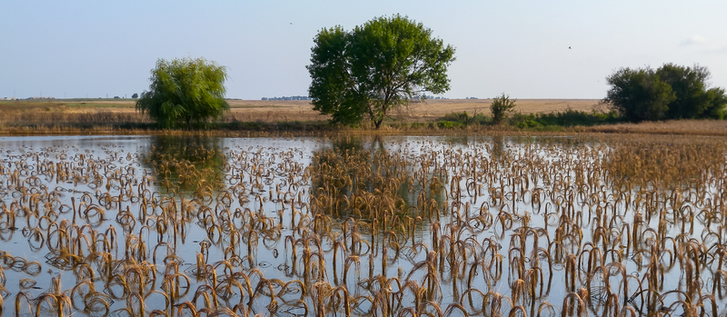
EU’s agri-food system must prepare for rising climate risks and accelerate emission reductions
I am happy that the SMR by TerraPower got the green light to be built in Wyoming. This 235 MW sodium-cooled reactor will be operational "early 2030s". I am a curious person and I think it's important to explore new options.
But let's focus on the "here and now". This article gives a possible example of the current bring-your-own-capacity mentality to power data centres in the US: truck-sized gas turbines generating electricity (and pollution) without permit.
https://www.theguardian.com/environment/2026/feb/13/elon-musk-xai-datacenters-air-pollution-mississippi

‘A different set of rules’: thermal drone footage shows Musk’s AI power plant flouting clean air regulations
Images confirm xAI is continuing to defy EPA regulations in Mississippi to power its flagship datacenters
I created this visualisation using 15-minute CAISO data from January 2023 to December 2025 to explore how batteries operate in relation to wind & solar generation and overall grid demand.
Each dot is a 15-minute snapshot. The X-axis shows combined wind & solar output (GW), the Y-axis shows battery net output (positive -> discharging into the grid, negative -> charging). Color encodes grid demand. It is quite evident the solar fingerprint and how demand shapes the dispatch.
Don't tell me. Sycophantic AI serves as a personal echo chamber that can actually keep you from finding good ideas.
https://arxiv.org/abs/2602.14270
A Rational Analysis of the Effects of Sycophantic AI
People increasingly use large language models (LLMs) to explore ideas, gather information, and make sense of the world. In these interactions, they encounter agents that are overly agreeable. We argue that this sycophancy poses a unique epistemic risk to how individuals come to see the world: unlike hallucinations that introduce falsehoods, sycophancy distorts reality by returning responses that are biased to reinforce existing beliefs. We provide a rational analysis of this phenomenon, showing that when a Bayesian agent is provided with data that are sampled based on a current hypothesis the agent becomes increasingly confident about that hypothesis but does not make any progress towards the truth. We test this prediction using a modified Wason 2-4-6 rule discovery task where participants (N=557) interacted with AI agents providing different types of feedback. Unmodified LLM behavior suppressed discovery and inflated confidence comparably to explicitly sycophantic prompting. By contrast, unbiased sampling from the true distribution yielded discovery rates five times higher. These results reveal how sycophantic AI distorts belief, manufacturing certainty where there should be doubt.
Very very nice.
Apache Parquet has officially introduced native GEOMETRY and GEOGRAPHY logical types.
https://parquet.apache.org/blog/2026/02/13/native-geospatial-types-in-apache-parquet/Native Geospatial Types in Apache Parquet
Native Geospatial Types in Apache Parquet
From The Verge: "One of the humblest and most ubiquitous file formats is stumping the world’s most advanced models" 👉
https://www.theverge.com/ai-artificial-intelligence/882891/ai-pdf-parsing-failure
How many AIs does it take to read a PDF?
For all of the AI industry’s advancements, the major models like ChatGPT and Claude still struggle with PDFs, one of the oldest and ubiquitous file formats.