Matilda's Lab

146 Followers
129 Following
1.4K Posts
The science blog that speaks to kids via grown ups

Don't talk about politics at work? You may be missing a trick

https://www.eurekalert.org/news-releases/1120514
#sciencenews

Talking about politics at work may support employee well-being

In an era of nonstop headlines and growing political division, many workplaces still follow a familiar rule of thumb: Don’t talk politics at work. New research from Washington State University suggests the issue is more nuanced, and talking about politicized news at work may help employees better manage stress and foster improved well-being.

EurekAlert!
Now that the Easter break is out of the way, let's get back to some posting some new lessons.
The next instalment of the history of science is a big one. It's the Wheel!
https://matildaslab.wordpress.com/2026/04/07/the-wheel/
#scicomm #historyofscience
The Wheel

This edition covers the best theory for the invention of wheels within the mines of central Europe.

Matilda's Lab
Not every hour is created equal. Bonus time really does seem to be worth more.
https://www.eurekalert.org/news-releases/1121048
#sciencenews
Why a canceled meeting feels so liberating

Unless your employer is Lumon Industries where the Severance workday never ends, a canceled meeting can feel like a gift of limitless time. A Rutgers University study published in the Journal of the Association for Consumer Research explains why: Unexpectedly gaining time alters our perception of how that time passes, which in turn affects how we spend it. “An hour gained feels longer than 60 minutes, and that deviation from expectation creates a unique sense of opportunity,” said Gabriela Tonietto, an associate professor of marketing at the Rutgers Business School and lead author of the study.

EurekAlert!
No matter how independently minded you think we are, our tribal nature gives all of us a herd mentality.
The question isn't will you go along with the others, it's how much pressure does it take for you to go along with the others.
https://www.eurekalert.org/news-releases/1120041
#sciencenews
Why some people change only when enough others do

From climate action to public health, even widely supported solutions often fail to gain momentum. Researchers at the University of Zurich now show why: people differ in how much social support they need before changing their behavior. Measuring these individual “tipping points” could help make social change campaigns more effective.

EurekAlert!
Striking a chord: How music primes our minds for connection

When neuroscientist and musician AZA Allsop discovered research by his Yale colleague Joy Hirsch about how group drumming and musical interaction can affect social behavior, he knew there was a collaboration in their future. Five years later, their joint work has shown that music is a powerful social enhancer that directly impacts brain functioning. “When I reached out to see if we could work together on a project focused on music, Joy was as excited as I was,” said Allsop, an assistant professor of psychiatry at Yale School of Medicine who is also a jazz artist. “As we drafted our new research, I really relied on my background in music production, theory, and performance to help shape things.” Hirsch, also a neuroscientist, brought her own musical experience to the partnership. A veteran competitive ballroom dancer, she has won many accolades including national championship titles. “AZA and I connected immediately, because of our shared love of music, our experience with music in one form or another, and our commitment to understanding how the brain operates under music conditions,” said Hirsch, the Elizabeth Mears and House Jameson Professor of Psychiatry and professor of comparative medicine and of neuroscience. In a new study, published in The Journal of Neuroscience, they find that listening to harmonically consonant chord progressions during face-to-face interaction strengthened neural activity in brain areas that help people understand and respond to others. The findings suggest that music may help promote social bonding on a biological level, they say, explaining why it often plays an important role in social rituals and group experiences.

EurekAlert!

Looking for love? Don't list what you're looking out for, tell a story

https://www.eurekalert.org/news-releases/1119982

#sciencenews

Stories, not shopping lists: Narrative dating profiles draw more interest

If you want to attract more interest on dating apps, don’t just list your best qualities in your profile – instead, tell a story about your life. Dating profiles that tell a story create empathy and connection and attract more interest from potential dates, according to research published by the American Psychological Association.

EurekAlert!
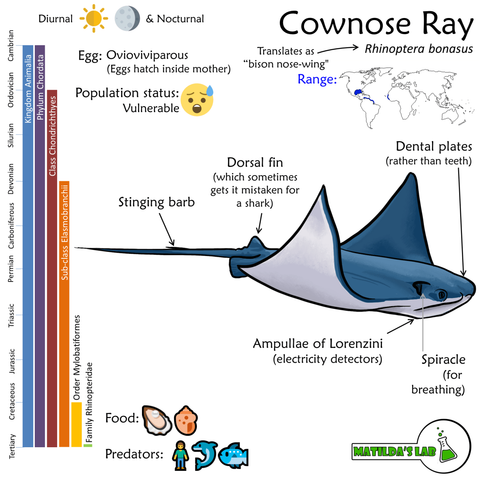
Today's featured post is about some fish that I used to love seeing when I worked in an aquarium.
#scicomm #sciart
https://matildaslab.wordpress.com/2022/02/25/cownose-ray/
Cownose Ray

Matilda’s Lab ©2022. 

Matilda's Lab
Irreligious anxiety. I may not be religious, but there's no denying the benefits that a religion can bring to your wellbeing.
https://www.eurekalert.org/news-releases/1120406
#sciencenews
More anxiety when religion is lacking

Young people around the world are increasingly suffering from anxiety disorders. A team from the Mental Health Research and Treatment Center (FBZ) at Ruhr University Bochum, Germany, has investigated how this development correlates to changes in societal expectations and values in education. The researchers were able to show that religious belief plays a key role in protecting the mental health of children and adolescents. Countries where religiosity has lost significance exhibit a relatively high increase in the incidence of anxiety disorders, as the researchers report in the journal Developmental Science from February 11, 2026.

EurekAlert!
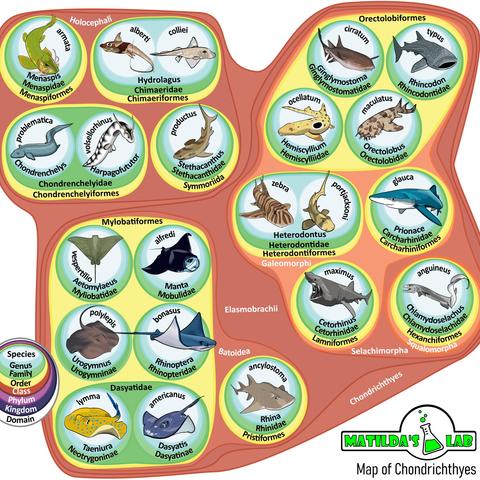
Here comes the next addition to the map of life. This time I've added all of my illustrated carpet sharks (the orectolobiformes).
Remember, you can see the full map of life (without these recent shark updates) here: https://matildaslab.wordpress.com/map-of-life/
#sciart #scicomm
Different species seems to enjoy the same kinds of sounds.
https://www.eurekalert.org/news-releases/1120057
#sciencenews
Humans and animals share preferences for sounds, citizen-science study shows

Do humans share a sense of acoustic beauty with other animals? According to a new study, the answer may be yes. In a global citizen-science experiment, researchers show that humans tend to prefer many of the same animal sounds that animals themselves favor – findings that offer support for Charles Darwin’s longstanding idea that different species can share a “taste for the beautiful.” Across the animal kingdom, animals produce sounds to communicate and attract mates. Although mating calls and songs vary within a species, those listening for them often favor certain variations over others. These preferences can arise from inherent sensory biases, evolutionary pressures, or a combination of both. Because the basic organization of sensory systems is widely shared across species, the sounds designed to attract conspecifics, such as a pleasant birdsong, may also appeal to other species, including humans – a theory that Charles Darwin called “a taste for the beautiful.” However, the idea that humans share similar aesthetic preferences for sounds with other animals has not been rigorously tested.   Logan James and colleagues conducted a global citizen-science experiment in which 4,196 human participants evaluated 110 pairs of animal sounds recorded from 16 species. In each pair, previous studies had already established which sound animals themselves preferred. Participants chose which of the two paired sounds they liked more, allowing the authors to compare human acoustic preferences with animals’. James et al. found that humans share certain acoustic preferences with a wide range of animals, including insects, frogs, birds, and other mammals. Overall, humans were more likely than chance to prefer the same sounds that animals themselves favor, and this agreement strengthened when animals showed clearer preferences. Moreover, humans tended to choose animal-preferred sounds more quickly and repeatedly. Together, these findings suggest a modest but consistent overlap between human aesthetic judgments and the signals animals use in mate choice. According to the authors, preferences likely reflect complex combinations of cues rather than any single property such as pitch, loudness, or duration. However, humans showed one notable tendency – they favored lower-pitched sounds. The findings also suggest neither expertise with animal sounds nor musical training increased agreement with animals’ preferences, though individuals who reported listening to more music daily showed slightly greater alignment, possibly due to enhanced auditory attention and discrimination.


EurekAlert!