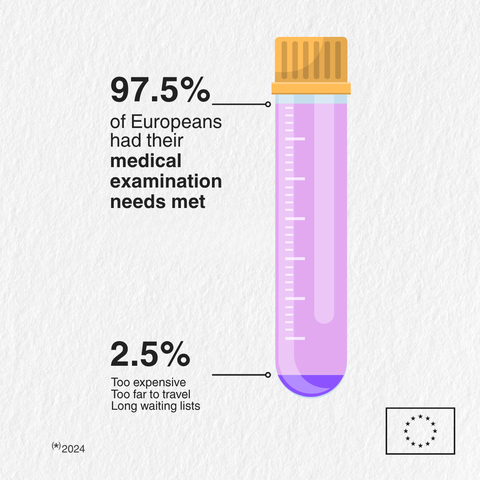
Our latest report shows how Europeans can benefit from it:
💶The average annual healthcare spend per person is €870
🏥68.4% rate their health as ‘very good’ or ‘good’
Full report ➡️ https://link.europa.eu/WHxcQM
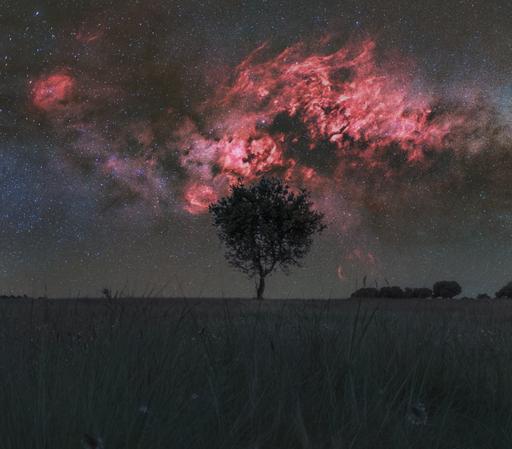
Cygnus and the Solitary Tree
Image Credit & Copyright: 2025 Horacio Lander / AstroHoracio
Text: Keighley Rockcliffe (NASA GSFC, UMBC CSST, CRESST II)
Explanation: A lone tree stands in a quiet meadow in Guadalajara, Spain, silhouetted against the Cygnus region rising above like flames in the night sky. This deep night skyscape is a composite of exposures that reveals a range of brightness and color human eyes can't quite see on their own. Spanning over a thousand times the angular size of the full moon, Cygnus sets the sky afire with active star formation where clouds of gas and dust collapse under gravity until nuclear fusion ignites and new stars are born. These stars ionize the surrounding hydrogen gas, causing it to glow crimson, while tendrils of interstellar dust absorb some of that light and cast dark shadows across the sky. Cygnus is a trove of celestial treasures, notably the Veil, Crescent, and Pelican nebulae, as well as Cygnus X-1, the first confirmed black hole. Cygnus continues to yield fresh science, including a new three-dimensional model of the Cygnus Loop made possible by the Chandra X-ray Observatory.
Today is European 112 Day 🇪🇺
📞 112 is the EU’s single emergency number.
It connects you to ambulance, fire brigade or police. It’s free of charge across Europe and offers language support in many countries.
A life-saving number everyone should know.
Red Spider Planetary Nebula from Webb
Image Credit: ESA/Webb, NASA & CSA, J. H. Kastner (RIT)
Explanation: Oh what a tangled web a planetary nebula can weave. The Red Spider Planetary Nebula shows the complex structure that can result when a normal star ejects its outer gases and becomes a white dwarf star. Officially tagged NGC 6537, this two-lobed symmetric planetary nebula houses one of the hottest white dwarfs ever observed, probably as part of a binary star system. Internal winds flowing out from the central stars, have been measured in excess of 1,000 kilometers per second. These winds expand the nebula, flow along the nebula's walls, and cause waves of hot gas and dust to collide. Atoms caught in these colliding shocks radiate light shown in the featured false-color infrared picture by the James Webb Space Telescope. The Red Spider Nebula lies toward the constellation of the Archer (Sagittarius). Its distance is not well known but has been estimated by some to be about 4,000 light-years.