
Leo Martins

260 Followers
180 Following
516 Posts

Computational Biologist. Tenure Track Fellow in Health at the University of Liverpool. 🇧🇷🇯🇵🇪🇸🇬🇧🇨🇭

Phylogenomics and Chemometrics. Prog Rock and Post-Punk. C and Python.

Leonardo de Oliveira Martins (he/him).

Personal pagehttps://leomrtns.github.io/
QIBhttps://quadram.ac.uk/people/leonardo-de-oliveira-martins/
Githubhttps://github.com/leomrtns
Google Scholarhttps://scholar.google.co.uk/citations?user=XvcsndkAAAAJ&hl=en

We're looking for a bioinformatician leaning towards a software engineer or programmer, to join our Core Bioinformatics team and help us maintaning our infrastructure, while collaborating in cool projects. I am happy to answer any questions.

💷 £43,550 to £54,900
🗓️ Apply by 2 July 2024
➡️ https://quadram.ac.uk/vacancies/bioinformatics-programmer/
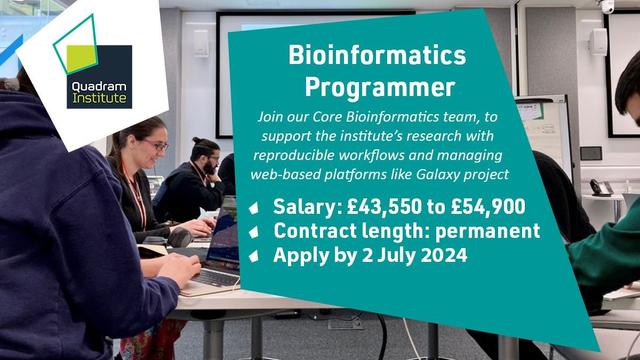
Bioinformatics Programmer - Quadram Institute

We’re looking for an enthusiastic and motivated Bioinformatics Programmer to join the Core Bioinformatics team. Background The post holder will contribute to the activities of Core Bioinformatics, with a particular focus on infrastructure maintenance and development. Familiarity with Linux, containers (e.g. Apptainer), and HPC is important, as well as understanding and building of bioinformatics workflows […]

Quadram Institute

"This article is not open despite all the several badges." (from https://journals.sagepub.com/doi/abs/10.1177/09567976231221990)

Remember this when discussing openness.

Come work with us! The Quadram is in search of a Head of Bioinformatics to lead and cultivate a specialised bioinformatics core support team. Applications Close 04 December 2023
https://quadram.ac.uk/vacancies/head-of-bioinformatics/
Head of Bioinformatics - Quadram Institute

The Quadram Institute (QI) is a pioneering interdisciplinary research centre at the forefront a new era in food and health research. It brings together clinical and non-clinical scientists in a new state-of-the-art building. Based on the Norwich Research Park, home of the John Innes Centre, The Norfolk and Norwich University Hospital, The Earlham Institute and […]

Quadram Institute

That is usually not the case, unfortunately, although it should be common practice. Journals have an incentive not to publish criticism of their own papers.
Some journals, for instance, send the criticism for approval of the authors being criticised. Imagine Reviewer Number Two with an axe to grind... (see e.g. https://doi.org/10.1126/science.ade7837)

(Image from https://www.nature.com/articles/d41586-023-02711-5, of which I can't comment anything other than the above)

Today I escaped unscathed from a discussion of Bayesianism vs Frequentism. I was born and raised a Bayesian, but as with other religions I am an apatheist here as well.

I was reminder, however, of this passage I wrote a few years back. (from https://biologydirect.biomedcentral.com/articles/10.1186/s13062-016-0120-y)

Infinitely long branches and an informal test of common ancestry - Biology Direct

Background The evidence for universal common ancestry (UCA) is vast and persuasive. A phylogenetic test has been proposed for quantifying its odds against independently originated sequences based on the comparison between one versus several trees. This test was successfully applied to a well-supported homologous sequence alignment, which was however criticized on the basis of simulations showing that alignments without any phylogenetic structure could mislead its conclusions. Results Here we present a simplified version of this same counterexample, which can be interpreted as a tree with arbitrarily long branches, and where the UCA test fails again. We also present another case whereby any sufficiently similar alignment will favour UCA irrespective of the true independent origins for the sequences. Finally, we present a class of frequentist tests that perform better than the purportedly formal UCA test. Conclusion Despite claims to the contrary, we show that the counterexamples successfully detected a drawback of the original UCA test, of relying on sequence similarity. In light of our own simulations, we therefore conclude that the UCA test as originally proposed should not be trusted unless convergence has already been ruled out a priori. Reviewers This article was reviewed by Professor Eugene Koonin, Dr. Yuri I. Wolf and Professor William Martin.

BioMed Central
Report by the National Audit Office: Tackling fraud and corruption against government https://www.nao.org.uk/reports/tackling-fraud-and-corruption-against-government/
£21bn is estimated level of fraud as set out in the 2020-21 and 2021-22 Annual Report and Accounts, compared to £5.5 billion in 2018-19 and 2019-20. One third of it relates to temporary COVID-19 schemes. (from the Summary report, PDF file)
Tackling fraud and corruption against government - National Audit Office (NAO) report

Most public bodies do not know how much fraud they face and cannot demonstrate that they have the correct level of counter fraud resources, according to the National Audit Office.

National Audit Office (NAO)

Some of you may know that I have a thing for definitions. And my main beef with GISAID is that it's perverting the meaning of 'open'. Probably to double dip: 'open' gets grants and makes papers acceptable, but being actually open means offering data to people you don't like, means being unable to control who access the data. This reflects on the number of scientists who don't know anymore what open means (https://www.nature.com/articles/d41586-023-00901-9).

1/n

COVID-origins report sparks debate over major genome hub GISAID

GISAID revoked researchers’ access following the report, sparking discussion about findings based on data found in online repositories.

NVIDIA just dropped the most x-rated library name yet, if you ever studied or spoke Spanish or Portuguese.

https://nvidianews.nvidia.com/news/nvidia-asml-tsmc-and-synopsys-set-foundation-for-next-generation-chip-manufacturing

NVIDIA, ASML, TSMC and Synopsys Set Foundation for Next-Generation Chip Manufacturing

NVIDIA today announced a breakthrough that brings accelerated computing to the field of computational lithography, enabling semiconductor leaders like ASML, TSMC and Synopsys to accelerate the design and manufacturing of next-generation chips, just as current production processes are nearing the limits of what physics makes possible.

NVIDIA Newsroom

update: res3data removed the "open access" badge from GISAID https://www.re3data.org/repository/r3d100010126

(although the cynical me says it's just a matter of time until they get it reinstated).

GISAID | re3data.org

Since I've uploaded our latest manuscript to biorxiv last week (https://www.biorxiv.org/content/10.1101/2023.01.31.526458v1), I've been receiving spam invitations almost every day.

For the folks out there with problems identifying a predatory practice: never submit your work to a journal you yourself is not familiar with.