Leapter

@leapter
1 Followers
7 Following
66 Posts

AI-generated code is great. But only if we can trust it. At Leapter, we want to reinvent how software is delivered, from prompt to production.

Read more about how we're approaching the problem on our blog: www.leapter.com/blog/

AI agents are great at natural language. They are less reliable when the same input must produce the same output every time.

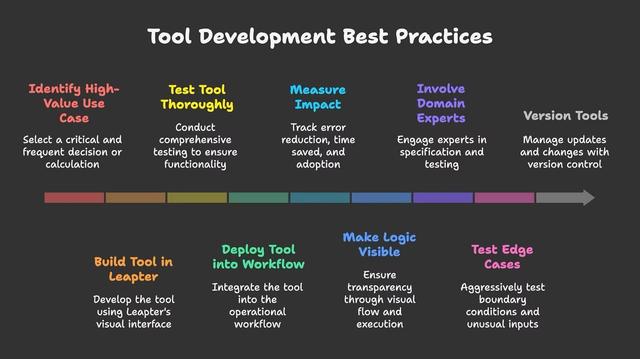
We documented a simple pattern for deterministic tools without writing code: spec → visual review → boundary testing → export to n8n, MCP, API, or code.
https://www.leapter.com/post/deterministic-tools-for-ai-agents-without-writing-code
“For quick prototypes, speed can be enough. But when it comes to business-critical systems, speed without understanding isn’t an advantage; it’s a liability.”

That’s the trust gap behind “vibe coding.” It runs, but nobody can confidently explain it, change it, or debug it when the real world gets messy.

Leapter’s take: assistive AI should output verifiable system logic (blueprints) that humans can review together before deployment.

https://www.leapter.com/post/ai-helped-me-build-it

Most AI agent demos look great until you ask: can we reproduce this outcome?

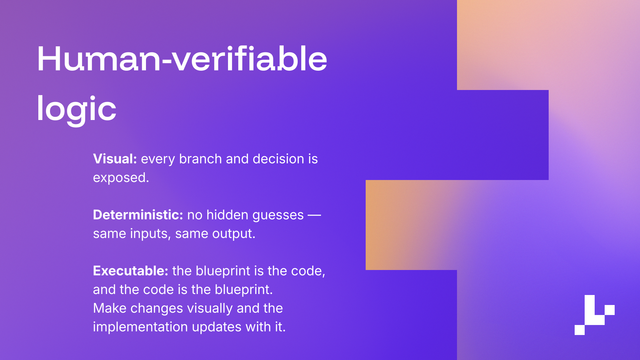
Human-verifiable logic = visual + deterministic + executable. You can inspect each branch, run test inputs, and only then publish it as a tool.

Example in the post: “>€500 + new customer => 10% else 5%.” The ambiguous parts become explicit nodes you can verify.

https://www.leapter.com/post/what-does-human-verifiable-logic-actually-look-like

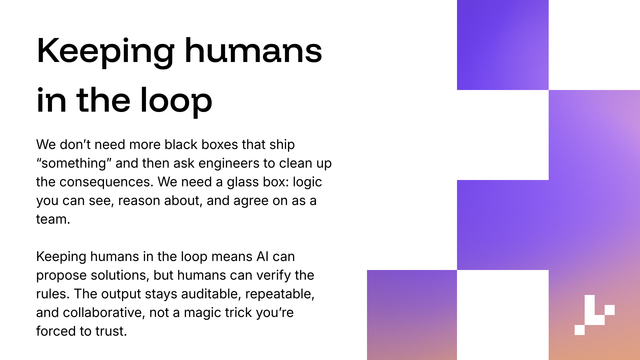
Keeping humans in the loop isn’t a vibe. It’s the difference between “AI shipped something” and “we can verify what actually runs.”

We don’t need more black boxes that dump the cost into review + incident response. We need a glass box: logic you can inspect, test, and repeat.

Read: https://www.leapter.com/post/mind-the-gap-why-we-don-t-trust-ai-generated-code-yet

Welcome to 2026: the hype correction is a feature, not a bug.

LLMs can generate code fast, but logic still needs to be owned, inspected, tested, and repeatable.

If an agent ships something you can’t verify, you didn’t gain speed. You moved the cost into review, incident response, and rework.

Source link in reply.

“You can’t trust what you didn’t validate. And you shouldn’t have to.”

AI-generated code can run and still be wrong. When logic is opaque, teams pay the review tax.

Leapter makes logic visible first — so humans can verify it before it becomes code.

https://www.leapter.com/post/mind-the-gap-why-we-don-t-trust-ai-generated-code-yet

Big leaps in software come from clarity, not just code. 🐸

Leapter makes business logic visual & verifiable—so teams can trust what they ship.

👉 leapter.com

The myth of AI code gen:
🚫 Hallucinations aren’t going away
🚫 “Faster” now means slower later in validation

At Leapter, trust comes first: visible, verifiable blueprints → production code.

🎥 Oliver Welte explains.

Everyone talks about “keeping humans in the loop.” But too often, that means developers are stuck validating AI code.

At Leapter, we think the real human in the loop should be the person with the business intent. Domain experts deserve to see and validate the logic, even if they can’t read code.

That’s why we make software logic visual, explainable, and collaborative.

Every startup begins with a moment of clarity. ✨

For Robert Werner & Oliver Welte, it was realizing AI code tools promised magic—but left teams with mistrust.

Leapter isn’t another code generator. It’s a visual, AI-native way to turn intent into systems teams can trust.

👀 Read the full story: https://www.leapter.com/from-idea-to-trust-the-story-behind-leapter/