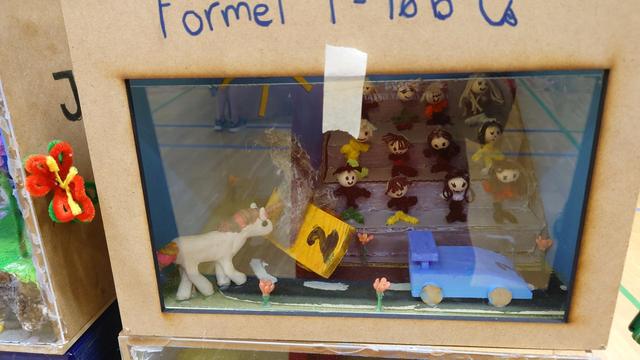
Visiting school fairs, one can sometimes observe very interesting objects - this time, it is about unicorns and formula one. Maybe it is the next movie about cars? Unicorn cars?
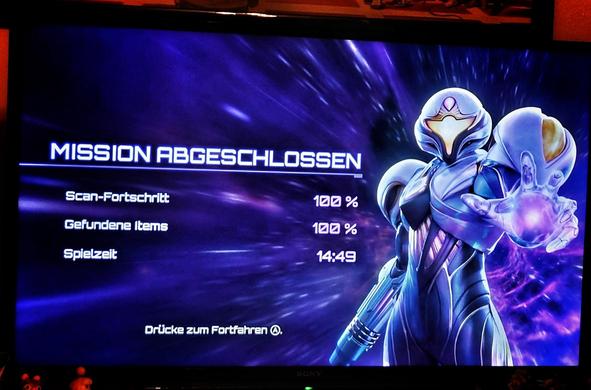
#schoolfairs #risskovWisst ihr Bescheid - Metroid Prime 4 auf schwer und zu 100%, mit Allem. Es war der zweite Anlauf und es war zu 100% und nicht nur 98% erfolgreich
Sometimes, it is funny to look at old textbooks (here: Lehninger Biochemistry) and see this analogy with telephone wires and DNA.
How many nowadays students would not get this analogy, because telephones with wires - what is that?
#iamfeelingoldTo summarize: we identified in a large-scale N-terminomics screen in a cross-sectional cohort a cleavage in complement C3 which is increasingly present in SLE patients, significantly correlating with some clinical parameters and inhibiting the CP & MBL pathways of the human complement system while at the same time being a trigger for a IL6 response in vitro and vivo (organoids). Thanks for reading, the story about 43 pages of a rebuttal letter for another journal is for another long night. 10/10
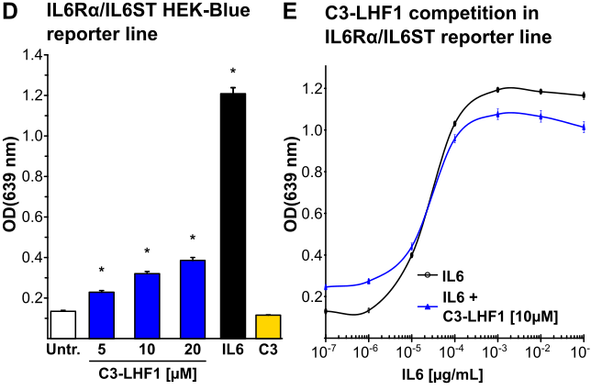
For further test this interaction, we performed C3-LHF1 application to HEK-Blue IL6 reporter cell lines and could observe a triggered IL6 response, which was not obtained by full-length human C3. There is even a small degree of competition observable. 9/n
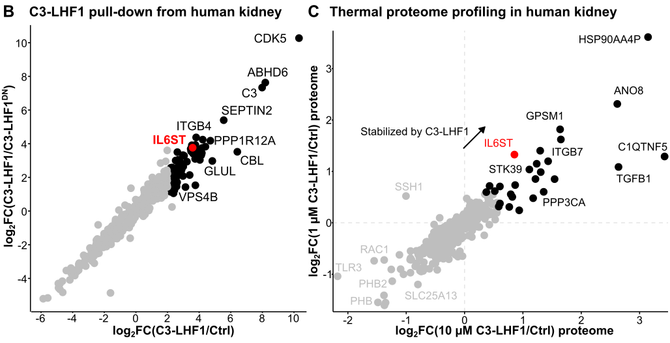
Next, we screened putative interacting proteins for our rec. C3-LHF1 in human kidneys by classical pull-down assays and Thermal Proteome Profiling, PISA style (TPP-PISA): One of the top candidates is the IL6ST (aka gp130), a very important (co-)receptor for IL6 signalling. 8/n
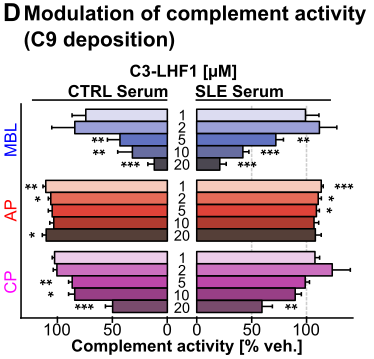
We produced the C3-LHF1 fragment as a rec. protein and performed complement assays, revealing an inhibitory effect of C3-LHF1 on the classical and MBL pathway of the complement system. These assays were done with the SVAR Complement ELISA kits. Inhibiting complement can come in handy, but do we see other effects? 7/n
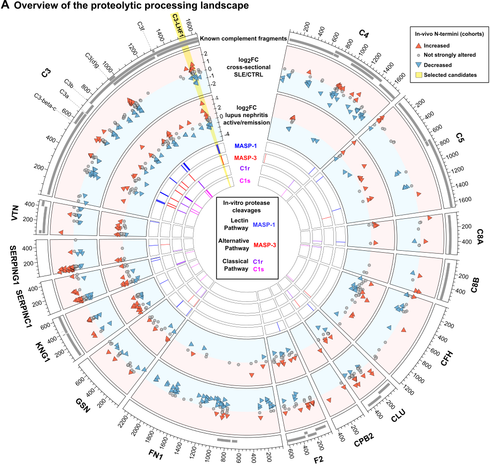
Combining all of this data into a fabulous circle plot clearly pointed towards an important role of the cleavage at pos. 1514, generating C3-LHF1. This became the focus of our future efforts.
#LHF1 #CirclePlot 6/n
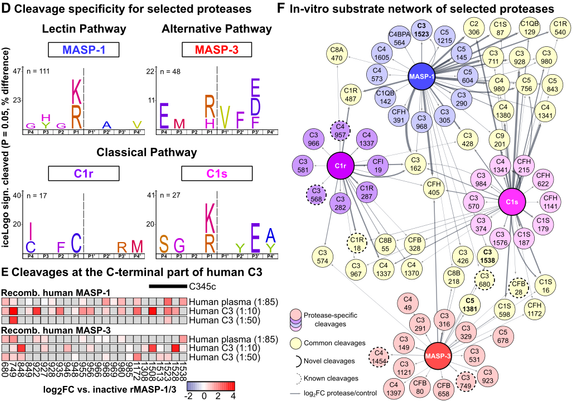
Knowing this cleavage, we sought to explain, how this or similar cleavages in human plasma proteins could be generated by four candidate proteases of the complement system: MASP-1/-3, C1r and C1s. We could generate substrate profiles for these proteases and identify common substrates as well as intriguingly present cleavages at the C-terminus of C3, similar to C3-LHF1. 5/n
Generating mass spec data is trivial, but deriving conclusions is difficult, thus we applied the MOFA2 framework for analysis of our data. It yields significant correlations between some MOFA factors and clinical parameters and interestingly the presence of our C3-LHF1 cleavage in one of these factors.
#MOFA 4/n