
Jason Orendorff

63 Followers
87 Following
98 Posts
XXX TODO

@lindsey Oh, thanks for the hint! The very first proof listed here <https://en.wikipedia.org/wiki/AM%E2%80%93GM_inequality#Proofs_of_the_AM%E2%80%93GM_inequality> is the one I was grasping for. The article for the term "concave function" says how it's equivalent to a statement about second derivatives...

I was talking in terms of exp being convex, and they talk about log being concave instead. But, same thing.

AM–GM inequality - Wikipedia

And if they don't intersect, if the parabola is always above the line, then the zigzag still goes up and right, and there is nothing to stop it -- so `s` diverges to positive infinity.

If you've read this far, I'm sure you can take it from there.

This argument is far from rigorous, about as far as you can get---but I find it completely convincing! Weird.

Now depending on a, either the parabola and the line intersect, or they don't.

If they do, your zigzag path always goes vertically up and horizontally to the right, but there's no way it can get past an intersection. So the sequence converges to the x-coordinate (or y-coordinate if you prefer; they're the same) of the intersection.

From somewhere I remember a way to turn this idea into a shape. First graph the function f, which makes a parabola; and on the same axes draw the diagonal line x = y.

Now put your pen at (0, 0) and draw a line up until you reach the parabola at (0, f(0)). Now go horizontally until you reach the diagonal line at (f(0), f(0)). Now go vertically until you hit the parabola at (f(0), f(f(0))); and so on. The coordinates of the points you visit are the elements of the sequence s.

How do you solve this? Suppose we define a function

f(x) = x^2 + a

Then s = [0, f(0), f(f(0)), f(f(f(0))), ...]

OK, another math puzzle.

Given a positive real number `a`, the sequence `s` is given by

s[0] = 0
s[n + 1] = s[n]^2 + a

For which values of `a` does the sequence `s` converge?

(again, from the early pages of a book, this time _Problems in Real Analysis_ by Rădulescu, Rădulescu and Andreescu)

@lindsey Yes, good eye

exp : R -> R

but via a typically mathy abuse of notation, on the last line it's "mapped" to all the elements of the collection a.

It's like `map(exp, a)`.

How that interacts with the rest of the argument is another thing about this I can't claim to understand 😐

I dunno. If I was smart enough to write out this proof I'm calling "good", there is probably still induction somewhere. That's another thing to be curious about...
Then I think the fact that exp is continuous, and its second derivative is everywhere positive, probably settle it? I dunno. This isn't so elementary that I can easily complete it myself, but if I could complete it, then I would know some things!

Yes -- proof was not super helpful to me.

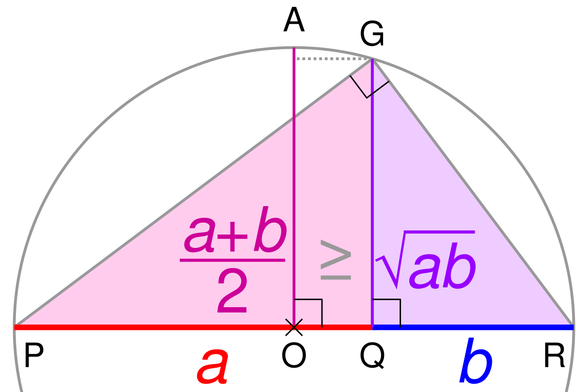
The theorem was: The arithmetic mean of a collection of positive real numbers is greater than the geometric mean.

I think a good proof ought to start with how the two means are related via the exp function.

exp(arithmean(a))
= e^((a1 + a2 + ... + an)/n)
= (e^a1 * e^a2 * ... * e^an)^(1/n)
= geomean(exp(a))