This morning I read the sentence "We proceed by induction" and thought, "well I guess I'm in for some insight-free symbol twiddling"

That's probably unfair. For me it's hard enough to write any proof, of any proposition, much less one that makes you feel you "understand" "why" it's true.

Yes -- proof was not super helpful to me.

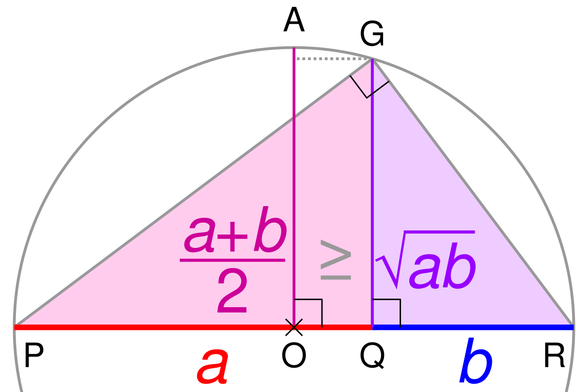
The theorem was: The arithmetic mean of a collection of positive real numbers is greater than the geometric mean.

I think a good proof ought to start with how the two means are related via the exp function.

exp(arithmean(a))
= e^((a1 + a2 + ... + an)/n)
= (e^a1 * e^a2 * ... * e^an)^(1/n)
= geomean(exp(a))

@jorendorff What's the type of `exp`? It looks like you're giving it a number on the first line and a set of numbers on the last line.

@lindsey Yes, good eye

exp : R -> R

but via a typically mathy abuse of notation, on the last line it's "mapped" to all the elements of the collection a.

It's like `map(exp, a)`.

How that interacts with the rest of the argument is another thing about this I can't claim to understand 😐

@jorendorff Wikipedia has a bunch of proofs of this property that use a bunch of different approaches. Maybe some of them are more to your taste than others?

@lindsey Oh, thanks for the hint! The very first proof listed here <https://en.wikipedia.org/wiki/AM%E2%80%93GM_inequality#Proofs_of_the_AM%E2%80%93GM_inequality> is the one I was grasping for. The article for the term "concave function" says how it's equivalent to a statement about second derivatives...

I was talking in terms of exp being convex, and they talk about log being concave instead. But, same thing.

AM–GM inequality - Wikipedia