Jonas Mirbeth

52 Followers
93 Following
54 Posts
Open access publishing at Ulm University, cyclist, personal account, views my own
ORCiDhttps://orcid.org/0000-0001-7711-7088
“Zehn Länder, ein Fluss, unzählige Geschichten. Die Leipziger #Buchmesse widmet sich erstmals nicht nur einem Gastland, sondern dem Donauraum.” https://www.deutschlandfunkkultur.de/themenfeld-die-donau-ist-fokusthema-auf-der-leipziger-buchmesse-100.html
Zehn Länder, ein Fluss, unzählige Geschichten: Die Leipziger Buchmesse widmet sich dem Donauraum

Kein Gastland, sondern der Donauraum prägt das Programm der Leipziger Buchmesse in diesem Jahr. Migration, politische Umbrüche und Krieg sind zentrale Themen.

Deutschlandfunk Kultur

Von der Schreibmaschine zur KI: Wie verändern sich Editionspraktiken im digitalen Zeitalter?

Eine Veranstaltung der AG Philosophische Editionen der Deutschen Gesellschaft für Philosophie in Kooperation mit dem Zentrum Preußen – BBAW.

Anmeldung (Zoom-Link nach Registrierung): https://www.bbaw.de/veranstaltungen/veranstaltung-editionspraktiken-im-historischen-wandel-von-der-schreibmaschine-zur-kuenstlichen-intelligenz

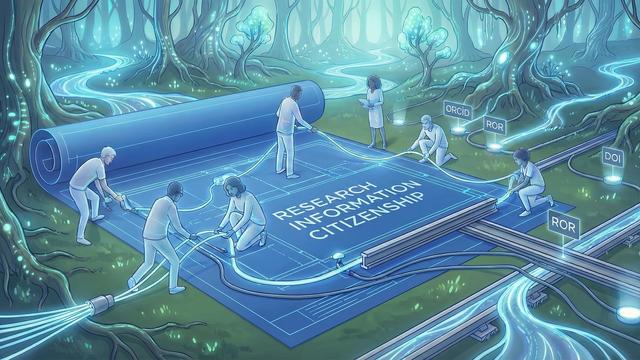
This blog post discusses recent events that reveal fragilities of the open research information ecosystem:

https://www.digital-science.com/blog/2026/02/no-shortcuts-to-research-information-citizenship/

"The most valuable work of the coming years will not be building, and investing in the curation of ever-larger mirrors of the research system, but finishing the foundational tasks we already know are necessary. That means complete, genuinely open metadata in @crossref and @datacite , including affiliations with @ResearchOrgs IDs."

#openscience

No shortcuts to research information citizenship - Digital Science

Being open isn't enough - true "research information citizenship" requires a robust, genuinely open research infrastructure.

Digital Science
Beyond Citations: A Cross-Domain Metric for Dataset Impact and Shareability https://arxiv.org/abs/2511.12966
Beyond Citations: A Cross-Domain Metric for Dataset Impact and Shareability

The scientific community increasingly relies on open data sharing, yet existing metrics inadequately capture the true impact of datasets as research outputs. Traditional measures, such as the h-index, focus on publications and citations but fail to account for dataset accessibility, reuse, and cross-disciplinary influence. We propose the X-index, a novel author-level metric that quantifies the value of data contributions through a two-step process: (i) computing a dataset-level value score (V-score) that integrates breadth of reuse, FAIRness, citation impact, and transitive reuse depth, and (ii) aggregating V-scores into an author-level X-index. Using datasets from computational social science, medicine, and crisis communication, we validate our approach against expert ratings, achieving a strong correlation. Our results demonstrate that the X-index provides a transparent, scalable, and low-cost framework for assessing data-sharing practices and incentivizing open science. The X-index encourages sustainable data-sharing practices and gives institutions, funders, and platforms a tangible way to acknowledge the lasting influence of research datasets.

arXiv.org

Der Diamond Open Access Standard (DOAS) ist jetzt auf Deutsch verfügbar!
Die Übersetzung macht einen zentralen Qualitätsrahmen für faires, gemeinwohlorientiertes Publizieren im deutschsprachigen Raum besser zugänglich.

Der DOAS definiert erstmals gemeinsame Standards für Diamond-Open-Access-Zeitschriften – von Governance und Finanzierung bis zu Diversität und Sichtbarkeit.

🗞️ Mehr Infos: https://open-access.network/services/news/artikel/diamond-open-access-standard-jetzt-auf-deutsch-verfuegbar

#OpenAccess #DiamondOpenAccess #WissKomm #OpenScience #DiamondOA

"Open Access kreist von jeher um die Frage, wie die Wissenschaft sich wieder aneignen kann, was sie erschafft." Mehr dazu hier im Text-Beitrag zum Blog-Symposium "Wem gehört die Wissenschaft?" #openaccess https://verfassungsblog.de/open-access-oeffentliche-gueter/
The Revolution Will Not Be Institutionalized


Verfassungsblog

RE: https://legal.social/@verfassungsblog/115742413082971477

"Open Access kreist von jeher um die Frage, wie die Wissenschaft sich wieder aneignen kann, was sie erschafft." Mehr dazu hier im ersten Text-Beitrag zum Blog-Symposium "Wem gehört die Wissenschaft?" #openaccess

Wofür die meisten Menschen in meinem Umfeld #AI derzeit verwenden, ist das Outsourcing von Kreativität, Lernen, Lesen und Denken.

Du hast keine Idee? Hier, Ideen! Du willst nicht lernen wie man zeichnet? Hier, ich zeichne für dich! Du willst diesen Artikel nicht lesen? Hier, die Key Take Aways! Du weißt nicht, wie man Quellen analysiert? Hier, erledigt!

Kurz gesagt: Wir streichen genau das, was uns herausfordert, wachsen lässt und uns stolz auf uns und unsere Fähigkeiten machen kann.

"Centralizing essential scientific resources in a single geopolitical or institutional hub is inherently dangerous, as any disruption can paralyze diverse ongoing research."
https://arxiv.org/abs/2509.19206
A decentralized future for the open-science databases

Continuous and reliable access to curated biological data repositories is indispensable for accelerating rigorous scientific inquiry and fostering reproducible research. Centralized repositories, though widely used, are vulnerable to single points of failure arising from cyberattacks, technical faults, natural disasters, or funding and political uncertainties. This can lead to widespread data unavailability, data loss, integrity compromises, and substantial delays in critical research, ultimately impeding scientific progress. Centralizing essential scientific resources in a single geopolitical or institutional hub is inherently dangerous, as any disruption can paralyze diverse ongoing research. The rapid acceleration of data generation, combined with an increasingly volatile global landscape, necessitates a critical re-evaluation of the sustainability of centralized models. Implementing federated and decentralized architectures presents a compelling and future-oriented pathway to substantially strengthen the resilience of scientific data infrastructures, thereby mitigating vulnerabilities and ensuring the long-term integrity of data. Here, we examine the structural limitations of centralized repositories, evaluate federated and decentralized models, and propose a hybrid framework for resilient, FAIR, and sustainable scientific data stewardship. Such an approach offers a significant reduction in exposure to governance instability, infrastructural fragility, and funding volatility, and also fosters fairness and global accessibility. The future of open science depends on integrating these complementary approaches to establish a globally distributed, economically sustainable, and institutionally robust infrastructure that safeguards scientific data as a public good, further ensuring continued accessibility, interoperability, and preservation for generations to come.

arXiv.org
Hot off the press: Reformation of science publishing: the Stockholm Declaration. Im #openaccess verfügbar unter: https://doi.org/10.1098/rsos.251805