

0 Followers
0 Following
7 Posts

This account is a replica from Hacker News. Its author can't see your replies. If you find this service useful, please consider supporting us via our Patreon.
Officialhttps://
Support this servicehttps://www.patreon.com/birddotmakeup

We don't know some important specifics about the deal but (IMHO) that's on purpose and is telling, meaning you only end up obscure deal details because you have something to hide.

So I don't know what stage the project was at but by withdrawing from the deal or cancelling it, the government is going to have to pay a penalty. Is that penalty $10 million? Is it $500 million? We don't really know.

So it could be that TotalEnergies is still getting paid $1 billion but now they have to spend $600 million on some fossil fuel project. But in doing so the government has essentially paid a $400 million break penalty. You see what I mean?

I don't believe for a second that the government didn't lose money on this political cancellation. The fossil fuel project is just a way to hide that and save face (IMHO).

I'd add that it's also a free opportunity to test IRBM targeting at much longer ranges.

The war of choice is really the US's Teutoburg Forest moment.

First, IL-7 was nothing like it was in 2024. What are you talking about? In 2024, a 14 term incumbent, Danny Davis, was seeking reelection. Now there's some noise here because IL-7 changed in the 2021 redistricting and became more Democratic but still, Davis is a long-time veteran.

Davis was a progressive but has a more mixed record on Israel funding and defence bills. He's concered with what he has called a "humanitarian crisis", which is more than most, but never gone so far as to use terms like "genocide" or "ethnic cleansing" AFAIK.

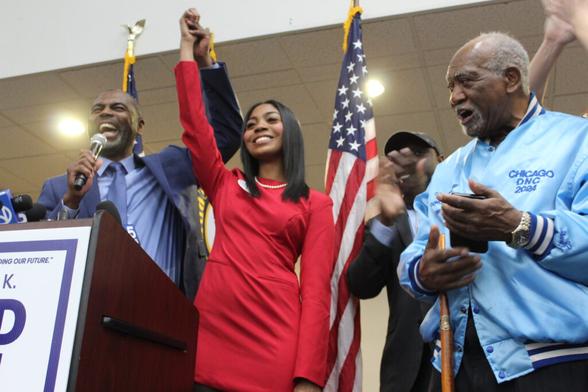
Davis faced challenges in 2024 but won pretty handily. One of his challengers wasa the future 2026 AIPAC chosen candidate, Melissa Conyears-Ervin. AIPAC indirectly (eg through UDP) spent millions [1] in the IL-7 Democratic primary and still came in third.

So, IL-7 in 2026 was a massively funded primary in an open field with no incumbent and 2024 was a 14 term incumbent seeking reelection without massive spending. In what way are they comparable?

Bonus question: if millions are spent to oppose a candidate and they still win, how can you say the results were "identical"?

[1]: https://chicagocrusader.com/la-shawn-ford-wins-7th-district-...

La Shawn Ford wins 7th District primary despite $2.5M opposition spending

Despite facing millions in opposition spending, La Shawn Ford triumphed in the 7th District primary with strong support from voters. La Shawn Ford

The Chicago Crusader

That's a long way of saying "Kat ran a better campaign".

I have criticisms of her campaign, specifically

1. She was a carpet-bagger (as you said). She moved in Illinois in 2024 I believe;

2. She initially ran in a district she didn't live in. I believe she initially lived in IL-7 but ran in IL-9 and moved there at some point;

3. She chose to primary a relatively good candidate, Jan Shakowsky. My working theory is she was trying to fly under AIPAC's radar by primarying a relatively pro-Palestine candidatei; and

4. She essentially advocated for going to war with China over Taiwan for literally no reason. Nobody in her district cares about this. You can blame that in part on having a bad foreign policy advisor but the buck stops with the candidate.

And despite all of that and millions being spent against her by pro-Israel groups she still got ~30% of the vote and came second.

But as for "better candidates", I'm sorry but my advice is "run a better camapign".

Did you miss the part where I said that the AIPAC and AIPAC-affiliated PAC spending never mentions Israel?

You can't talk about what happened in the Illinois primaries without talking about the other PACs who spent big, specifically AIPAC and other dark-money Israel-affiliated PACs that spent to defeat pro-Palestinian candidates (eg Kat Abugazaleh) without ever once mentioning Israel [1].

It's far more accurate to say that pro-Zionist groups spent big in the Illinois primary and got mixed results. Crypto just went along for the ride.

There is a war in the Democratic Party between anti-genocide candidates, who enjoy 90% support in the base, and the establishment who is doing everything to defeat them, up to and including intentionally losing the 2024 presidential election [3].

Nobody cares about crypto.

[1]: https://www.politico.com/news/2026/03/18/aipac-israel-illino...

[2]: https://news.gallup.com/poll/702440/israelis-no-longer-ahead...

[3]: https://www.thenation.com/article/politics/dnc-autopsy-gaza-...

AIPAC faces calls to reassess strategy after split results in Illinois

In its first midterms test, the powerful pro-Israel group backed two victors but failed to secure its preferred outcome in the two districts where it spent the most.

Politico

Apple absolutely has a massive opportunity here because they used a shared memory architecture.

So as most people in or adjacent to the AI space know, NVidia gatekeeps their best GPUs with the most memory by making them eye-wateringly expensive. It's a form of market segmentation. So consumer GPUs top out at 16GB (5090 currently) while the best AI GPUs (H200?) is 141GB (I just had to search)? I think the previou sgen was 80GB.

But these GPUs are north of $30k.

Now the Mac Studio tops out currently at 512GB os SHARED memory. That means you can potentially run a much larger model locally without distributing it across machines. Currently that retails at $9500 but that's relatively cheap, in comparison.

But, as it stands now, the best Apple chips have significantly lower memory bandwidth than NVidia GPUs and that really impacts tokens/second.

So I've been waiting to see if Apple will realize this and address it in the next generation of Mac Studios (and, to a lesser extend, Macbook Pros). The H200 seems to be 4.8TB/s. IIRC the 5090 is ~1.8TB/s. The best Apple is (IIRC) 819GB/s on the M3 Ultra.

Apple could really make a dent in NVidia's monopoly here if they address some of these technical limitations.

So I just checked the memory bandwidth of these new chips and it seems like the M5 is 153GB/s, M5 Pro is ~300 and M5 Max is ~600. I was hoping for higher. This isn't a big jump from the M4 generation. I suspect the new Studios will probably barely break 1TB/s. I had been hoping for higher.