Jim Proctor

136 Followers
124 Following
61 Posts
Jim Proctor (https://jimproctor.us) is a geographer and professor of environmental studies at Lewis & Clark College (USA), specializing in environmental theory. One recent project is EcoTypes (https://ecotypes.us), a survey-based exploration of environmental difference. Jim is an avid (if slow) biker and runner, a singer-songwriter, and advanced student of Kojosho, a soft martial art. Jim also founded Alder Creek Community Forest (https://aldercreek.org) in rural Oregon.
JDP websitehttps://jimproctor.us
EcoTypes initiativehttps://ecotypes.us
Alder Creek Community Foresthttps://aldercreek.org
How do you navigate difference? It's a broad question, I know, but one for which my #ecotypes initiative ultimately offers guidance. See four ways, attached and here: https://ecotypes.us/going-deeper/ecotypes-reflection-form/
EcoTypes Reflection Form

Not much overlap I suspect btw #mastodonians and members of @aess, but lmk if interested in environmental frameworks mingle I'm leading on 14 Nov: https://aessonline.org/event/frameworks-mingle/?event_date=2023-11-14
Frameworks Mingle - AESSOnline.org

Building on the successful AESS Frameworks Project workshops held as part of the 2022 and 2023 AESS Meetings, the Frameworks Mingle offers a simple way for interested Environmental Studies and Sciences instructors to reflect on the frameworks they bring to their teaching and scholarship. It proceeds with a simple form participants fill out in advance,

AESSOnline.org - AESSOnline
EcoTypes website and survey now freely available in multiple European (& potentially other) languages. Interested? Contact me for a group code. https://ecotypes.us
EcoTypes – Exploring Environmental Ideas

Exploring Environmental Ideas

How do EcoTypes compare among students in US vs. France? Linked URL is a comparison of two institutions. Biggest difference: preference for small vs. big Action. https://bit.ly/etlcesscafa23
EcoTypes LC-ESSCA Fa23 Data Summary

Demographics EcoTypes LC-ESSCA Fa23 Data Summary: Demographics,LC,ESSCA Total N,83,114 U.S. Proportion,97.5%,8.2% "Male" Gender ID (vs. Female/Nonbinary),29.3%,49.6% "Neither" ID (vs. Religious/Spiritual),49.4%,36.8% Age, years (as of end calendar year),19.2,18.8 Economic Class (-1 = "lower cla...

Google Docs
Hello, fellow #mastodonians, and sorry to be out of touch...teaching is a full-time job, no? Shared this NYT op-ed yesterday with students in context of #populist distrust in institutions across political spectrum, and #polarization resulting in trust feeding distrust feeding trust across same spectrum. Would you say the same is true outside of the U.S.?: https://www.nytimes.com/2023/10/03/opinion/science-americans-trust-covid.html
Opinion | Americans Are Losing Trust in Science After Covid

We may be entering a new political order polarized around institutional trust.

The New York Times
My students, mostly white upper middle class, find inspiration in what they read of #Indigenous peoples of #northamerica. This is good!...but it may just be a search for #purity, with earlier icons such as #wilderness now abandoned. This quiet little NYT article of a woman who made beautiful basketry offers a more variegated story: https://www.nytimes.com/2023/09/05/arts/design/washoe-baskets-louisa-keyser-native-americans.html
The Artistry of Her Baskets Is Complex. So Is the Story Around Them.

A couple recognized the Washoe weaver Louisa Keyser’s prodigious talent and spun myths to promote it. But her fortitude shines in work that today can be seen in museums and at the Independent 20th Century fair.

The New York Times
Quick help request: #ecotypes now testing major #european languages via #google translate (neural). #GDPR compliant. How well does the translation work for your language(s)?: https://ecotypes.us/
EcoTypes – Exploring Environmental Ideas

Exploring Environmental Ideas

I'm surprised how #highered courses often take #climateanxiety as a given: a justified response to the facts of climate change. But this research in #germany suggests otherwise. Maybe the fuller facts might help reduce climate anxiety? https://link.springer.com/article/10.1007/s10584-023-03518-z
Environmental knowledge is inversely associated with climate change anxiety - Climatic Change

This study tests the hypotheses that overall environmental knowledge and climate-specific knowledge are inversely related to climate change anxiety, such that people who know more (less) about the environment in general, and about climate in particular, are less (more) anxious about climate change. Time lagged data were collected from N = 2,066 individuals in Germany. Results showed that, even after controlling for demographic characteristics, personality characteristics, and environmental attitudes, overall environmental knowledge and climate-specific knowledge were negatively related to climate change anxiety (both B = -.09, p < .001).

SpringerLink
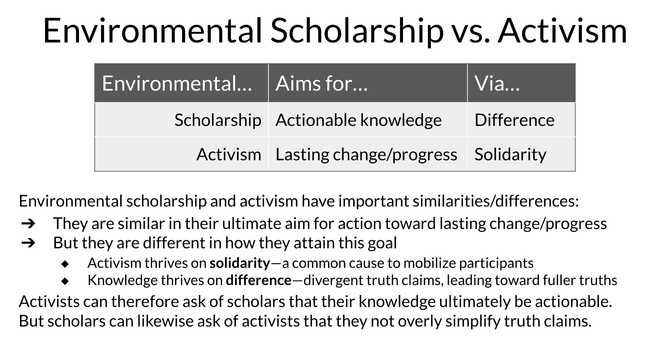
Some approaches to scholarship, like #participatoryactionresearch, seek a union between #scholarship and #activism. But I prefer a healthy tension between the two, possibly summarized via this diagram...thoughts/questions before I discuss with students next week? Thank you.
Reading this review of the new #naomiklein book. I guess when you say “I’ve always called my writing ammo for activists,” it's hard to think hard about misplaced certainties across the full right/"diagonalist"/left spectrum: https://www.nytimes.com/2023/08/30/magazine/naomi-klein-doppelganger.html
When Your ‘Doppelganger’ Becomes a Conspiracy Theorist

If you’re Naomi Klein, you write a book about it.

The New York Times