15 Followers
54 Following
137 Posts

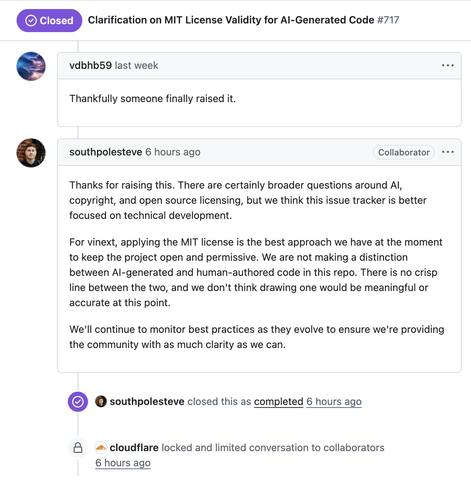
Issue shut down. Politely but most definitely shut down.

https://github.com/cloudflare/vinext/issues/717

Issue shut down. Politely but most definitely shut down.

https://github.com/cloudflare/vinext/issues/717

Cloudflare’s vinext project is a vibe-coded replica of Vercel’s Next.js, built off Vercel’s open-source unit tests.

By AI-cloning functionality, Cloudflare may have created code that’s not copyrightable, effectively laundering licensing terms. What began open-source might now be unlicensable.

I raised an issue with the Cloudflare project because this is a direct challenge to the principles of open-source.

Clarification on MIT License Validity for AI-Generated Code https://github.com/cloudflare/vinext/issues/717

@jhlagado The Israelis taught them, tried and tested on children.

There's this feature of people from the "Land of the Free" where many have internalised the notion that slavery was "no big deal". Certainly not the greatest crime against humanity.

The American obsession with "liberty" is all about the freedom to own, not the freedom from being owned.

What is the defining feature of this war? America's persistent use "double-tapping" on every attack.

Specifically to use a second attack to target and kill first responders and anyone trying to help the victims of the first attack.

I don't need to tell you that that's a war crime. That's because in practice war crimes don't apply to imperial powers.

They only apply to their victims.

@ramin_hal9001

Software was not protected by copyright in the early 1970s but software was tightly bound to the hardware that it ran on.

When software started to escape the hardware with the microcomputer revolution, that's when interest in the software copyright became influential.

I think it comes down to how many instances of a piece of software were running at a time. Software went from single instances to millions of instances.

@ramin_hal9001

The other thing about software in that era, people were still undecided about whether it was copyrightable or public domain.

The only kind of protection available was the use of trade secrets. if you didn't want the software copied or closely examined you needed to rely on access control, not copyright.

I think you're right that the nature of software itself is changing and maybe we are actually returning to a form of code that is literally free.

As in "free beer". i.e. $0

@jhlagado I got a copy, but I doubt it would ever be useful to me. The Emacs Claude Code system is a far superior interface to the client/server model the in-browser (or Electron-based) interface to the Claude LLM could ever be.

The great irony of #AgenticAI is that it is basically a re-discovery of the old Lisp machines integrated programming environments. The idea of having all of the software in your computing environment fully integrated and controllable with natural language goes way back to Douglas Engelbart “Mother of All Demos,” and Terry Winnograd and the “SHRDLU” system. These were first realized as a commercial product at companies like Symbolics with Genera OS in the late 1970s and early 1980s. Emacs is one of the last surviving integrated programming environments from that era.

The idea that any computing problem can be solved with an app, and the idea of app stores, was always a regression. Apps are a way of maximizing the rent-seeking ability of tech companies. Algorithms and math equations are free, that won’t do at all. So wrap up every algorithm, and every math equation, into a little package you can manipulate on a touch screen and sell them to people. You can even sell the same algorithm exact algorithm a dozen times, each with different parameter configurations, as long as you create a new icon for each one.

But now that AgenticAI is a thing, I think people won’t tolerate the idea of apps anymore. The old mantra “there’s an app for that” may finally be on it’s way out. Who needs apps if you can just ask an AI to make one for you? And who needs an AI to make apps for you if you can just ask it to perform a task and let it choose the right algorithm to accomplish that task?

So that might be the one thing that is actually good about AI: it made people aware of the rent-seeking nature of “apps.” Hopefully, people will go back to the old Lisp Machine model of computing, or “Agentic AI” as they are calling it nowadays. The big difference now is that 1. we have enough computing power to train these massive multi-layer perceptrons that they call “LLMs”, 2. we have the Internet full of digitized information for free* to train the LLM, and 3. everyone has a n Internet-connected computer in their pocket.

(* Of course, anything is free if you just take it without paying.)

@makdaam The US Copyright Office has said that the existing laws are adequate and new laws are not needed. AI assisted software may be copyrightable but vibe coded software is not likely to be copyrightable.

https://www.congress.gov/crs-product/LSB10922

The question of training is less positive for property owners. There have been court cases where the verdict is that training in LLM on copyright material is considered "fair use" as long as a copy of the material used in the training was purchased by the LLM owner.

Generative Artificial Intelligence and Copyright Law