
@jcinPDX

19 Followers
23 Following
33 Posts
Husband, father, tech exec, and sportsfan. Some of my messages are about work. But mostly it's an immature rant about a referee.

@pytorch 2.4 upstream now includes a prototype feature supporting Intel GPUs through source build using #SYCL and #oneDNN as well as a backend integrated to inductor on top of Triton - enabling a path for millions and millions of GPUs through #oneAPI for #AI.

Lots of important milestones to make this happen - including support for #UXL Foundation open AI technologies. Just a prototype, but a big step forward... thanks to all in the PyTorch community. Feedback welcome!

https://pytorch.org/blog/pytorch2-4/

PyTorch 2.4 Release Blog

We are excited to announce the release of PyTorch® 2.4 (release note)! PyTorch 2.4 adds support for the latest version of Python (3.12) for torch.compile. AOTInductor freezing gives developers running AOTInductor more performance-based optimizations by allowing the serialization of MKLDNN weights. As well, a new default TCPStore server backend utilizing libuv has been introduced which should significantly reduce initialization times for users running large-scale jobs. Finally, a new Python Custom Operator API makes it easier than before to integrate custom kernels into PyTorch, especially for torch.compile.

PyTorch

#GenAI enthusiasts... the folks from Prediction Guard and the Intel Liftoff program have a fun series of 5 progressively more challenging problems. The Intel Developer Cloud is offering cycles, GPUs and more for contenstants...and I hear about 2k have signed up to test their skills. The first couple are easy.

Check it out on this vid... and have fun!

https://www.youtube.com/watch?v=9VC6EZ7b6sk

Welcome to the Advent of GenAI Hackathon 2023 - Prediction Guard and Intel Liftoff

YouTube

Hey... the HPC Wire Readers just chose our #oneAPI tools (since contributed to the #UXL Foundation as Best Programming Tool or Technology! We're seeing real momentum in Khronos #sycl as a neutral, open, multi-architecture language for accelerators at #SC23 and beyond

https://www.hpcwire.com/2023-readers-editors-choice-programming-tool-technology/

2023 Readers' & Editors' Choice Awards - Best HPC Programming Tool or Technology - HPCwire

Best HPC Programming Tool or Technology Readers’ Choice Awards Intel® oneAPI Toolkit software libraries for building, analyzing and scaling HPC and AI applications across shared- and distributed-memory computing systems. Editors’ […]

HPCwire
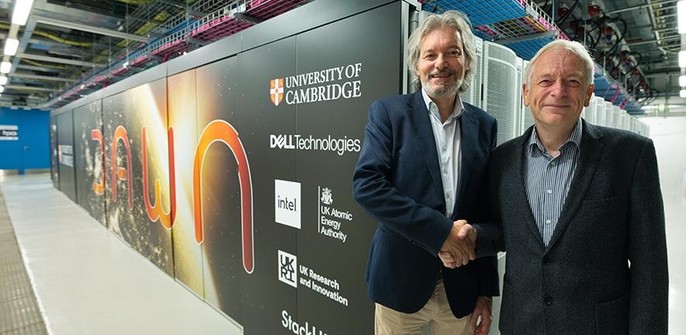
Cambridge, Intel and Dell join forces on UK’s fastest AI supercomputer

The Cambridge Open Zettascale Lab is hosting Dawn, the UK’s fastest artificial intelligence (AI) supercomputer, which has been built by the University of

University of Cambridge

I'd been told that #oneAPI seemed complicated by a friend in our developer community. I countered...well not really... and

So that friend told me I should simply record that pitch. It made it clear why this is important and it was short and sweet...

It took me a couple months to get time to record it, but... here you go!

https://www.youtube.com/watch?v=qvxmeupPftU

What is oneAPI? Overview and Benefits | Intel Software

YouTube

One of Amazon's Top #C++ #programming texts -- now updated and in 2nd edition!
This book teaches us how to harness accelerated computing using C++ with SYCL and provides advice for balancing application performance, portability across compute devices, and productivity.

https://link.springer.com/chapter/10.1007/978-1-4842-9691-2_1

Introduction

Chapter 1 introduces data parallelism and foundational topics for programming accelerated systems with modern C++ and SYCL.

SpringerLink

This is a nice article on Argonne Leadership Computing Facility's work on the Monte Carlo application OpenMC. And there are some nice complements for the compiler engineers at Intel Software for responsiveness. But underlying the story is the importance of supporting standards like #openmp and #llvm - both available in the #oneAPI compilers - to achieve performance portability.

Open standards for accelerated computing work. Accept nothing less.
https://lnkd.in/gK2Y-kTg

LinkedIn

This link will take you to a page that’s not on LinkedIn

Earlier this week Intel Software announced the launch of Intel Developer Cloud where devs can get access to the lastest hardware, security features, developer software and more. Guy Tamir - who was a great series of <3 minute intros for Dev Tools put this intro together for folks who want to try out the developer cloud

https://youtu.be/QFR3SvcTikY?si=xaMtfAt3kE25eb5G

Get Started with Intel® Developer Cloud | Intel Software

YouTube

At the airport getting ready to return after #intelinnovation. A couple big announcements on Open accelerated computing and the new UXL Foundation, Intel Trust Authority and Secure Attestation, progress in AI both in the datacenter and client, and an amazing 288 cores in upcoming Sierra Forest.

The software and advanced tech keynote is here: https://www.youtube.com/watch?v=7SoOwVP0VLw

Day 2 Intel Innovation 2023 Keynote with Chief Technology Officer Greg Lavender

YouTube

Lots of coverage today on the Linux Foundation launch of UXL.

Proprietary development serves the proves the possibility of new technologies. Over time, openness provides scale and market expansion. Along with cool AI domain interfaces like XLA and Triton, general accelerated programming also has made a huge step forward today with UXL

https://www.nextplatform.com/2023/09/19/the-new-uxl-foundations-has-bold-blueprint-for-open-acceleration/

The New UXL Foundation’s Has a Bold Blueprint for Open Acceleration - The Next Platform

Heterogeneous computing is clearly here to stay but now’s the time to get down to brass tacks and start addressing standards, portability, and other elements common to maturing technologies. The need to integrate various types of processors, including CPUs, GPUs, and specialized chips for AI and other applications is clear, thus today we’re met with

The Next Platform - In-depth coverage of high-end computing at large enterprises, supercomputing centers, hyperscale data centers, and public clouds.