NASA's Juno spacecraft will be flying past Io all year long. I wrote about what we'll see and why a proposed mission could tell us even more about Io:

Jason Davis
- 396 Followers
- 33 Following
- 39 Posts
Retired from posting

Looks like NASA's Ingenuity Mars helicopter saw the Perseverance rover's tracks during its 40th flight on Jan. 19 #space #NASA #Mars
📷NASA/JPL-Caltech/edited by me


 NASA
NASAIn addition to their official crew photo, the STS-61C crew took a second photo wearing their helmets as a gag.
Standing, L–R: Bob Cenker, Bill Nelson, Steven Hawley, George Nelson, and Franklin Chang-Diaz. Seated: Charlie Bolden and Hoot Gibson
#NASAhistory

Tidal forces can cause the surface of Jupiter's moon Io to bulge up to 100 meters (330 feet).
On Earth, the biggest difference between low and high tide is 18 meters (60 feet), and this is for water, not a solid surface!
All of that stress makes Io the most volcanically active world in our solar system.
📷 NASA's New Horizons spacecraft, 2007. Credit NASA/JHUAPL/SwRI
NASA's Kennedy Space Center sits in the middle of the Merrit Island National Wildlife Refuge in Florida. This creates some interesting interactions between rockets and wildlife.
Here, an osprey perches in front of the Space Launch System moon rocket with Orion at the top.
📷 credit NASA/Keegan Barber
#NASA #space #spaceflight #bird #birds #photography #wildlife

Happy December solstice!
Here's what Earth looked like on June 21 (June solstice, left) vs. Dec. 20 (the day before December solstice, right).
Notice how North and South America trade places in the Sun! Our planet has an axial tilt of 23.4 degrees, which gives each hemisphere a turn in more direct sunlight during the year.
The images were taken by NASA's EPIC camera aboard the NOAA DSCOVR spacecraft located nearly 1 million miles away.

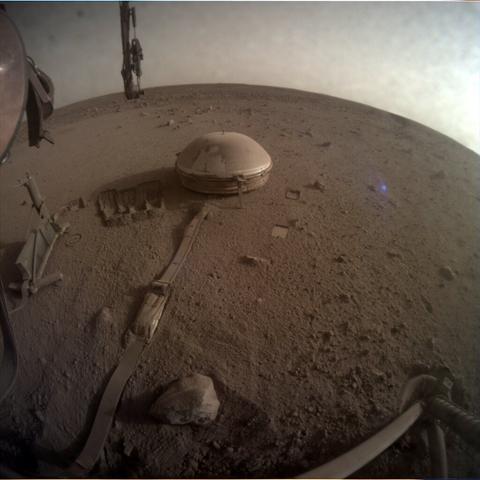
This may be the final image from NASA's InSight lander on Mars. The spacecraft's power levels are extremely low due to four years' worth of dust on the solar panels.
Going to wheat paste flyers all over town saying "Who is John Mastodon?" to get the revolution started
This collection of side-by-side photos of comparable Apollo and Artemis events at @NASAKennedy is phenomenal! Check it out: https://go.nasa.gov/3W2Bj6Q
#NASAhistory
#NASAhistory
