I have some news I’m very happy about.
| Location | Oxford/London, UK |
| Website | https://jakeanders.uk |
| RePEc | https://ideas.repec.org/f/pan354.html |
| Gravatar | https://gravatar.com/jakeanders |
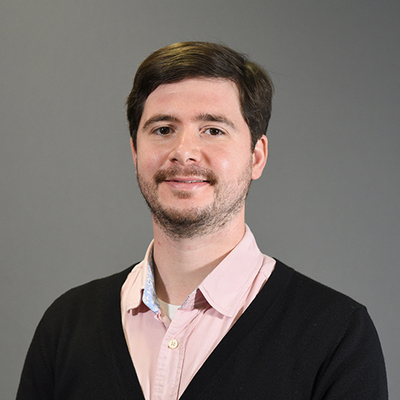
| Location | Oxford/London, UK |
| Website | https://jakeanders.uk |
| RePEc | https://ideas.repec.org/f/pan354.html |
| Gravatar | https://gravatar.com/jakeanders |
Those of you who know me will know what a difficult and devastating year it has been for me in my personal life. Nothing can make up for our family’s loss.
I am determined, nevertheless, to be pleased with this professional success.
Delighted to have contributed the chapter on England to this new book on the education policy response to the COVID-19 pandemic's unequal disruption to young people's education.
The full publication was launched today and is available here: https://op.europa.eu/en/publication-detail/-/publication/13381883-ec31-11ee-8e14-01aa75ed71a1
This is awesome.
How can we convert from an effect size to a percentile point difference?
Just multiply by 37.
So simple. So useful.
Educational researchers often report effect sizes in standard deviation units (SD), but SD effects are hard to interpret. Effects are easier to interpret in percentile points, but conversion from SDs to percentile points involves a calculation that is not intuitive to educational stakeholders. We point out that, if the outcome variable is normally distributed, simply multiplying the SD effect by 37 usually gives an excellent approximation to the percentile-point effect.
Over the last twenty years, education researchers have increasingly conducted randomised experiments with the goal of informing the decisions of educators and policymakers. Such experiments have generally employed broad, consequential, standardised outcome measures in the hope that this would allow decisionmakers to compare effectiveness of different approaches. However, a combination of small effect sizes, wide confidence intervals, and treatment effect heterogeneity means that researchers have largely failed to achieve this goal.
Read our working paper and let us know what you think: https://econpapers.repec.org/RePEc:ucl:cepeow:23-07
We're still actively working on this, so your thoughts and suggestions are much appreciated.
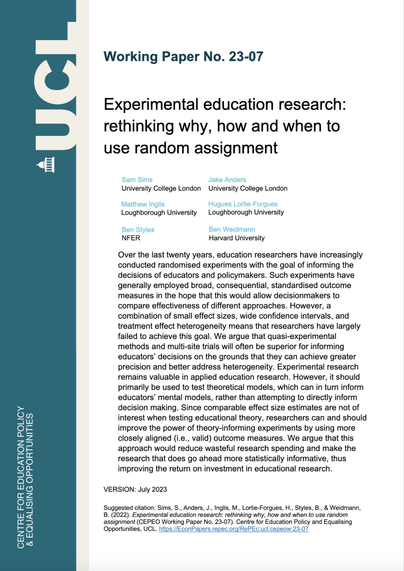
By Sam Sims, Jake Anders, Matthew Inglis, Hugues Lortie-Forgues, Ben Styles and Ben Weidmann; Abstract: Over the last twenty years, education researchers have increasingly conducted randomised experiments with the goal of
