IXI

@ixi@infosec.exchange
11 Followers
0 Following
104 Posts

xⓋx

אנטיפה

ژن، ژیان، ئازادی

Am Yisrael Chai

Be gay, do crime.

Biji Berxwedana Rojava!

White silence is violence.

The future is intersectional.

"In all our decadence people die"

Destroy The Patriarchy Not The Planet!

Sufficient alt text or audio description is essential for posts focused on images, audio or video.

Accessibility isn't a feature, it's a requirement.

[Alt acc for longer posts, occ.]

Pronouns • Pronomenhe/him • er/ihn
LanguagesENG • GER
Privilegeswhite • cishet • abled
IPA[ˈꞮKSI]
AVATAR+BANNERblack
Main Account@ixi

30 November 1941

"Developments on the front are taking a turn for the better.
Hitler continues to tread water near Moscow. Suffers massive losses.
The general impression is that the Germans are not strong enough to break through to Moscow.

[...] I am going to Moscow. To accompany Eden and take part in the negotiations! Hurrah! ...

__

[There are no further entries in the diary for 1941. Maisky, who was actively involved (at Eden’s request) in the preparatory stages of the conference in London, joined the foreign secretary on his trip to Moscow during 7–30 December. Never sure as to what was in store, he made sure he took along ‘a considerable quantity of Dunhill’s best’ for Stalin. On the whole, Eden shared Molotov’s hopes of concluding the conference with two agreements, one defining the common strategy and relationship during the war, and the other the nature and borders of Europe in the aftermath of the war (though he did not wish the second to be specific and detailed).
At Eden’s instigation, the Foreign Office embarked on the drafting of the so-called ‘Volga Charter’, to be incorporated into the ‘Atlantic Charter’, recognizing the Soviet demand for a buffer zone in the Baltic and East Poland.
This, they insisted, did not reflect expansionist ambitions, but was a ‘legitimate security claim’.

Once again, Churchill considered only the tactical and propaganda value of the visit. To prevent undesirable commitments, he timed the visit for after the launch of the offensive in Libya. This offensive, he knew, would stifle any debate on strategic priorities and would enable Eden to claim that Britain had indeed opened a second front.

Eden’s visit in early December was overshadowed by two major events.
On his way to Russia he was informed of the attack on Pearl Harbor. A day before the attack, Churchill still appeared conciliatory and flexible in his farewell talk with Maisky, embarking in detail on his vision for a post-war Europe in which the Soviet Union was assigned a prominent role.
Churchill’s hasty departure for Washington a few days after the attack, accompanied by all the chiefs of staff, and the discussion on common strategy at the White House stood in sharp contrast to the perfunctory treatment of Russia.

The second event that overshadowed Eden’s visit was the impressive Soviet counter-offensive at the gates of Moscow. While the Russians gained in confidence, Eden lost a great deal of his bargaining power. As anticipated, he was confronted with the issues of frontiers and strategic collaboration. The initial cordial atmosphere, again coloured by Soviet expectations, soon gave way to frustration and conflict. The intensive negotiations reached deadlock, but a final noncommittal joint declaration and an ostentatious farewell reception at the Kremlin served Stalin as a morale booster at home and a display of unity vis-à-vis the Germans.]"

23 November 1941

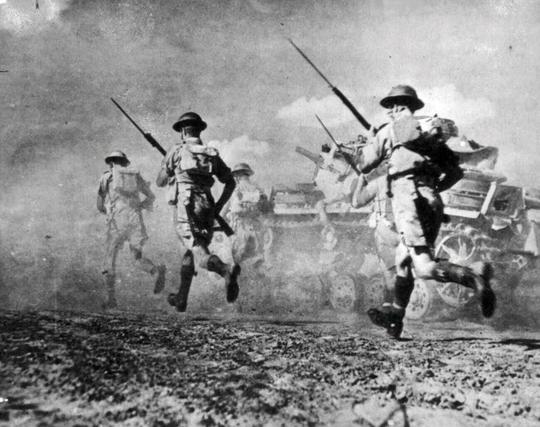
"Last week (18 November) the British finally started their long-awaited offensive in Libya.

If the British manage a successful Blitzkrieg in Libya, it may have serious consequences for the general course of the war, because this time they will surely not stop at Benghazi but will go on to Tripoli and possibly even Tunisia.

This would be of immense importance for North Africa, would ease the shipping situation in the Mediterranean and would open routes for attacking Sicily, Sardinia and Italy.

A second front in Europe could be opened before spring. But can the British launch a Blitzkrieg? I am not sure. Well, we’ll see."

11 November 1941

"It seems that we’ve come to the first crisis in relations between the ‘allies’!
Today I handed the prime minister Stalin’s reply to his message of 4 November. Churchill received me in his office in Parliament. Eden was also present at my request. We had come together from the Foreign Office, where I had had a preliminary talk with Eden on various issues of the day. When we entered the prime minister’s office, Churchill stood up to greet us and, shaking my hand, said with a friendly smile: ‘Let us have a good talk.’

We sat down at the long table covered in green cloth at which Cabinet meetings are usually held, and I handed Churchill the package I had brought with me. He took out the letter and began reading. I observed his facial expression: it became increasingly dark. Churchill reached the last line and passed the document to Eden in silence.
Then, also in silence, he jumped up from his chair and quickly paced the room a couple of times. It was difficult to recognize the prime minister: his face was as white as chalk and he was breathing heavily. He was obviously enraged. Finally, having gained a measure of control over himself, Churchill uttered: ‘Grave message!
And added icily: ‘I don’t want to answer this message now! I have to consult my colleagues.’
It was said in such a tone that I thought it better to rise and take my leave. But Eden held me back and I remained.

Churchill did not maintain his outward restraint for long. He again paced the room a couple of times, getting more and more worked up. Eventually, he could keep silent no longer: ‘So, Stalin wants to know our post-war plans? We do have such plans – the Atlantic Charter! What else can be said at the present moment?’

I objected that the Atlantic Charter was too general a document and that within its framework (for we also recognize the Atlantic Charter) a number of points could be usefully clarified. Just one example: about three weeks ago Eden, referring to the question Stalin had asked Beaverbrook during the Moscow conference, told me that the British Government would like to build post-war relations between England and the USSR on the basis of friendly cooperation. Couldn’t this matter be profitably solved within the framework of an agreement about the post- war plans of both powers?

‘It’s true that I spoke with you about it,’ Eden commented, ‘but I asked Mr Stalin to express his own thoughts on this matter.’ ‘I am inclined to interpret point (a) of Stalin’s wishes,’ I countered, ‘as a reply to the message you conveyed to me.’ Eden smiled sceptically.

Churchill suddenly flared up again and exclaimed: ‘If you want to turn England into a communist state in your post-war plans, you should know you’ll never succeed!’

‘What makes you think so!’ I protested with a suppressed laugh. ‘Stalin’s last speech should have quite reassured you in this respect.’ The prime minister again took Stalin’s message in his hands and glanced at the second sheet. It was as if he had been scorched. ‘Hm!’ Churchill cried out in fury. ‘I send two of my chief commanders to him but he can’t find the time to see them unless they are authorized to conclude those agreements...’ And the PM poked his finger in vexation at the passage where Stalin mentions the absence of agreements between England and the Soviet Union on mutual military assistance and post-war plans.
‘No, I am not going to propose any more military negotiations!’ continued Churchill in the same tone. ‘Enough!’

The prime minister rapidly paced his office once more and added: ‘And why was it necessary for Stalin to assume such a tone in our correspondence? I am not going to stand for it. I could well say things, too! Who will profit from it? Neither we, nor you – only Hitler!’

I remarked that I could see no grounds for such excitement. What Stalin is now suggesting is essentially what I discussed with Churchill more than two months ago – a joint strategic plan for the conduct of the war. Is that so unreasonable?

‘What strategic plan can there be today?’ Churchill exclaimed with irritation. ‘We are still on the defensive, you are still on the defensive, and the initiative is still in Hitler’s hands... What joint strategic plan can there be under such circumstances? Only to hold out until the moment arrives when we can snatch the initiative from our enemy’s hands – that is our plan!’

‘I agree that for the moment both you and we have to think about defence,’ I interjected, ‘but even defence requires a plan. What will we do in 1942, for instance – you and us? Wouldn’t it be a good idea to agree on that?’

Churchill flared up again as if he had touched white-hot iron, and shouted bitterly: ‘It was me who acted without hesitation on 22 June and offered you my hand, although only a few weeks earlier I had had no idea what you would do! Perhaps you were going to go with Germany?... Who needs all these disputes and disagreements?... After all, we are fighting for our lives and will keep on fighting for our lives whatever happens!’

‘We’re fighting for our lives too,’ I replied. ‘And not badly at that.’
‘You’re fighting superbly!’ exclaimed Churchill with passion. He thought for a minute, glanced at Eden, who had kept silent throughout, and finally added: ‘Right now I don’t wish to respond to Stalin... I might say a lot of undesirable things in the heat of the moment... I’ll consult our people, calm down and then write... You will be duly informed.’

‘Whether or not you like Stalin’s message,’ I remarked in conclusion, ‘there’s little sense in excessive excitement. One must keep a sober and cool head. We have a common cause and a common struggle. If I can help in building bridges, I am entirely at your service.’"

9 November 1941

"One more week. The twentieth week of war. The situation seems to be somewhat better. True, the Germans have captured the greater part of the Crimea and are approaching Sevastopol and Kerch.
The main thing, however, is that the Germans have been stopped on the Moscow front.
It looks as if the German offensive on this front is running out of steam – particularly with the advent of winter.
Still: once bitten, twice shy.
I am afraid to draw any conclusions.

[...]

The second joyful event, albeit on a much smaller scale, was the appointment of Litvinov as ambassador to the USA. My telegram sent ten days ago, stressing the necessity of immediately sending an ambassador to Washington, obviously played its part in hastening the resolution of this matter.
M.M. will surely be in the right place in America.

Today more than ever before, we need a reliable, strong and influential figure there."

__

The Strange World Of... Bolt Thrower | The Quietus
https://thequietus.com/interviews/strange-world-of/bolt-thrower/

Into the Eye of Chaos... - Matt Johnsen Dot Com
http://www.mattjohnsen.com/archive/2005/11/into_the_eye_of.php

[Graphic retelling + slurs] Vic's Dungeon: Bolt Thrower vs. neonazi scum - as narrated by Karl Willets
https://vics-dungeon.blogspot.com/2016/01/bolt-thrower-vs-neonazi-scum-as.html

Bar Fights, Brawls, Fires – The Five Most Unusual Concert Experiences
https://bravewords.com/news/bar-fights-brawls-fires-the-five-most-unusual-concert-experiences/

Realm of Chaos 80s: Slaves to Darkness 25th Anniversary: The Other Realm of Chaos: Bolt Thrower's Album and its Legacy
http://realmofchaos80s.blogspot.com/2013/01/slaves-to-darkness-25th-anniversary_18.html

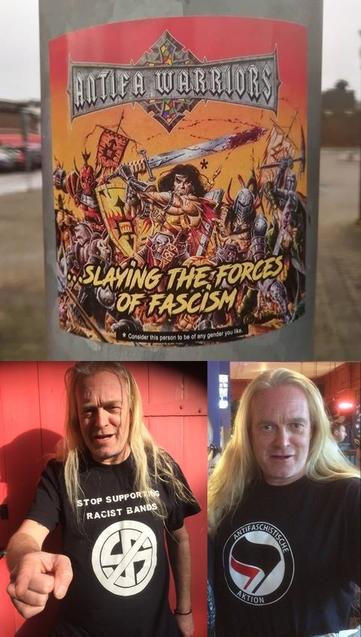
Picture [1] by Gottlieb Bros, further info: "Bolt Thrower early 90s promo pic and an issue of White Dwarf from 1990 promoting the release of Bolt Thrower’s first LP to use GW licensed artwork, Realm Of Chaos." by fortbraggmagazine (@fortbraggmagazine) - imginn.com
https://imginn.com/p/DE-RKzpoTbO/

Picture [2] collage featuring:

Karl Willetts(Bolt Thrower) has a message : rabm
https://old.reddit.com/r/rabm/comments/ldvnkn/karl_willettsbolt_thrower_has_a_message/

"Their Singer did very clearly approve of that sticker and even reposted it." Antifa sticker seen in Gothenburg, Sweden : AntifascistsofReddit
https://old.reddit.com/r/AntifascistsofReddit/comments/nxz52r/antifa_sticker_seen_in_gothenburg_sweden/

On 26 October 1991, grindcore/death metal legends and lifelong anti-fascist punks Bolt Thrower beat up violent, Sieg-Heiling Nazis at their gig in Pennsauken, New Jersey, while on tour with Immolation.

Members of a nearby Nazi biker gang had previously turned up at gigs and caused trouble by harassing people. That night would be no different:

Singer Karl Willets: "I remember throughout the support bands these nazi pricks had started to do that stupid arm streching routine a lot...I got on stage and told them to stop..(no suprise they didn't...but they'd had a warning....)"

A fan in the crowd recalled: "About a half hour into the set, a circle pit opened up, but it wasn't for moshing. The skins were brutally beating and kicking a guy who was lying on the floor in the fetal position, trying to protect himself from the boots.
A tall, skinny skinhead ran off to the back of the club, and when he came back, he had a baseball bat, which he used to pound this poor guy's head into mush. The crowd erupted into a proper riot. Bolt Thrower's singer, Karl, jumped into the crowd to pound on skinheads, god bless him."

"I looked out the corner of my eye to see this huge Neanderthal coming right at me, with Adolf Hitler tattooed on his chest- at this point our Tour Manager intervened with the German slugger!
I saw the nazi monster collapse to the floor with blood pissing out of his head, the backswing to the bat almost killed one of the skinhead kids whom must have been about 12.

The place descended into chaos, the security guards were related to the skinheads, it could have got bad... We loaded our gear out superquick thanks to a more together Immolation and high-tailed it out of there. As we left, Baz remembered we left the baseball bat in the venue, he went back in to retrieve it just as the skinheads returned to the venue for vengeance... I have never seen a man move so quick through a melee of flailing limbs!

We drove off and we then thought that we were being followed by carloads of nazis after our blood, so we pulled over to confront them, yelling as we approached the stopped vehicles, until we realised it was some fans just making sure we got away ok..."

20 years later Journalist Kez Whelan concluded: "As you’d expect from anyone with at least a rudimentary grasp of history too, Bolt Thrower have been defiantly anti-fascist since day one. In stark contrast to the apathetic “apolitical” leanings of many war obsessed metal bands, Bolt Thrower’s principled ethics have seen them get into some scraps over the years"

"As vital as Bolt Thrower are to the fabric of death metal, it’s stories like this that demonstrate the punk mentality that has always underpinned the band."

#BoltThrower #Antifascism #DeathMetal

23 October 1941

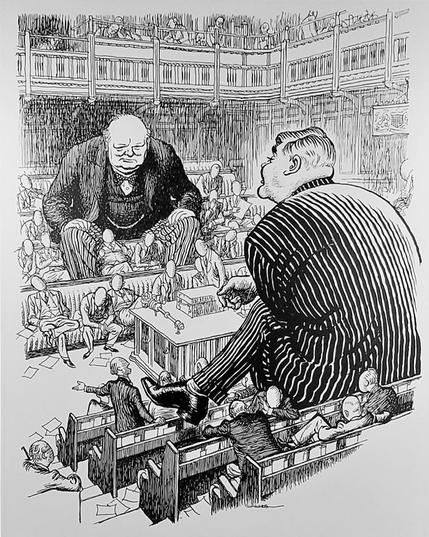
"Today I spent half the day in Parliament. The course of the war was discussed. There were comparatively few people present, but passions ran high.

Aneurin Bevan was particularly harsh, delivering a truly belligerent speech in which, inter alia, he attacked Halifax for the public statement he made in America that an ‘invasion of the Continent’ was now impossible because of the lack of shipping and arms.
Bevan called Halifax’s conduct ‘all but high treason’ (particularly so because he said all that just as Hitler was preparing his full-scale offensive against Moscow).

Addressing the Government, Bevan shouted several times: ‘If you can’t change your policy, then step down!’ It all had a powerful effect: such words had not been heard in the Commons since the time of the crisis which brought about Chamberlain’s resignation in May 1940."

20 October 1941

"Agniya and I saw Sorochintsy Fair at the Savoy theatre. The play is performed by a company of Whites under the direction of ‘the King of the Black Exchange’ – a certain Pomeroy, a clever Jew from Kharkov. All the revenue from the show goes to the Red Cross for the needs of the USSR.

We were given seats in a special box. With us in the box were Churchill’s wife, and Baron Iliffe and his wife. ‘God Save the King’ and the ‘Internationale’ were played before the beginning of the performance. All stood. Mrs Churchill was standing, too, even though it was her husband who forbade the ‘Internationale’ from being played over the radio, together with the other anthems of the Allies.

The audience clapped the prime minister’s spouse, but Agniya and I received even more applause. How this war has jumbled things up! The Soviet ambassador attends a performance by a White company, the White company gathers money for the Red Army [sic], and the wife of the British prime minister blesses this undertaking.

We had tea during the interval, and Mrs Churchill disclosed a few interesting details about her husband’s way of life.
Before the war, in peacetime, he used to go to bed at midnight and get up at eight. But now there’s no chance for him to sleep his usual eight hours. He almost always goes to bed at two or three in the morning and has to get up at eight, as before.
Which means no more than 5–6 hours of sleep. It’s not enough. The prime minister makes up for it after lunch: he undresses, lies down in bed in complete darkness, and sleeps for an hour or an hour and a half.
Experience has shown that this short daytime rest gives him a lot of strength, and he values it highly. If Churchill does not have any meetings or more or less official engagements in the morning, he stays in bed until lunch, summons his secretary and works with him.

As I was leaving Parliament, some young man in soldier’s uniform approached me and said with pain in his voice: ‘Mr Maisky, I would just like to tell you I’m ashamed of my country, of its conduct at this time.’ I gave the youth a firm handshake."

19 October 1941

"One more week has passed. It has not proved to be decisive. But the situation has not improved; if anything, it has deteriorated.

In the south we have evacuated Odessa. This did not come as a surprise to me. Beaverbrook told me that Stalin was weighing up the possibility of abandoning Odessa if the Crimea needed strengthening.
However, I consider the main deterioration of our position to lie not so much in events at the front as in events in international politics.

I saw Eden several times on the 16th and 17th and enquired about the possibility of England and the USA ‘warning’ Japan that any attempt to attack the USSR would mean war between Japan and the English-speaking democracies. Eden sent a telegraphic message to this effect to Washington and spoke with Winant.
I have no idea what the outcome will be, but I am not very optimistic.

The Soviet Government moved from Moscow to Kuibyshev. This event is both positive and negative at the same time. Positive as an indicator of firm belief in final victory and negative as an indicator of the fact that Moscow is in great danger.

On the morning of the 17th I received a telegram from Molotov in Moscow in which he informed me that on the night of 15–16 October most of the government departments and the diplomatic corps had left for Kuibyshev, but he himself was remaining in Moscow. Molotov also promised that an official statement about the evacuation of the Soviet Government would ‘probably’ appear on the 17th."

12 October 1941

"A hard week! These last seven days form a gloomy chain in my memory. In his last speech, Hitler was not only apologizing and bragging. He was also advertising the huge offensive against Moscow. The greatest offensive in this war. And indeed, in the course of the first 6–7 days, he really did achieve major successes: Timoshenko’s army was forced to make a 70–80 kilometre retreat, Orel was captured by the Germans, the fighting goes on at Vyazma and Bryansk, and in the south Berdyansk and Mariupol have been captured.
True, in the last 3–4 days we have managed to slow the speed of the German drive in the centre significantly, but it has not yet been stopped. Our further retreat ‘to new positions’ has been announced today. Will we manage to hold on to the new positions? Will we manage to halt the enemy’s advance? Will we manage to hold Moscow?

Some inner feeling tells me that we shall be able to hold Moscow, albeit by dint of great effort and immense losses. But inner feelings are a poor guarantee. Time will tell. My expectations with regard to the south are far gloomier. Will we hold the Donbass? I don’t know. Some feebleness can be sensed in our resistance on the Ukrainian front.

The events on our front elicit a complex reaction in England.
Disappointment at the inability to bring the war to a convenient conclusion, without huge and arduous efforts on the part of England itself, and anxiety about the course of events in the east and the course and outcome of the whole war. These feelings have intensified during the past week. Thursday, 9 October, was the worst day. The newspapers came out with panicky headlines. The whole Soviet front, it seemed, was collapsing like a pack of cards. A wave of pessimism rose high in social circles. Rumours (surely emanating from German sources) were abroad in the city that ‘Russia’ had actually withdrawn from the war and that negotiations between Berlin and Moscow on an armistice were already in progress. Many could find only one, rather dubious, consolation: ‘How lucky that Hitler’s diabolic machine, the entire might of which we’ve only seen now, fell not on us but on Russia!’

That is one facet of the English reaction. There is another, running in parallel to the first. I mean the colossal growth of goodwill and compassion towards the USSR, especially (but not solely) among the lower classes.

Everything ‘Russian’ is in vogue today: Russian songs, Russian music, Russian films, and books about the USSR: 75,000 copies of a booklet of Stalin’s and Molotov’s speeches on the war sold out instantly. Goodwill towards us has grown particularly strongly over the last 2–3 weeks. ‘The Russian Tank Week’ organized by Beaverbrook prior to his departure to Moscow was a brilliant success. The mayor of Kensington arranged a special reception for Agniya and me: some 500 guests attended, including many diplomats, political and public figures, the clergy, and all sorts of aristocrats. [...]
Along with this goodwill and sympathy, a disturbing question sounds louder and louder among the broad masses: ‘Has England done everything it can to help the USSR?’ And many, not without foundation, find this to be far from the case.
Will the campaign for a second front bring practical consequences? I doubt it.

Churchill himself is against a second front in Europe. It seems to me that Churchill is simply afraid of the might of the German war machine and, besides, he listens too much to his ‘military advisers’, particularly Admiral Pound. Can pressure from below change the Government’s line? I don’t know. For now it does not seem so."