194 Followers
99 Following
17 Posts
Data Analyst at POLITICO Europe・Interested in polarization, extremism, computational social science, NLP・previously: Dep't of Political Science, University of Zurich; Government Dep't Harvard University; Dep't of Politics and Int'l Relations, University of Oxford; University of Bremen

What are the implications?

Chiefly, it enriches our perspective on AP. Although often seen to threaten democracy, it might be ambiguous.

The Radical Right frequently clashes with liberal democracy. As the Radical Right divide depends on Radical Right voting, this divide could signal conflict over democratic values. While contested democracy is bad news, affective rejection of anti-democratic actors could even safeguard democracy by curbing anti-democratic challengers' electoral success (7/7)

What should we (not) learn from this?
AP is more than affective partisanship. Dynamic – not static! – camp divisions account for a sizeable portion of out-party AP.
BUT
The contextual relations are correlational, not causal (and naturally a bunch of other limitations 😉). (6/7)
Further, AP across the Radical Right divide (not the Radical Left divide) is higher (again, controlling for a range of factors) – but only if the Radical Right (RR) reaches some electoral threshold. (5/7)
Next, I demonstrate the affective relevance of two divides – and that it varies with context.
AP across the Left/Right divide is higher (controlling for a range of factors, incl. ideological distance). However, this link disappears when Left and Right parties co-govern. (4/7)
To empirically support this, I first quantify descriptively how much camp divisions matter for variance in out-party affect. AP is higher across the Left/Right divide, the Radial Right divide, and the Radical Left divide (and with ideological distance). (3/7)
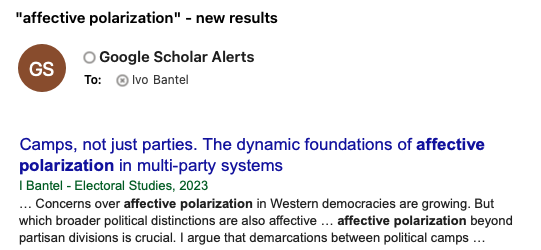
We often consider affective polarization (AP) in party-based terms. I argue AP goes beyond partisanship-based rejection: camp divides overlay partisan demarcations. Yet, they aren't always affectively charged – their affective relevance varies with political context (2/7)

🚨 My first paper is out: http://bit.ly/Bantel_ElSt (open access
@ElectoralStdies)

❓Which divides underlie partisan #AffectivePolarization (AP)? Does their relevance vary?

🧵about camp divides, context factors & AP as democratic defence mechanism (a.k.a. mandatory 🚨🧵😉) (1/7)
We are the Department of Political Science at the University of Zurich. Glad to be here!

https://ipz.uzh.ch/

The collapse of Twitter is a system breakdown. Mastodon and the fediverse represent something different: _system change_. From for-profit "Big Tech" to nonprofit, open source, community-owned public spaces.

System change is always harder than you think. It always incurs short-term costs, with hoped for long-term benefits.

The next few weeks will be really tough for the fediverse. Stick around, vibe with it, and you just might help us put a huge part of the web back in community hands. <3

#Introduction #polsci

I study citizens and parties, looking at political conflicts around democracy, immigration & party competition more broadly. Recently, I've also looked into gender & digital politics. I am enthusiastic about 'classical' as well as text-as-data & computational methods

I plan to post about social science, methods, central-eastern europe & the occasional outrage

I work as a tenure-track assistant professor for Comparative Politics at Viadrina University in Frankfurt (Oder).