 Nanoraptor
The Ides of Mac.


| Web | https://andreask.cs.illinois.edu/aboutme/ |
| Github | https://github.com/inducer/ |
| Arxiv | http://arxiv.org/a/klockner_a_1 |

Kloeckner et al., (2026). modepy: Basis Functions, Interpolation, and Quadrature (not just) for Finite Elements. Journal of Open Source Software, 11(117), 9294, https://doi.org/10.21105/joss.09294
Next semester I will teach a very experimental class called "Build your own Proof Assistant," in which we come together as a class to build a proof assistant from scratch, targeting some specific set of users (I'm thinking about making it a proof assistant for educational purposes). In doing so we will learn about every piece of the proof assistant, from the foundations to the automation to the interface.
Worst case we learn a lot. Best case we build something useful and get to write a paper about it too.
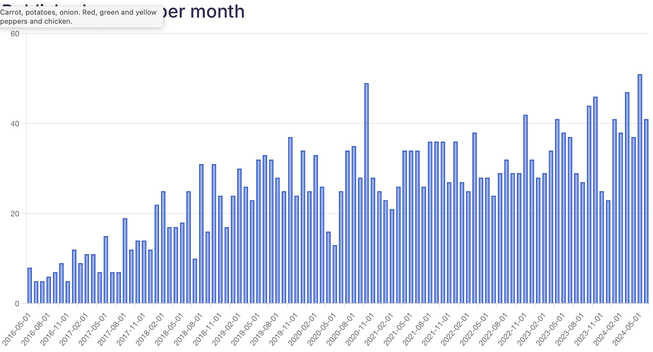
I was just happy to see that @joss passed 2500 published papers sometime in the last couple of weeks!
This is a nice demonstration of volunteer-run diamond open access succeeding, over about 8 years now.
And we seem to be accelerating, with a bunch of new editors.
Accepted papers per month for this year:
Jan 41
Feb 38
Mar 47
Apr 37
May 51 (a new record for a month!)
Jun 41 (so far)
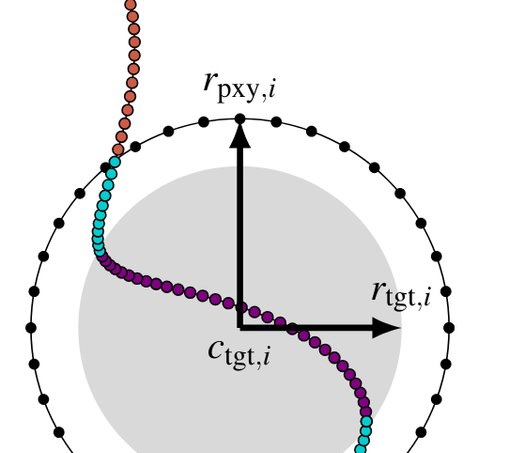

We construct and analyze a hierarchical direct solver for linear systems arising from the discretization of boundary integral equations using the Quadrature by Expansion (QBX) method. Our scheme builds on the existing theory of Hierarchical Semi-Separable (HSS) matrix operators that contain low-rank off-diagonal submatrices. We use proxy-based approximations of the far-field interactions and the Interpolative Decomposition (ID) to construct compressed HSS operators that are used as fast direct solvers for the original system. We describe a number of modifications to the standard HSS framework that enable compatibility with the QBX family of discretization methods. We establish an error model for the direct solver that is based on a multipole expansion of the QBX-mediated proxy interactions and standard estimates for the ID. Based on these theoretical results, we develop an automatic approach for setting scheme parameters based on user-provided error tolerances. The resulting solver seamlessly generalizes across two- and tree-dimensional problems and achieves state-of-the-art asymptotic scaling. We conclude with numerical experiments that support the theoretical expectations for the error and computational cost of the direct solver.
 Sohan Murthy
 JOSS
JOSS OpenStreetMap Ops Team
 Talia Ringer
 Electronic Frontier Foundation
 Ian Rogers
 Daniel S. Katz