Herman Wasserman

@hwasser
100 Followers
99 Following
15 Posts
Head: Department of Journalism, Stellenbosch University.
Disinformation in the Global South, media ethics, media and democracy. Opinions my own. www.media-analysis.co.za
We at
@StelliesJourn are delighted to welcome on board @_SeanJacobs, faculty member at @TheNewSchool and founder of @africasacountry,, as Extraordinary Professor in our department. We look forward to exciting collaborations.
https://newschool.edu/international-affairs/faculty/sean-jacobs/

Sean Jacobs | The New School

Sean Jacobs is associate professor of international affairs at the Julien J. Studley Graduate Programs in International Affairs at The New School. He is founder

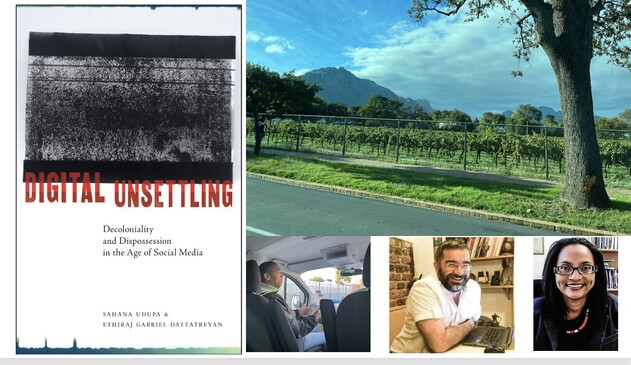
Digital Unsettling Book Launch happening tomorrow 30 Mar '23 @ Stellenbosch Institute for Advanced Study, South Africa. @sakaerka @radionerd76 will be on the panel. @GabrielDattatre @hwasser @NYUpress

Research I did with Tanja Bosch shows that despite tabloid newspapers' reputation as sensationalist, South Africa's Daily Sun's reporting on COVID-19 was contextually relevant and informative.

https://theconversation.com/tabloid-newspapers-are-seen-as-sensationalist-but-south-africas-daily-sun-flipped-that-script-during-covid-19-199911

Tabloid newspapers are seen as sensationalist - but South Africa's Daily Sun flipped that script during COVID-19

The newspaper confounded critics with its contextually relevant and informative stories.

The Conversation
How did South African cartoonists depict Covid-19?
Marina Joubert and I collected all cartoons appearing in SA news media during 2020 and analysed those referring to the virus, lockdown and social distancing. Our article out now (50 downloads free):
https://www.tandfonline.com/doi/full/10.1080/17512786.2023.2174578
Covid-19 in the Mass Media Through the Lens of South African Editorial Cartoons: An Exploratory Study

This study explored the main themes present in South African editorial cartoons related to Covid-19 published in 2020 to examine how they portrayed the societal discourse around the pandemic. Our d...

Taylor & Francis
Really surprised to hear Rodriguez' "Crucify your Mind" in the final episode of the excellent series "The English". First time that I can recall that his music made it onto a mainstream soundtrack. Wonder if the documentary "Searching for Sugarman" might have played a role?
How did South African tabloids cover the Covid-19 pandemic? New article out by myself and Tanja Bosch in Media, Culture and Society: https://journals.sagepub.com/doi/10.1177/01634437221140514
“Mediocrity was a low bar, but, in a matter of months, Musk sunk under it.”♦ Is This the End of Elon Musk’s Twitter Odyssey? https://www.newyorker.com/culture/infinite-scroll/is-this-the-end-of-elon-musks-twitter-odyssey

Many of the journalists Elon suspended today on Twitter are here on #Mastodon. Please follow and boost:

Drew Harwell, Washington Post
@drewharwell

Donie O’Sullivan, CNN
@donieosullivan

Steve Herman, VOA
@w7voa

Micah Lee, Intercept
@micahflee

Tony Webster
@tony

Matt Binder, Mashable
@MattBinder

#freepress #journalism #journalists #news

How effective are Chinese media in shaping audiences’ attitudes towards China? Findings from our survey in Kenya, Nigeria, and South Africa published today,(open access) https://www.degruyter.com/document/doi/10.1515/omgc-2022-0047/html
How effective are Chinese media in shaping audiences’ attitudes towards China? A survey analysis in Kenya, Nigeria, and South Africa

Purpose This paper measures how often audiences in Kenya, Nigeria and South Africa consume Chinese media, and investigates whether a positive relationship exists between the consumption of English language Chinese media and attitudes towards China. Method We analyze three waves of survey data collected in 2017/2018, 2020 and 2021 ( N  = 5876) in Kenya, Nigeria, and South Africa. Findings We show that, while Chinese State-owned news media have a growing but limited following, the minority of media users who report getting news from Chinese media have better attitudes towards China than those who don’t. Implications Our findings suggest that Beijing’s external communication activities might have the potential to fulfil Beijing’s goal of improving the country’s image overseas, provided that media reached a wider audience. Value The paper overcomes the limitations of previous studies on the reception of Chinese external communication practices in Africa (i.e., small sample sizes, failure to differentiate between increased presence and increased impact, and use of indirect rather direct measures of media use to infer possible effects on public opinion).

De Gruyter
Thoughts and prayers. theguardian.com/technology/202