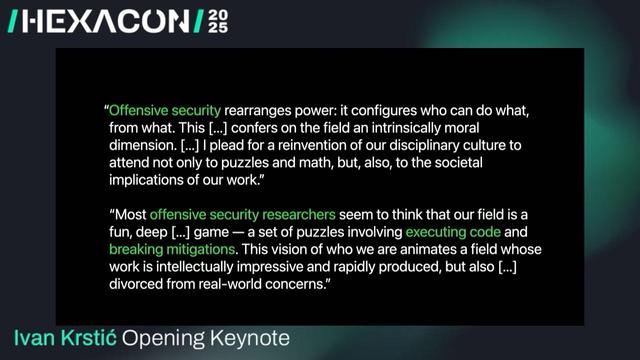
“The Moral Character of Offensive Security Work,” from Ivan Krstić:

Security, privacy, and tech policy at UCSD.
“[U]niquely among all government employees, lie[s] outside the scope of [the government speech] doctrine; […] stand[s] alone on a First Amendment pedestal, free to say what [he] please[s], no matter what [his] government employers, including even the State Legislature, think about it.”
Profile photo: Nox the tiercel peregrine, Cal Falcons class of '24, photographed by Billy Thein (California Raptor Center).
| Website | https://www.cs.utexas.edu/~hovav/ |
| Backdoored compiler attack idea | Karger and Schell, Multics security evaluation, 1974 |

UPDATE March 20 2025: The architecture is not being dropped for now after all. See the newer article for details. The next set of images will drop RISC-V support. The builder is currently still going but within the next few days it will stop, and the repositories will stay in place but frozen. Nothing will change in packaging (the build profile will remain, template support where present will remain, cross-toolchains will remain) but there will be no more updates to the repo for the foreseeable future.
Hot take: for the owner of the Mushroom House to let it fall into ruin is an act of cultural vandalism.
https://esotericsurvey.blogspot.com/2025/01/bell-pavillion-revisited.html

LLVM just keeps getting better and better at optimizing gnarly bitmanip code 🥰
Moritz Schneider, Daniele Lain, Ivan Puddu, Nicolas Dutly, and Srdjan Capkun, “Breaking Bad: How Compilers Break Constant-Time~Implementations,” manuscript, Oct. 2024. Online: https://arxiv.org/abs/2410.13489


The implementations of most hardened cryptographic libraries use defensive programming techniques for side-channel resistance. These techniques are usually specified as guidelines to developers on specific code patterns to use or avoid. Examples include performing arithmetic operations to choose between two variables instead of executing a secret-dependent branch. However, such techniques are only meaningful if they persist across compilation. In this paper, we investigate how optimizations used by modern compilers break the protections introduced by defensive programming techniques. Specifically, how compilers break high-level constant-time implementations used to mitigate timing side-channel attacks. We run a large-scale experiment to see if such compiler-induced issues manifest in state-of-the-art cryptographic libraries. We develop a tool that can profile virtually any architecture, and we use it to run trace-based dynamic analysis on 44,604 different targets. Particularly, we focus on the most widely deployed cryptographic libraries, which aim to provide side-channel resistance. We are able to evaluate whether their claims hold across various CPU architectures, including x86-64, x86-i386, armv7, aarch64, RISC-V, and MIPS-32. Our large-scale study reveals that several compiler-induced secret-dependent operations occur within some of the most highly regarded hardened cryptographic libraries. To the best of our knowledge, such findings represent the first time these issues have been observed in the wild. One of the key takeaways of this paper is that the state-of-the-art defensive programming techniques employed for side-channel resistance are still inadequate, incomplete, and bound to fail when paired with the optimizations that compilers continuously introduce.
At what point do you decide that this ( (A << (32-n)) | (B >>> n) ) ==> EXTR A, B, n peephole optimization just isn’t worth it?


https://bugs.webkit.org/show_bug.cgi?id=227171 Patch by Yijia Huang <[email protected]> on 2021-07-01 Reviewed by Robin Morisset. This patch includes two modifications: 1. Introduce...

Hey CISA/FBI/FVEY:
The correct citation for the paper “On the Effectiveness of Address-Space Randomization” isn’t
²⁹ Boneh, Dan. “On the effectiveness of address-space randomization.” ACM Digital Library. October 25, 2004. https://dl.acm.org/doi/10.1145/1030083.1030124.
It’s
²⁹ Hovav Shacham, Matthew Page, Ben Pfaff, Eu-Jin Goh, Nagendra Modadugu, and Dan Boneh. On the effectiveness of address-space randomization. In Birgit Pfitzmann and Peng Liu, editors, Proceedings of CCS 2004, pages 298–307. ACM Press, October 2004.
You skipped over five students’ names to list only the one famous professor!
( CC: @boblord )