Call for papers: Achieving carbon neutrality in China’s power sector
You are invited to submit your work to the special issue organizing with
#MichaelDavidson, #JiangLin, and #ZhaohongBie in The Electricity Journal.

| Web | https://drganghe.github.io |
| GoogleScholar | https://scholar.google.com/citations?user=vf90AuEAAAAJ&hl=en |
| Deep Policy Lab | https://deeppolicylab.github.io/ |
Call for papers: Achieving carbon neutrality in China’s power sector
You are invited to submit your work to the special issue organizing with
#MichaelDavidson, #JiangLin, and #ZhaohongBie in The Electricity Journal.
Global PV has achieved a net GHG mitigation of 1.29 Gt CO2e from 2009–2019, 1.97 Gt from PV generation minus 0.68 Gt of life-cycle emissions along manufacturing.
If prioritizing manufacturing at lower-carbon regions, and PV installations in carbon-intensive nations, the highest net GHG mitigation among future manufacturing-installation-scenarios to meet 40% global power demand in 2060 is as high as 204.7 Gt from 2020–2060.

Solar photovoltaic energy has the greatest potential to mitigate greenhouse gas emissions if manufactured in North America and Europe but deployed in Africa, Asia, and the Middle East, according to a spatialized-dynamic life-cycle-analysis approach
Climate change impacts energy supply, it impacts energy demand too, what about supply and demand balance?
Our paper published in Nature Energy finds that climate change is projected to reduce the supply-demand match (SDM) of wind or solar energy in up to 32% and 44% of non-Antarctic land area, respectively, by the end of this century.
Paper: https://www.nature.com/articles/s41560-023-01304-w
PDF: https://www.nature.com/articles/s41560-023-01304-w.pdf
Code: https://doi.org/10.5281/zenodo.6989075
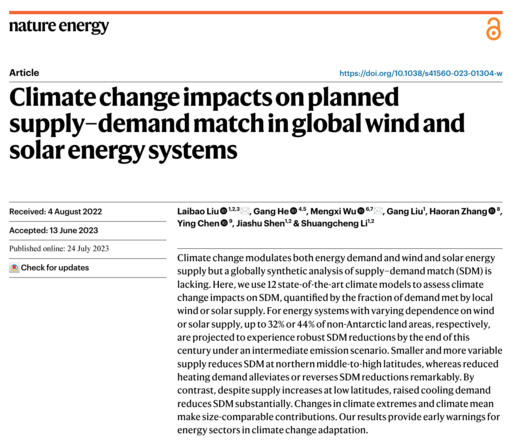

Energy demand patterns will shift under climate change, but so will generated electricity, particularly as the wind and solar power supply increases. Here the authors model the impacts of climate change on future supply–demand match, highlighting the importance of changes in climate variability.
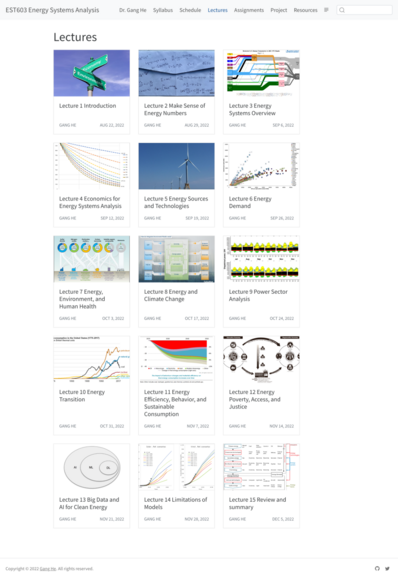
I finally completed a semester's effort to open my "Energy Systems Analysis" class.
15 Lectures:
https://drganghe.github.io/est603-energy-systems-analysis-2022-fall/lectures.html
Covering #overview , #energyeconomics , #energytechnologies , #energyandclimate , #powersystems , #energytransition , #energyefficiency , #energyaccess , #energyjustice , #AIandbigdataforcleanenergy, #limitations ...
5 Real-world assignments:
https://drganghe.github.io/est603-energy-systems-analysis-2022-fall/assignments.html
And more:
https://drganghe.github.io/est603-energy-systems-analysis-2022-fall/lectures.html
Feel free to reuse any material, copy rights belong to cited authors.
Hi Everyone … mastodon newbie here and #riptwitter refugee.
Clean energy, energy justice and climate researcher. Professor at #universityofcalifornia
Data cleaning in hard. It's a skill that can truly only be developed through practice. I thought it'd be fun to show the world an example "practice session" where I clean some gasoline price data I need for a project I'm working on. These data are in the form of 16 Excel files downloaded from eia.gov

The Cost of Going Solo in Solar
https://www.newsecuritybeat.org/2022/11/cost-solo-solar/
@jhelvy , #MichaelDavidson, and I summarize our recent Nature paper:
https://www.nature.com/articles/s41586-022-05316-6
There is a Chinese idiom that has a close corollary in the English-speaking world: 同舟共济 (tóng zhōu gòng jì), which roughly translates to “same boat, work together.” Time is not on our side. Countries like the U.S. and China must find a way to address their geopolitical differences while simultaneously working together to lower the cost of LCETs.
Post a few lectures recently added:
Lecture 8: Energy and climate change policy
Focusing on explaining the evolution of thoughts from mitigation wedges, to the Mckinsey cost curve, to best practices, to the social cost of carbon.
https://drganghe.github.io/est603-energy-systems-analysis-2022-fall/lectures/lecture8/index.html
Lecture 9: Power sector analysis
Keywords: electrification and decarbonization, featuring the open models that simulate the pathways.
https://drganghe.github.io/est603-energy-systems-analysis-2022-fall/lectures/lecture9/index.html

 Noelle Eckley Selin
 Dan Kammen
 John Helveston, Ph.D.