Missing at Random (MAR) means that the probability of data being missing is purely random after conditioning on observed data (e.g., in multiple imputation). That is to say, it depends only on the observed data, not the missing values themselves.


Missing at Random (MAR) means that the probability of data being missing is purely random after conditioning on observed data (e.g., in multiple imputation). That is to say, it depends only on the observed data, not the missing values themselves.
Just wrapped up today's lecture on missing data! Covered item- and construct-level missingness, detection, mechanisms, analysis (using Welch's t-tests with missingness indicators), solutions, and a theory intro to multiple imputation (since #jamovi lacks modules).

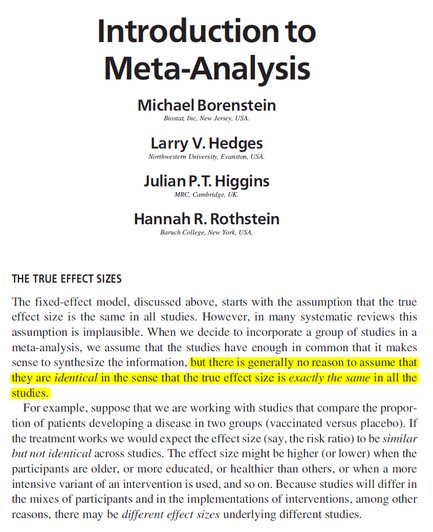
@wviechtb Yes, I agree, and I think the information we've provided is complementary. If the goal is to make inferences about only the specific set of studies included in the meta-analysis, a fixed-effects model can be used, even if the studies are not necessarily estimating a common effect size. However, I understand this is not usually the main aim in most meta-analyses, where a random-effects approach would better suit the type of inference needed.
Il n'y a pas de règle sans exception
Don't use a significance test of heterogeneity (eg Cochran's Q) to choose between fixed or random effects meta-analysis. If studies estimate a single common effect size, use fixed effects. If studies differ in populations, measures, or protocols, opt for random effects.