Missing at Random (MAR) means that the probability of data being missing is purely random after conditioning on observed data (e.g., in multiple imputation). That is to say, it depends only on the observed data, not the missing values themselves.


Missing at Random (MAR) means that the probability of data being missing is purely random after conditioning on observed data (e.g., in multiple imputation). That is to say, it depends only on the observed data, not the missing values themselves.
Just wrapped up today's lecture on missing data! Covered item- and construct-level missingness, detection, mechanisms, analysis (using Welch's t-tests with missingness indicators), solutions, and a theory intro to multiple imputation (since #jamovi lacks modules).

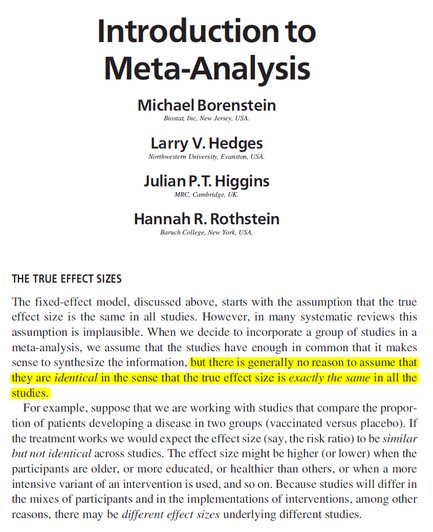
Don't use a significance test of heterogeneity (eg Cochran's Q) to choose between fixed or random effects meta-analysis. If studies estimate a single common effect size, use fixed effects. If studies differ in populations, measures, or protocols, opt for random effects.

The Zeigarnik effect suggests we remember unfinished tasks best, creating a mental burden. Case in point: that email I didn’t reply to? It’s been living rent-free in my head for 8 months. If a colleague doesn’t reply, take comfort—they might be thinking of you daily.
Predictive Mean Matching is a multiple imputation method that fills missing data using values already in your dataset with similar predicted values. This ensures imputations are realistic and consistent with the original data, making it ideal for most missing data cases.