 Erik Sandblom 🌻
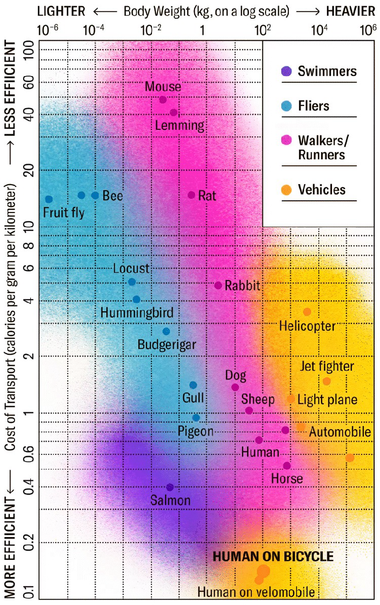
Today is #worldbicycleday and we celebrate this humble but fabulous invention. Scientific American has updated the graph of the efficiency of animal locomotion, showing that a human on a bike is the most efficient, even more so than salmon.

| Website | https://www.giorginolab.it |
| Google Scholar | https://scholar.google.it/citations?user=6uFYeoAAAAAJ&hl=it |
| GitHub | https://github.com/tonigi |
Today is #worldbicycleday and we celebrate this humble but fabulous invention. Scientific American has updated the graph of the efficiency of animal locomotion, showing that a human on a bike is the most efficient, even more so than salmon.
Genuinely wild how much scientists will rail against any notion of subjectivity in their analyses as if they are a machine diligently testing every possible outcome with complete indifference
My rationalist in Christ, how did you choose which data point to examine more carefully or which parameters to test first?
Mathematicians warn of AI threats to profession as industry encroaches
International Mathematical Union endorses warning about tech industry influence.
https://arstechnica.com/tech-policy/2026/06/mathematicians-warn-of-ai-threats-to-profession-as-industry-encroaches/?utm_brand=arstechnica&utm_social-type=owned&utm_source=mastodon&utm_medium=social

... and two more, to get
- Snakemake workflow registrations: https://w3id.org/np/RApMWbZ0ixGj88tPB4cEamKJQuQTZ5Dxpjh1a5BWteTdE
- or Snakemake report registrations: https://w3id.org/np/RA8rPcBcreaZF01eA6Xeh_wwqQcM-Nz7xQyKbLhRHkCXA
just to make a start. Pretty crude, but a start towards better software provenance.
Today someone (who is not on Mastodon) released a collection of more than 570 distinct operating systems, pre-installed with VM configurations for the 250+ different platforms, going back all the way to 1948.
Now, I have to admit I'm posting this without trying it myself, as I'm running low on disk space on this machine.
Because the full download is 121GB (174GB unzipped!). There is also a lighter version at 14GB that will download stuff on demand.
Seen near Holborn Station, on the route of the Unite the Kingdom rally. By the artist Frank Riot.
The poster says it better than most speeches:
When the scapegoats are gone, the borders are fortified, and the hatred has done its damage, the cost of living will still rise, the NHS will still be dying, and corporate vultures will still be picking our lives apart.
Who will they blame then?
What will they have gained?
A badge for barbarism against a backdrop of decay.

 Raf
Raf erl
erl Ars Technica
 geekysteven
 Carme Pont
 JA Westenberg
 Christian Meesters
 CONFIG.SYS: LOADHIGH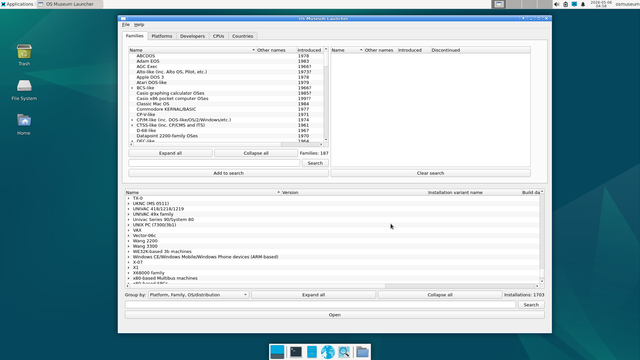
 Street Art Utopia