Jeremiah McCall

358 Followers
184 Following
170 Posts
He/him; PhD; History and video games (historical game studies); historian and author (ancient history); high school history teacher and instructional designer (20+ years); author of Gaming the Past and a bunch of books on Roman history for general readers; Musings on history, education, video games and their intersections. Big fan of Buddhist compassion. [email protected]
@gamingthepast.bsky.social
Websitehttps://gamingthepast.net/
Gaming the Past 2.0https://www.routledge.com/Gaming-the-Past-Using-Video-Games-to-Teach-Secondary-History/McCall/p/book/9781032223483
Historical Problem Spacehttp://gamestudies.org/2003/articles/mccall
Favorite Hashtags#GamingthePastInEd #HistoricalGameStudies #HistoricalProblemSpace #AncientWorldHistory

Beginning with my first public writing on historical games in history education, I adopted the term "defensible models" (I don't think I called it models in 2010, but that came). This is a VERY VERY off-the-top-of-my-head rough and unpolished draft exploring defensible models of a game's historical (and agential) problem spaces as an effective criterion instead of "historical accuracy".

I have entered in orange the areas to develop thanks to commenters -- haven't had time to revise anything yet. Since pulling defensible models out of my books and articles and laying it out seems to be helpful, I will pick at this. If enough of you (the most vocal 🙂 ) wish, get it into article state at some point. Otherwise I'll just let it sit on Gamingthepast.

In short, constructive criticism most welcome! Even just impressions. Unless they're just mean. Who needs that?
https://gamingthepast.net/2026/03/23/considering-the-evidence-based-validity-of-a-historical-game-defensible-models-and-why-we-should-care/

Considering the Evidence-Based Validity of a Historical Game: Defensible Models and Why We Should Care

Disclaimer: I decided to post this immediately on finishing and I wrote it quickly. It is a discussion piece, not even remotely a polished essay. Would love your feedback. We Should Move Beyond Eva…

Gaming the Past
Designing Historical Games for Classrooms: A Practical Guide for Educators

Designing Historical Games for Classrooms: A Practical Guide for Educators is a complete introductory guide for designing analog and interactive choice-based historical games for history classes. It is designed to support educators who wants to design games or who want to guide and assess student game-making projects in history class. Chapters lead the educator-designer through a range of topics, including the core features of historical games and simulations; the educational power of using hist

Routledge & CRC Press

Imagine a computer like a PDP-11 but with more than 3 billion SP4T switches. The switches are various combinations of 'magic' and 'more magic'

the authors of the code are dead, there are no comments except for old code, and sometimes the comments run anyway

and it's wet

this is biology.

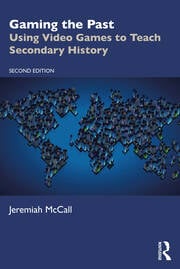
BTW friends interested in historical game mechanics & how historical games present history (an important area in Historical Game Studies), Gaming the Past 1st Edition (2011) & Gaming the Past 2nd Edition, definitely Historical Game Studies books even though the primary audience is educators. https://www.routledge.com/Gaming-the-Past-Using-Video-Games-to-Teach-Secondary-History/McCall/p/book/9781032223483

Is it shameless self-promotion when you point our your own works because they are seemingly unique, people seem to find them helpful, and few are aware of them? Gosh I hope not (truly). Makes me nervous each time I post a post like the last one. 😱
Just in case you forgot I have impostor syndrome too

Gaming the Past: Using Video Games to Teach Secondary History

Gaming the Past is a complete handbook to help pre-service teachers, current teachers, and teacher educators use historical video games in their classes to develop critical thinking skills. It focuses on practical information and specific examples for integrating critical thinking activities and assessments using video games into classes. Chapters cover the core parts of planning, designing, and implementing lessons and units based on historical video games. Topics include: Talking to administ

Routledge & CRC Press

This standard allows for inaccurate discrete details. It even allows some parts of the model might be less defensible. But since historical (agential) games are about agents acting within systems, this standard seems to me to get at heart of evaluating game's modeling of evidence and "reality"

Now, as to why you might care about a historical game's defensibility (it's a debated issue in HGS), I will leave that until someone asks, because I have to get back to my email pile 🙂. Would love to know what you think about this standard, or anything related, as always 2/

Hi! Some know I use phrase/standard "Does this historical game have defensible models about the past?" with the Historical Problem Space framework. With (newer) Agential Problem Space framework one can ask "Does this agential game have defensible models about the world?". I use that instead of "is the game (historically) accurate?".

Since I've deepened "defensible models" since posing the term in GTP 1st Ed. (2011) up to the upcoming Designing Historical Games, just wanted to run through my current understanding. I've pinned it to the historical/agential problem space of a game, because historical games present problem spaces. So ... A game has defensible models to the extent evidence supports (and here the repeated THIS means "the game"):

"Some agents in a place like THIS, had goals like THIS, in a world system like THIS, and were able to make action-choices like THIS."

1/

Just did a BSky thread on criteria for historical boardgames I use in my classes and my go-to games. Too long to reproduce, but you might find it interesting https://bsky.app/profile/gamingthepast.bsky.social/post/3mhij64lpfc2b
Jeremiah McCall (he/him) (@gamingthepast.bsky.social)

I have to start getting shorter in my answers so you won't think I've forgotten @cyrusriahi.bsky.social. Video games I did: https://bsky.app/profile/gamingthepast.bsky.social/post/3mgkd6aatge2r Now let's talk useful board games. For BGs the criteria are similar to VG. Challenge, connection to topics. 🧵 1/ #gamingthepast #AncientBluesky 🗃️ [contains quote post or other embedded content]

Bluesky Social

Becoming Saint now available on Android. https://play.google.com/store/apps/details?id=com.OpenLab.BecomingSaint

I admit it's an acquired taste & hecka quirky, bt there's just nothing like this topically in historical games. Can't guarantee you'll like it, bt I'm charmed by the effort & want to support devs. I suspect $4.99 Android (+Apple) will be a better match

Becoming Saint - Apps on Google Play

A medieval strategy game of faith, sins, penitence & conquest

Everything seems to be moving for April proofs, early May index, and (early) August for printing of _Designing Historical Games for the Classroom: A Practical Guide for Educators_. So excited!!!!
My colleague-friend Volodymyr Kramskyi
https://h-visnyk.com.ua/index.php/home/article/view/470 found HPS up through 2024 to be useful enough to discuss in his recent article (it's in English BTW). I'm honored, Vlad!
The Ancient World in Digital Games: Themes, Trends and Challenges in Current Research | Вісник гуманітарних наук