 Yohan John 🤖🧠
Key events in the discovery of inhibition.
Fishell & Rudy 2011.


| Website | https://www.urmc.rochester.edu/labs/garcea.aspx |
Key events in the discovery of inhibition.
Fishell & Rudy 2011.

TL;DR This article discusses how monkey dorsolateral prefrontal cortex represents abstract visual sequences during a no-report task. The study found that monkey DLPFC monitors abstract visual sequential information potentially with different dynamics in the two hemispheres.
Linked by @DesrochersLab (13⭐)
Monitoring sequential information is an essential component of our daily lives. Many of these sequences are abstract, in that they do not depend on the individual stimuli, but do depend on an ordered set of rules (e.g., chop then stir when cooking). Despite the ubiquity and utility of abstract sequential monitoring, little is known about its neural mechanisms. Human rostrolateral prefrontal cortex (RLPFC) exhibits specific increases in neural activity (i.e., “ramping”) during abstract sequences. Monkey dorsolateral prefrontal cortex (DLPFC) has been shown to represent sequential information in motor (not abstract) sequence tasks, and contains a subregion, area 46, with homologous functional connectivity to human RLPFC.

Monitoring sequential information is an essential component of our daily lives. Many of these sequences are abstract, in that they do not depend on the individual stimuli, but do depend on an ordered set of rules (e.g., chop then stir when cooking). Despite the ubiquity and utility of abstract sequential monitoring, little is known about its neural mechanisms. Human rostrolateral prefrontal cortex (RLPFC) exhibits specific increases in neural activity (i.e., “ramping”) during abstract sequences. Monkey dorsolateral prefrontal cortex (DLPFC) has been shown to represent sequential information in motor (not abstract) sequence tasks, and contains a subregion, area 46, with homologous functional connectivity to human RLPFC. To test the prediction that area 46 may represent abstract sequence information, and do so with parallel dynamics to those found in humans, we conducted functional magnetic resonance imaging (fMRI) in three male monkeys. When monkeys performed no-report abstract sequence viewing, we found that left and right area 46 responded to abstract sequential changes. Interestingly, responses to rule and number changes overlapped in right area 46 and left area 46 exhibited responses to abstract sequence rules with changes in ramping activation, similar to that observed in humans. Together, these results indicate that monkey DLPFC monitors abstract visual sequential information, potentially with a preference for different dynamics in the two hemispheres. More generally, these results show that abstract sequences are represented in functionally homologous regions across monkeys and humans. SIGNIFICANCE STATEMENT Daily, we complete sequences that are “abstract” because they depend on an ordered set of rules (e.g., chop then stir when cooking) rather than the identity of individual items. Little is known about how the brain tracks, or monitors, this abstract sequential information. Based on previous human work showing abstract sequence related dynamics in an analogous area, we tested whether monkey dorsolateral prefrontal cortex (DLPFC), specifically area 46, represents abstract sequential information using awake monkey functional magnetic resonance imaging (fMRI). We found that area 46 responded to abstract sequence changes, with a preference for more general responses on the right and dynamics similar to humans on the left. These results suggest that abstract sequences are represented in functionally homologous regions across monkeys and humans.
Network Neuroscience
Creativity at Rest: Exploring Functional Network Connectivity of Creative Experts
https://direct.mit.edu/netn/article-abstract/doi/10.1162/netn_a_00317/115621/Creativity-at-Rest-Exploring-Functional-Network/

Abstract. The neuroscience of creativity seeks to disentangle the complex brain processes that underpin the generation of novel ideas. Neuroimaging studies of functional connectivity, particularly functional magnetic resonance imaging (fMRI), have revealed individual differences in brain network organization associated with creative ability; however, much of the extant research is limited to laboratory-based divergent thinking measures. To overcome these limitations, we compare functional brain connectivity in a cohort of creative experts (n = 29) and controls (n = 25) and examine links with creative behavior. First, we replicate prior findings showing reduced connectivity in visual cortex related to higher creative performance. Second, we examine whether this result is driven by integrated or segregated connectivity. Third, we examine associations between functional connectivity and vivid distal simulation separately in creative experts and controls. In accordance with past work, our results show reduced connectivity within primary visual cortex in creative experts at rest. Additionally, we observe a negative association between distal simulation vividness and connectivity to the lateral visual cortex in creative experts. Taken together, these results highlight connectivity profiles of highly creative people and suggest that creative thinking may be related to, though not fully redundant with, the ability to vividly imagine the future.Author Summary. This study sought to uncover the neurocognitive basis of creativity by comparing brain connectivity in a cohort of creative experts and controls. Using graph theory methods, we replicate past work showing reduced connectivity to the primary visual cortex in highly creative people. Additionally, we observed a negative association between vividness of distal future simulation and connectivity to the lateral visual cortex in creative experts. Taken together, these findings highlight connectivity profiles of highly creative people and suggest that creative thinking may be related to the ability to vividly imagine events in the distant future.
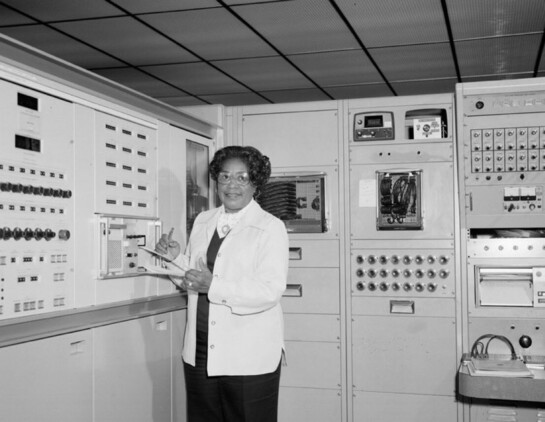
Mathematician and aerospace engineer Mary Jackson was born #OTD in 1921. She worked at the National Advisory Committee for Aeronautics until it was succeeded by NASA in 1958. Jackson then became the first Black woman to work as a NASA engineer.
Bio: https://www.nasa.gov/content/mary-w-jackson-biography
Image: NASA
nature medicine
Beautiful work by @yetianmed
@AndrewZalesky
@DrBreaky
Heterogeneous aging across multiple organ systems and prediction of chronic disease and mortality
https://www.nature.com/articles/s41591-023-02296-6

Organ-specific aging clocks for multiple brain and body systems show that the biological age of one organ system selectively influences the aging of multiple other systems via characteristic aging pathways.
Machine learning can easily produce false positives when the test set is wrongly used. Just et al in
@NatureHumBehav suggested that ML can identify suicidal ideation extremely well from fMRI and we were skeptical. Today retraction and our analysis of what went wrong came out.
Here is the retracted paper: https://nature.com/articles/s41562-017-0234-y and here is our refutation https://nature.com/articles/s41562-023-01560-6. If true, the paper's approach could revolutionize psychiatric approaches to suicide.
So what went wrong? The authors apparently used the test data to select features. Obvious mistake. A reminder for everyone into ML: never use the test set for *anything* but testing. Only practical way to do so in medicine? Lock away the test set till algorithm is registered.
Side note: it took 3 years to go through the process of demonstrating that the paper went wrong. Journals need procedures to accelerate this. Also, all the good things of this were by
@tdverstynen
RT @dora_hermes
Our new paper on the speed of cortico-cortical signaling just came out today in @NatureNeuro
https://www.nature.com/articles/s41593-023-01272-0
With @DorienBlooijs @Kai_J_Miller and collaboration with @UMCUtrecht

This study mapped the developmental trajectory of transmission speed in the human brain by using electrical pulses and intracranial recordings. The authors found that these pulses travel with increasing speeds up to at least the age of 30.
Be like @frankgarcea
He knows how to rock.
Pavlov's Dogz at the 30th Annual Cognitive Neuroscience Society meeting. Saturday, March 25, 9:30pm

The authors describe the first electrophysiological technique for intraoperative localization and protection of the TCT in both asleep and awake craniotomies with tractographic validation, while avoiding the collision paradigm. None of the above paradigms have been previously reported. More data are …
 JamieLarsH
 Links of the day
 CLaE
CLaE Robert McNees
 Konrad Kording
 Earl K. Miller
 Marcia Petyt