
Edwin Dalmaijer

669 Followers
331 Following
167 Posts

Cognitive neuroscientist with an interest in the development of individuals and populations. Also into statistics, machine learning, and Python. And cats.

Lecturer (AssProf) at Bristol
Postdoc at Cambridge
DPhil at Oxford
BSc at Utrecht (Netherlands)

Lab Websitehttps://www.dalmaijer.org
Python Eye-Trackinghttps://www.pygaze.org
GitHubhttps://github.com/esdalmaijer

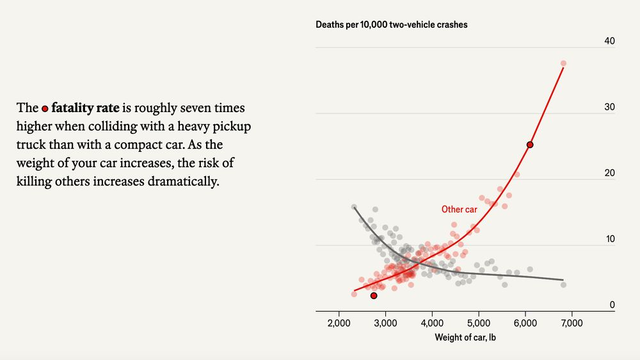
“this suggests that getting hit by an additional 1,000lbs of steel and aluminium—roughly the difference between a Toyota Camry and a Ford Explorer—boosts the likelihood of death by 66%.”

the economist publishes research on how US car bloat kills people

no paywall: https://archive.ph/faiXa
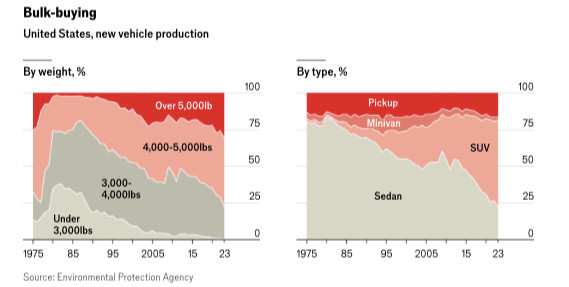
The Economist has published a deeply-researched story about car bloat -- and it's very, very damning.

"For every life that the heaviest 1% of SUVs and trucks save, there are more than a dozen lives lost in other vehicles."

Well worth your time: https://www.economist.com/interactive/united-states/2024/08/31/americans-love-affair-with-big-cars-is-killing-them

Americans’ love affair with big cars is killing them

New analysis shows that the heaviest vehicles kill more people than they save in crashes

The Economist
Hey #ECEM2024 people,
if anyone is on mastodon and up for a run in Maynooth let me know. I'll arrive there in 1h. Also, visit me at my Christmas poster. I will have some sample stimuli (i.e., cookies).

 My PhD has finally been validated and published on University of Bristol's repository
LINK: https://lnkd.in/drzfJS3U

"Understanding the Role and Utility of Philosophy of Science in Psychology and Beyond"

Huge thanks to the countless people who helped along the way - especially @fidlerfm and @stworg for their great feedback and discussion during the viva - and obviously my supervisors Marcus Munafo and James Ladyman.

LinkedIn

This link will take you to a page that’s not on LinkedIn

JOB JOB JOB - We are HIRING!

Postdoctoral researcher on our #metaresearch project on Distributed Peer Review with the Volkswagen Foundation

https://www.jobs.ac.uk/job/DII861/research-associate

Closes 7th of July. In person, fixed term (8 months), full time (but we're flexible).

You'll be part of University of Sheffield and @RoRInstitute, and supported to apply your experiment design, data analysis and visualisation skills to this fantastic research-on-research project

Please boost for reach

Research Associate at University of Sheffield

Looking for a new job opportunity in academia? Check out this job opening for a Research Associate on jobs.ac.uk!

Jobs.ac.uk

At the @spinoza Centre for Neuroimaging advanced technology collides with innovative neuro- and clinical science.

To celebrate the 10 year anniversary of the Spinoza Centre, world-leading experts will discuss innovations in 7 Tesla MRI technology, cognitive neuroscience and clinical sciences.

We are delighted to invite you to celebrate our 10th anniversary with us.

https://www.spinozacentre.nl/nieuws/symposium-10-year-anniversary-7t/

We're still new to Mastodon, so our profile is a WIP! What better time than #SIPS2024 to join the conversation? :)
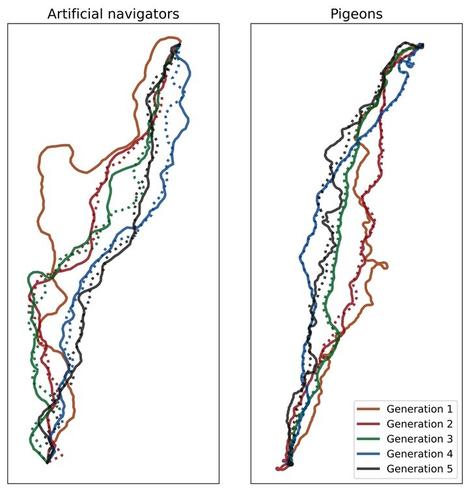
#HomingPigeons improve their route efficiency in consecutive generations, potentially through #SocialInteraction. @esdalmaijer uses artificial agents with a highly limited cognitive architecture to show that although their only "social" capacity is to seek proximity, their behavior matches that of #pigeons, and they show cumulative improvements in route efficiency #PLOSBiology https://plos.io/3X6NNOi
Cumulative route improvements spontaneously emerge in artificial navigators even in the absence of sophisticated communication or thought

Homing pigeons improve their route efficiency in consecutive generations, potentially through social interaction. This study uses artificial agents with a highly limited cognitive architecture to show that although their only "social" capacity is to seek proximity, their behavior matches that of pigeons, and they show cumulative improvements in route efficiency.

New paper! Pigeons incrementally improve their idiosyncratic paths between generations. Is this cumulative culture?

This paper shows cumulative improvements simply emerge if individuals know roughly where the goal is, seek social proximity, and memorise landmarks along the route. Naive agents learn routes from experienced ones. Crucially, naive agents err towards the goal, and thus bias each generation towards better efficiency.

Read it in @PLOSBiology: https://doi.org/10.1371/journal.pbio.3002644

Cumulative route improvements spontaneously emerge in artificial navigators even in the absence of sophisticated communication or thought

Homing pigeons improve their route efficiency in consecutive generations, potentially through social interaction. This study uses artificial agents with a highly limited cognitive architecture to show that although their only "social" capacity is to seek proximity, their behavior matches that of pigeons, and they show cumulative improvements in route efficiency.

Chamois now has all the standard features needed for regular reading experiments. We've tested it and are now using it in production with a TRACKPixx3 tracker. Data looks super clean.

https://github.com/tmalsburg/chamois

GitHub - tmalsburg/chamois: A simple Python app for running eye-tracking experiments on reading behaviour

A simple Python app for running eye-tracking experiments on reading behaviour - tmalsburg/chamois

GitHub