Margaret Maitland

644 Followers
95 Following
66 Posts

Today on #internationalwomensday I’m thinking about extraordinary women in antiquity & amazing women colleagues today ❤️

Next Friday @ 18:30 I’ll be speaking at UCL Institute of Archaeology & online about The ‘Qurna Queen’: Reassessing a 17th Dynasty Intact Royal Burial: https://www.friendsofpetrie.org.uk/wp/lectures/2023-24-lecture-series/

How did ancient Egyptian artefacts end up in UK museums?

Join us for a free online event next Tuesday February 6th: ‘Buying Power: British Archaeology & the Antiquities Market in Egypt & Sudan 1880–1939’ with broadcaster Samira Ahmed!

https://www.nms.ac.uk/exhibitions-events/online-event/national-museum-of-scotland/buying-power-british-archaeology-and-the-antiquities-market-in-egypt-and-sudan-1880-1939/

Buying Power: British Archaeology and the Antiquities Market in Egypt and Sudan 1880–1939

Where did the ancient Egyptian collections in National Museums Scotland come from? How did they get here? Join Dr Dan Potter to discover the untold stories behind these enduringly popular collections.

National Museums Scotland
📢 Join us for a free conference on archaeology & the antiquities trade in Egypt & Sudan on Friday February 16th at the National Museum of Scotland! The event is part of an AHRC-funded project led by Dan Potter & will feature talks by leading scholars Stephen Quirke, Alice Stevenson & more! https://www.nms.ac.uk/exhibitions-events/events/national-museum-of-scotland/buying-power-conference/
Buying Power Conference | National Museum of Scotland

Discover a diverse programme of exhibitions and events across National Museums Scotland's four museums.

National Museums Scotland

My article ”Networks of Inequality: Access to Water in Roman Pompeii” was published!

I'm actually quite excited about this. The article outlines a methodology to study health inequality in ancient urban context.

#Pompeii #archaeology #health #inequality #RomanEmpire #history

https://journal.caa-international.org/articles/10.5334/jcaa.116

Networks of Inequality: Access to Water in Roman Pompeii | Journal of Computer Applications in Archaeology

The Journal of Computer Applications in Archaeology (JCAA) is a peer-reviewed, open access, electronic journal, featuring papers in all the disciplines related to digital archaeology, including but not limited to 3D modelling, spatial analysis, remote sensing, geophysics, field recording techniques, databases, semantic web, statistics, data mining, simulation modelling, network analysis and digital reconstructions of the past. The journal welcomes papers reporting original research, as well as papers that critically reflect on the use and impact of digital technologies in archaeology.

Journal of Computer Applications in Archaeology

January 16th, 128 CE—the strategos of the Gynaecopolite nome writes to the strategos of the Oxyrhynchite nome #OTD #OnThisDay, saying that a certain Achilleus accused of harboring a fugitive from slavery (and likely wanted for trial) has gone missing himself.

https://papyri.info/ddbdp/p.oxy;12;1422

p.oxy.12.1422 = HGV P.Oxy. 12 1422 = Trismegistos 21829

It was great to end 2023 with the Art Newspaper announcing that its top news story of the year was an article about my research on an 'impossible' statue in our museum collection that led to the discovery of a previously unrecognised statue-type from ancient Egypt! Check out the story here: https://www.theartnewspaper.com/2023/04/21/kneeling-man-ancient-egypt-statue-riddle-solve-national-museums-scotland And my original publication here: https://formazioneericerca.museoegizio.it/en/pubblicazioni/deir-el-medina-en/
Riddle of ancient Egypt’s ‘impossible’ sculpture is finally solved—in Scotland

Pioneering research by a National Museums of Scotland curator finds statue reflects a village of eminent tomb-makers

The Art Newspaper - International art news and events
It was great to welcome to the National Museums Collection Centre researchers from the Fitzwilliam Museum at the University of Cambridge, Helen Strudwick & Julie Dawson, to study construction techniques used in ancient Egyptian coffins. This is the outer coffin of Amenhotepyin (c.754-656 BC), whose son Pakepu’s coffin is held in the Fitzwilliam Museum. Both were gifted to the Prince of Wales on his visit to Egypt in 1869.
#museums #museum #ancientegypt #egyptology #archaeology

Esna temple ceiling restoration complete! The colours of the reliefs and inscriptions in the building have been covered by a coating of dirt and soot for some 2000 years. Experts uncovered the in five-year project. #Egyptology

https://uni-tuebingen.de/en/university/news-and-publications/press-releases/press-releases/article/ancient-egyptian-temple-ceiling-restoration-complete/?fbclid=IwAR2t2mn7-GsHurpvLMTRc1Au2d6TJCTkliZDZ96bkYPLAns8BCs8c6yob5U_aem_AfrGfNBgZHUk1-cK0oM6BRU1p228wRw8f1vJsOT_bF6k8zHUlBJ73s0tSufIdK4Xccw

Before After

Ancient Egyptian temple ceiling restoration complete | University of Tübingen

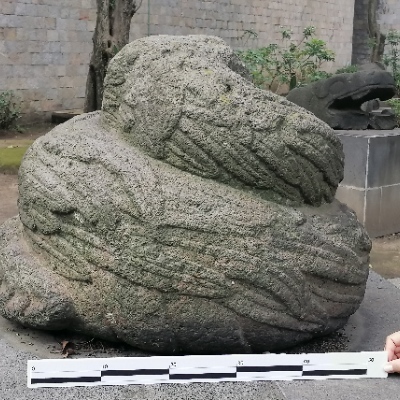
My small participation in an article published in Live Science about the snake head discovery recently announced by INAH.

https://www.livescience.com/archaeology/earthquake-reveals-giant-aztec-snakehead-beneath-mexico-city-university

#mexica #arqueologiamexicana #Tenochtitlan #sculpture #archaeodons

Earthquake reveals giant Aztec snakehead beneath Mexico City university

Researchers are conserving a rare snakehead from the Aztecs that still retains its painted colors from hundreds of years ago.

Live Science
“Egypt had an unusually powerful 'female king' 5,000 years ago, lavish tomb suggests: Excavations of the tomb of ancient Egyptian queen Meret-Neith reveal she was an influential figure with ‘unusually high levels of authority,’ but experts are divided about whether she actually reigned”: https://www.livescience.com/archaeology/ancient-egyptians/egypt-had-an-unusually-powerful-female-king-5000-years-ago-lavish-tomb-suggests
Egypt had an unusually powerful 'female king' 5,000 years ago, lavish tomb suggests

Excavations of the tomb of ancient Egyptian queen Meret-Neith reveal she was an influential figure with "unusually high levels of authority," but experts are divided about whether she actually reigned.

Live Science