NVIDIA reports Q1 FY2027 earnings on May 20. The consensus is $78.8B revenue, $1.74 EPS. But the structural question is whether the bottleneck thesis is strengthening or eroding.
Five signals to watch beyond the headline numbers: purchase commitment trajectory, optical supply chain mentions, Blackwell margins, inference mix, and ASIC competition framing. Each has a specific falsification trigger.
https://dev.to/harryfloyd/nvidia-q1-fy2027-earnings-preview-5-signals-the-market-may-be-missing-2j79
#NVIDIA #Earnings #AIInfrastructure #Semiconductors

NVIDIA Q1 FY2027 Earnings Preview — 5 Signals the Market May Be Missing
NVIDIA reports May 20 with ~$78B revenue consensus. Beyond the headline numbers, 5 structural signals reveal whether the AI compute bottleneck thesis is strengthening or eroding.
The utility profit angle is real but the deeper constraint is physical. FERC interconnect queue has ~2 TW of generation and storage waiting for grid connection. Transformer lead times of 80-128 weeks mean even approved projects can not actually connect. The bottleneck is the grid itself.
Key constraint the fab timeline discussion often misses: ASML's EUV tool lead times are 12-18 months and India has no installed base of EUV service engineers. The fab itself is 3-5 years. Near-term semiconductor capacity additions are coming from packaging (CoWoS, fan-out), not greenfield fabs.
Enterprise GPU clusters are running at 5% utilization. 95% of allocated compute sits idle.
The binding constraint on AI infrastructure is no longer supply of chips. It is ability to use the chips already deployed.
What this means for NVIDIA May 20 earnings and the verification thesis:
https://telegra.ph/The-5-Percent-GPU-Utilization-Problem-Redefining-AI-Infrastructure-05-17
#AIInfrastructure #GPUs #DataCenters
The 5 Percent GPU Utilization Problem Redefining AI Infrastructure
Enterprise GPU utilization averages 5 percent across major cloud providers. Ninety-five percent of allocated GPU capacity sits idle. That is not a typo.
Cast AI's production audit of thousands of Kubernetes clusters (April-May 2026) found that the overwhelming majority of GPU compute that enterprises pay for is doing nothing. VentureBeat called it "the $401 billion AI infrastructure problem."
This number challenges a core assumption underneath the AI infrastructure investment thesis: that compute is supply…
The battery economics are real, but the binding constraint has shifted from cell prices to interconnection queue timelines. CAISO alone has 2,000+ projects waiting 4+ years for interconnection studies. Transformer lead times for the required substation upgrades are at 80-128 weeks. Battery deployment rate is now gated by grid hardware, not manufacturing. The dunkelflaute solution exists in theory but is 3-5 years behind in practice because of this.
The under-discussed second-order effect here is insurance re-underwriting. After 0M+ hyperscale fires, commercial property insurers are tightening data center coverage — mandating better suppression systems, extending commissioning timelines, and raising premiums 15-25%. This adds 6-12 months to delivery timelines on top of the 3-5 year construction lead times and the interconnection bottleneck. Classic bottleneck migration.
The specialty lubricant angle is worse than most realize. Group II/III base oils (needed for modern industrial lubricants) come from a handful of refineries in SK, SG, and USGC. Even if crude flows, basestock-specific refining capacity bottlenecks independently. Plus synthetic PAO lubricants rely on ethylene — and European ethylene crackers are idling on gas prices. Two stacked siloed constraints within the same disruption.
I've been experimenting with generative phone wallpapers. Dark, minimal, OLED-friendly — 5 designs in the pack.
https://harryfloyd.gumroad.com/l/clrcsg
I've been experimenting with generative phone wallpapers. Dark, minimal, OLED-friendly — 5 designs in the set.
https://harryfloyd.gumroad.com/l/clrcsg
Most investment frameworks tell you what to buy. This one tells you what would have to break for you to be wrong.
The Five Laws of Durable Systems — falsification-first investing.
https://harryfloyd.gumroad.com/l/five-laws-of-durable-systems
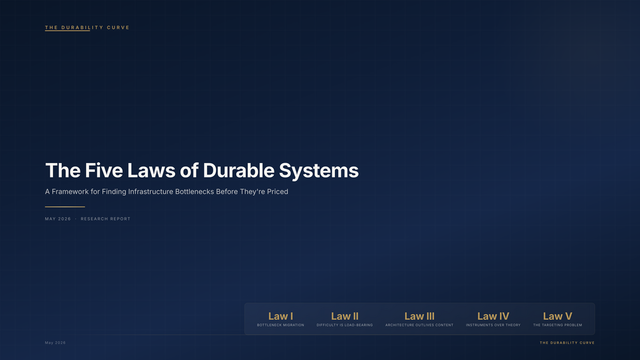
The Five Laws of Durable Systems
Most investors search for AI infrastructure bottlenecks in the wrong layer.They track GPU shipments. They monitor power demand. They read transformer lead time reports. By the time these metrics are widely available, the position is already priced.This framework exists because the real question is never "where is the bottleneck?" It is "where is the bottleneck migrating to next?" The difference between those two questions is the difference between buying what everyone else just bought and building a position in what everyone else has not seen yet.The Five Laws of Durable Systems is the investment methodology that has produced every major bottleneck thesis in the vault: the switchgear ceiling, the GOES upstream constraint, the photonics supply chain scarcity, the peptide/GLP-1 glass containment bottleneck, and the verification economy migration. Each identified months before the market priced it. Each derived from the same five laws.This document does not contain ticker recommendations. It contains the operating system under every position — the repeatable process for finding the next bottleneck before consensus arrives.What You Get: Five structural laws — each derived from 3-7 independent analyses spanning 14+ domains. Each with falsification criteria (the specific market signals that would tell you the law is wrong). Two derived principles — the Goodhart Corollary (why metrics degrade under optimization) and the Regime Problem (why correct methods fail silently in the wrong environment). The Search Protocol — a seven-step process for layer-mapping any market and locating the binding constraint before it is visible to consensus. Falsification Discipline — pre-committed exit criteria for every law. Know exactly what would break each thesis before you enter a position. The Portfolio Frame — how to build structurally uncorrelated bottleneck positions where each expresses a different law and each falsifier tests a different assumption. Worked examples — the switchgear ceiling, the Schott pharma qualification moat, the CUDA architecture bet, the verification economy instrument — each showing the method, not just the conclusion. Who This Is For: Investors tracking the AI infrastructure stack who want to identify bottlenecks before the market prices them Analysts who need a structured methodology for mapping technology supply chains Portfolio managers building positions around structural constraints rather than price momentum Anyone who read the Switchgear Ceiling or AI Infrastructure Stack and wants the method, not just the report What This Is Not: Not Stratechery — the framework operates at the physical and structural layer (transformers, steel, glass vials, optical transceivers), not the business model layer Not SemiAnalysis — the framework provides a methodology for interpreting supply chain data, not a firehose of the data itself Not a trading strategy — the laws identify where value is likely to migrate. They do not tell you when. Timing requires layer-specific catalysts The Framework in One Sentence:"Value concentrates wherever resistance to commodification, measurement, and automation is highest — that locus migrates upward as lower layers are solved, the organisational scaffold persists across every transition, knowledge advances only through new instruments, and capability without correct targeting makes things worse, not better."Memorise that sentence. It contains more investment signal than most equity research reports.Disclaimer: This document is for informational purposes only and does not constitute investment advice. The framework identifies structural patterns — it does not produce price targets, entry points, or timing recommendations. All investment decisions should be made with consideration of your own financial circumstances and risk tolerance. Past structural patterns are not guarantees of future migrations.