
Dan Scolnic

@danscolnic
60 Followers
40 Following
10 Posts
Astrophysics Professor at Duke University
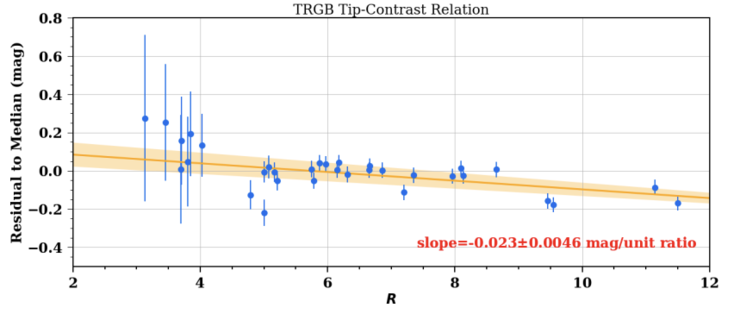
We also find something really interesting, which is that this contrast ratio correlates with the tip magnitude, at about 5sigma. We discuss a couple ideas about why this might be, maybe it is due to an age correlation (predicted by stellar models), or something correlating with dust. Importantly, it's a powerful component of any analysis to measure the Hubble constant, making things consistent between rungs. That's next for our CATS team :)
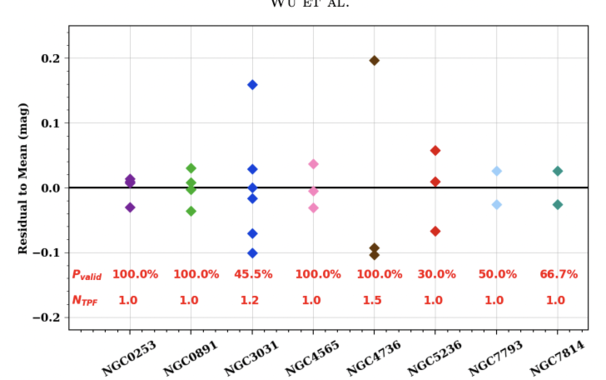
We optimize an algorithm that works quite well. We show we can reach as low as ~0.05 mag dispersion across fields per galaxy. That's really good! The catch is that we have to toss a bunch of the fields for not having sharp enough contrast, almost 50%. We actually find that the 'contrast' parameter, which is the number of stars above versus below the tip, is super important, and is basically the key quality cut one can use to get to lower dispersion. #Astrodon #astronomy
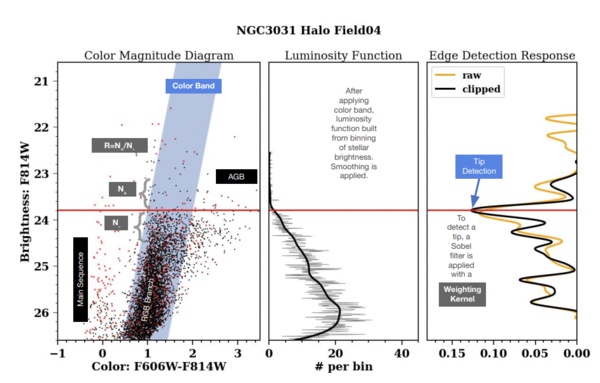
We try out a number of different analysis choices in the literature - here is our explainer figure of the different knobs one has to play with.
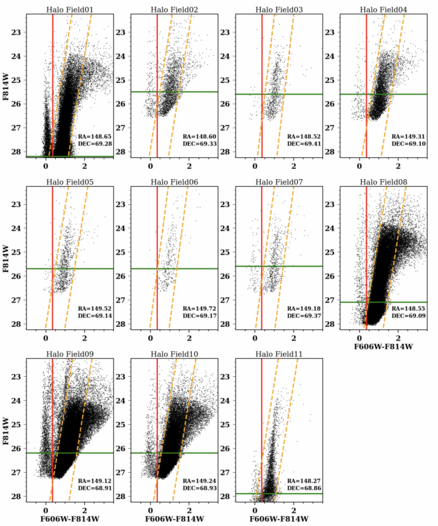
This is what the Color-Magnitude Diagrams of all the fields in one galaxy look like. You can see, there are clear differences. TRGB is that break one can see with their eye, but it's obvious the slant/color/contrast can all change somewhat field-by-field.
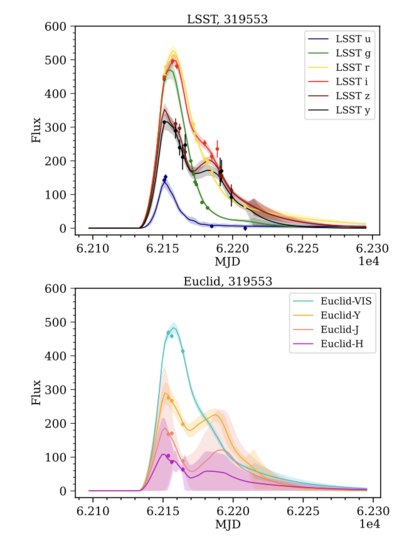
New paper out led by Duke undergrad Ava Bailey and postdoc mentor Maria Vincenzi: https://arxiv.org/abs/2211.01206 . Paper poses a question - how useful can Euclid be for SN Ia cosmology considering it's just designed for LSS probes. Turns out with deep fields, they have repeat observations, then long gaps, but those repeats can be quite useful. We show this would really boost LSST constraints, and independently help solve one of biggest mysteries of SNe Ia. And would be great Roman prep. #Astrodon
Type Ia Supernova cosmology combining data from the $Euclid$ mission and the Vera C. Rubin Observatory

The $Euclid$ mission will provide first-of-its-kind coverage in the near-infrared over deep (three fields, $\sim$10-20 square degrees each) and wide ($\sim$10000 square degrees) fields. While the survey is not designed to discover transients, the deep fields will have repeated observations over a two-week span, followed by a gap of roughly six months. In this analysis, we explore how useful the deep field observations will be for measuring properties of Type Ia supernovae (SNe Ia). Using simulations that include $Euclid$'s planned depth, area and cadence in the deep fields, we calculate that more than 3700 SNe between $0.0<z<1.5$ will have at least five $Euclid$ detections around peak with signal-to-noise ratio larger than 3. While on their own, $Euclid$ light curves are not good enough to directly constrain distances, when combined with LSST deep field observations, we find that uncertainties on SN distances are reduced by 20-30% for $z<0.8$ and by 40-50% for $z>0.8$. Furthermore, we predict how well additional $Euclid$ mock data can be used to constrain a key systematic in SN Ia studies - the size of the luminosity 'step' found between SNe hosted in high mass ($>10^{10} M_{\odot}$) and low mass ($>10^{10} M_{\odot}$) galaxies. This measurement has unique information in the rest-frame NIR. We predict that if the step is caused by dust, we will be able to measure its reduction in the NIR compared to optical at the 4$σ$ level. We highlight that the LSST and $Euclid$ observing strategies used in this work are still provisional and some level of joint processing is required. Still, these first results are promising, and assuming $Euclid$ begins observations well before the Nancy Roman Space Telescope (Roman), we expect this dataset to be extremely helpful for preparation for Roman itself.

arXiv.org