Calling Moms for Liberty a “parents rights group” is like calling the KKK a fraternal organization, @[email protected] Technically not wrong, but an absurd gloss that does nothing to get at the core of what the organization is about.
Chris Slaby
@cjslaby
- 312 Followers
- 110 Following
- 65 Posts
Historian and Art Historian; currently Ph.D. candidate at William & Mary; working primarily at the intersection of Native American and Indigenous Studies and the environmental humanities. #histodons
 Roopika Risam
Thank you to Miranda Hughes-Ribeiro for her excellent work on production for this issue. We hope you enjoy the issue and check out The Digital Black Atlantic in print or open access online. #ReviewsInDH https://dhdebates.gc.cuny.edu/projects/the-digital-black-atlantic

The Digital Black Atlantic | Debates in the Digital Humanities
This timely collection of essays about the relationship between digital humanities and Black Atlantic studies offers critical insights into race, migration, media, and scholarly knowledge production. It spans the African diaspora’s range—from Africa to North America, Europe, and the Caribbean—while its essayists span academic fields—from history and literary studies to musicology, game studies, and library and information studies.
This place isn’t the same as the other one (for better and worse?) and I feel dumb for wanting to grieve for all that has been lost. And of course there’s the nagging thought in the back of my head, “oh, less time on social media means you’ll be more productive.” Hah. If only.

The frustration/concern now is the splintering. People are everywhere. This is no one primary alternative (including this place). It wouldn’t be bad for people to get outside, to meet IRL, as people said twenty years ago. But especially for academics (among others, in sure), digital community is so important because we’re so scattered, and more and more nowadays institutionally untethered.
Jumping back on here now, again?
It’s community—that’s what social media has offered quite a few of us. And now we need to make it again, or somewhere else. I can’t imagine if this had happened at the height of the pandemic. Not that the outcomes of social media at that time were great exactly. But boy was that connectivity a lifeline for lots of people.
 Jason M. Kelly
Congratulations to Elizabeth Kryder-Reid and Sarah May for editing the new collection, Toxic Heritage: Legacies, Futures, and Environmental Injustice. It's available open access as well!

Toxic Heritage: Legacies, Futures, and Environmental Injustice
Toxic Heritage addresses the heritage value of contamination and toxic sites and provides the first in-depth examination of toxic heritage as a global issue. Bringing together case studies, visual essays, and substantive chapters written by leading scholars from around the world, the volume provides a critical framing of the globally expanding field of toxic heritage. Authors from a variety of disciplinary perspectives and methodologies examine toxic heritage as both a material phenomenon and a
 Maeve Kane
My book is on sale! Cornell Press is having a flash sale today June 23 only, $20 for any hardback including mine. Code 09ALHCB8 at checkout.
https://www.cornellpress.cornell.edu/book/9781501767883/shirts-powdered-red/#bookTabs=1
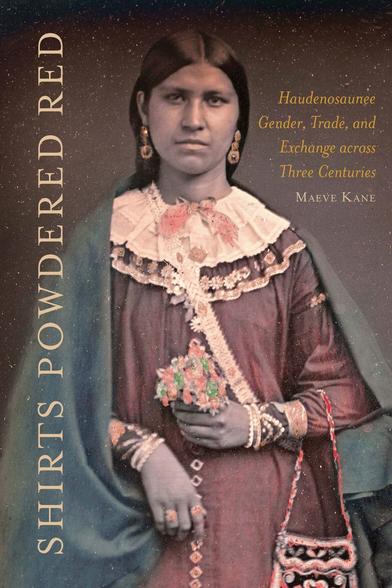

Shirts Powdered Red by Maeve Kane | Hardcover | Cornell University Press
Beginning with a purchased shirt and ending with a handmade dress, Shirts Powdered Red shows how Haudenosaunee women and their work shaped their nations from the sixteenth century through the nineteenth...
 Cassandra Good
Fellow #histodons who are staying off the bird site: lots of conversation over there about a panel at #Berks2023 last night where Lois Banner (emerita, USC) apparently said she thought her career would have been easier if she had been Black.
I share this bc I think it's important, esp for white scholars, to be aware that this kind of attitude is still in our profession. I'm only surprised that she said it publicly; when working on DEI efforts for my home conference, some (mostly senior) white scholars either refused to or could not see that there is a lot of necessary work to do to make our field more welcoming and equitable.
I look forward to seeing a statement and action from the Berkshires Conference; they immediately released a tweet condemning the remarks. But that group shouldn't be singled out; please consider what you could be doing at your institutions and conferences to make change.
 Ryan Cordell
When Elon fights Zuck they should only get to throw punches while their respective sites are fully up
 Max Kennerly
LOL this is not how you deal with "data scraping," this is how you deal with a catastrophic loss of system capacity.
You limit data scraping by blocking things a human user couldn't do, like access a thousand posts a minute. This is aimed directly at reducing normal activity across the whole system.
