
https://gizmodo.com/google-water-usage-exploding-with-ai-development-1850673427
www.changepartnership.org
It’s really too early to say how meaningful it is from a climate perspective, since it takes 10-20 years of data to form a recognizable climate trend.
If there is a shift from the 1981-2010 baseline, that’s useful to know but the meaning is unclear because we don’t know what that trend looked like pre-1981 with such high resolution.
If Antarctic ice doesn’t recover year after year after year, and then the same trend happens in the Arctic as well…then that would be significant.
2/2
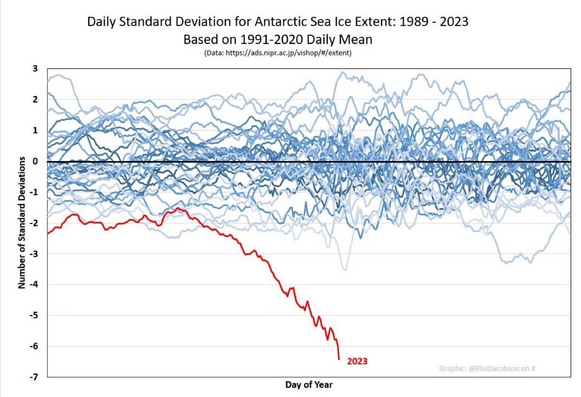
This chart is making the rounds and freaking out a lot of people, but what does it really show?
There’s definitely a detectable departure from recent historical averages this year. Here’s what the UC Boulder National Snow and Ice Data Center has to say about sea ice extent this year: https://nsidc.org/arcticseaicenews/
The question is: How well does the Antarctic ice recover when it peaks later this year? And what is the multi-year trend, especially as this year’s super El Niño fades?
1/2
Today Fervo Energy announced breakthrough well test results at their full-scale commercial pilot, Project Red, confirming the viability of Fervo’s next-generation #geothermal technology. This establishes Project Red as a productive enhanced geothermal system.
As Jesse Jenkins of Princeton University noted, “Fervo’s successful commercial pilot takes next-generation geothermal technology from the realm of models into the real world.” https://fervoenergy.com/fervo-energy-announces-technology-breakthrough-in-next-generation-geothermal/