RT @KoenCuypers3
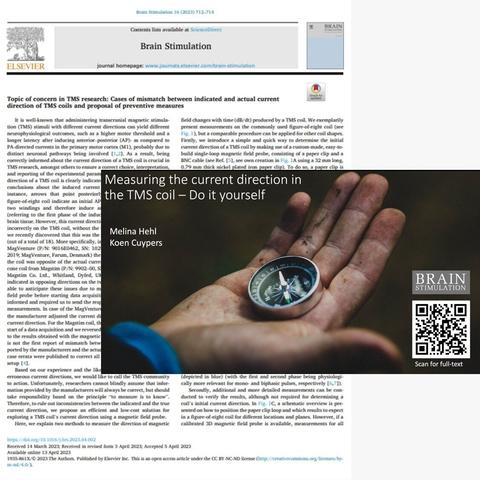
Check out our short DIY movie and publication about how to measure the current directions of your TMS coils:
https://www.youtube.com/watch?v=LhpTAvVQL_w @brainstimj @REVALResearch @Hersenstim

Measuring the current direction in the TMS coil
RT @LabReif
Another important piece in the puzzle microbiome, vagus and depression!
https://twitter.com/KevinJTraceyMD/status/1654075103817129988
Prof Kevin J Tracey MD on Twitter
“Important and provocative: new results in Mol Psych @nature establish role of #vagus nerve signaling and gut #microbiome in brain responses to stress. @institutpasteur https://t.co/lnvD71uPdo”
RT @KevinJTraceyMD
Important and provocative: new results in Mol Psych @Nature establish role of
#vagus nerve signaling and gut
#microbiome in brain responses to stress. @institutpasteur
https://www.nature.com/articles/s41380-023-02071-6
Gut microbiota changes require vagus nerve integrity to promote depressive-like behaviors in mice - Molecular Psychiatry
Chronic stress constitutes a major risk factor for depression that can disrupt various aspects of homeostasis, including the gut microbiome (GM). We have recently shown that GM imbalance affects adult hippocampal (HPC) neurogenesis and induces depression-like behaviors, with the exact mechanisms being under active investigation. Here we hypothesized that the vagus nerve (VN), a key bidirectional route of communication between the gut and the brain, could relay the effects of stress-induced GM changes on HPC plasticity and behavior. We used fecal samples derived from mice that sustained unpredictable chronic mild stress (UCMS) to inoculate healthy mice and assess standard behavioral readouts for anxiety- and depressive-like behavior, conduct histological and molecular analyses for adult HPC neurogenesis and evaluate neurotransmission pathways and neuroinflammation. To study the potential role of the VN in mediating the effects of GM changes on brain functions and behavior, we used mice that sustained subdiaphragmatic vagotomy (Vx) prior the GM transfer. We found that inoculation of healthy mice with GM from UCMS mice activates the VN and induces early and sustained changes in both serotonin and dopamine neurotransmission pathways in the brainstem and HPC. These changes are associated with prompt and persistent deficits in adult HPC neurogenesis and induce early and sustained neuroinflammatory responses in the HPC. Remarkably, Vx abrogates adult HPC neurogenesis deficits, neuroinflammation and depressive-like behavior, suggesting that vagal afferent pathways are necessary to drive GM-mediated effects on the brain.
RT @angstdepressie
De universiteit van Maastricht doet momenteel onderzoek naar relapse aantallen in depressie en de toegepaste behandelingen. Het onderzoeksteam is op zoek naar deelnemers die ten minste één keer hersteld zijn van een depressie:
https://maastrichtuniversity.eu.qualtrics.com/jfe/form/SV_ekTgwbA6bjXZCqGRelapse preventive effects of psilocybin in depression.
The present study is about the use of psilocybin to prevent relapse in depression.
You are invited to take part in this study if you have at least once recovered from depression.
This letter provides information about the study to help you decide on participating. Give yourself some time to read carefully, and to consider your voluntary participation. During the study, you will have the right to withdraw your participation and results at any time without any consequences.
You will be filling out an online questionnaire, at a time that suits you, taking about 20 – 30 minutes. The questionnaire will be asking about previous depressive episodes, any medication used during recovery, and any psilocybin use. If you think talking about depression can revive memories that are difficult to handle you might want to refrain from participating in this study.
Your participation can help to improve the quality of life for future patients suffering and/or recovering from depression.
Personal Data and Research Data will be stored confidentially.
This concerns the following data:
Age, gender, and questionnaires containing mental health-related information, medicine administration, and psilocybin administration.
Research Data can be published and re-used in other research, but only in such a way that they cannot be traced back to you.
You can withdraw your consent to the use of your personal data at any time. In that case, they will be deleted if possible. For more information about privacy, consult the responsible researcher (see below), the website (www.maastrichtuniversity.nl/fpn/ercpn under Fast Facts), or the Data Protection Officer of Maastricht University at [email protected].
Marvin Essers (student)
Email: [email protected]
Tel: 06 50 52 41 40
Kim Kuypers (responsible researcher)
Email: [email protected]
Tel: 043 7654321'
RT @YossiBerlow
I'm excited to share our paper demonstrating that recovery from depression with transcranial magnetic stimulation (TMS) is well-modeled using an exponential decay function!
https://www.nature.com/articles/s41598-023-33599-w

Modeling the antidepressant treatment response to transcranial magnetic stimulation using an exponential decay function - Scientific Reports
Recovery from depression often demonstrates a nonlinear pattern of treatment response, where the largest reduction in symptoms is observed early followed by smaller improvements. This study investigated whether this exponential pattern could model the antidepressant response to repetitive transcranial magnetic stimulation (TMS). Symptom ratings from 97 patients treated with TMS for depression were collected at baseline and after every five sessions. A nonlinear mixed-effects model was constructed using an exponential decay function. This model was also applied to group-level data from several published clinical trials of TMS for treatment-resistant depression. These nonlinear models were compared to corresponding linear models. In our clinical sample, response to TMS was well modeled with the exponential decay function, yielding significant estimates for all parameters and demonstrating superior fit compared to a linear model. Similarly, when applied to multiple studies comparing TMS modalities as well as to previously identified treatment response trajectories, the exponential decay models yielded consistently better fits compared to linear models. These results demonstrate that the antidepressant response to TMS follows a nonlinear pattern of improvement that is well modeled with an exponential decay function. This modeling offers a simple and useful framework to inform clinical decisions and future studies.
RT @Hersenstim
Save-the-date: The 2nd BeNe Brain Stimulation Symposium: November 16-17, 2023; Nijmegen. Keynotes: @tobergmann & Dennis Schutter and more to come! The symposium will bring together experts from Belgium, the Netherlands, and beyond to share the latest research and developments.
RT @DrMiron_MD
We are delighted to present our case series on the outcomes of intravenous (IV) ketamine in patients with treatment-resistant depression (TRD) who were unresponsive to transcranial magnetic stimulation (TMS). 🧵
https://authors.elsevier.com/a/1gxz9bXYirBs9#.ZEEsl3nHB48.twitter
RT @michaelgrandner
@sleepscientist Gummies are a huge issue. It’s a largely untested delivery mechanism. Especially for melatonin where timing is key.

Quantity of Melatonin and CBD in Melatonin Gummies Sold in the US
This study assesses the actual measured quantities of melatonin and cannabidiol (CBD) in products marketed and sold in the US as melatonin gummies compared with the quantities declared on their labels.