Keith Kaisershot

@blitter
167 Followers
73 Following
169 Posts
Programmer. Pippin hacker. Fan of Macs, Apple, 70s/80s/novelty music, retro gaming, VR, DeLoreans, and combinations thereof. Opinions expressed are mine. He/him. blitter.net
❤️

For this year's #AlienDay I put together my own silly "How Aliens Should Have Ended" edit 😆

(with apologies to Aliens fans everywhere)

By far the highlight of my GDC 2024 experience was meeting @jmechner and giving him a demo of Advanced Mac Substitute, a reimplementation of the classic Mac Toolbox by Josh Juran (with a little help from me). What better way to show off AMS than to play the 1992 Mac version of Prince of Persia, of course!

Thank you Jordan for your games, your books, coming out to San Francisco, signing the strategy guide I've had since I was a kid, and inspiring further development of AMS. ❤️ www.v68k.org/ams/

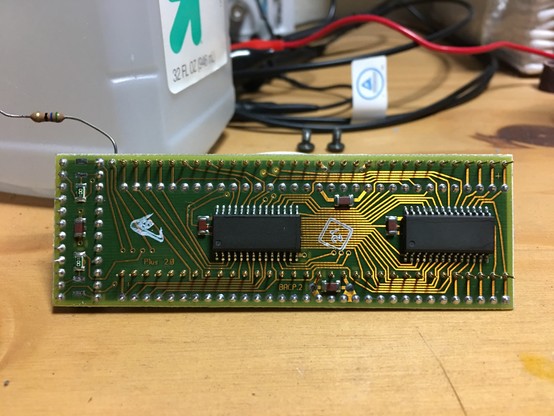
Likewise, I suspect the ASX-6 chip might be a PAL20L8 based on the pin count and how it beeps out. I drafted this incomplete schematic in KiCAD based on my findings. My maps of pins to functions might be wrong-- they're just my best guess-- but my mappings of pin numbers to pin numbers are definitely correct, as I triple-checked them. Any unmapped pins means I simply don't know their purpose; they don't connect to any other pins on the board.
I beeped out the two chips on the underside and I strongly suspect they are ROMs, possibly even EEPROMs, based on the pinout. They seem to match the pinout of the 27C512 chips used by the Mac Plus ROMs, albeit in a SOP-28 package. The first troubleshooting step I'd like to try is to dump the contents of these ROMs, but alas I don't have anything that fits an SOP-28 footprint ( @tubetime ?). Likewise I'd like to dump the Plus ROMs just to verify their expected contents.
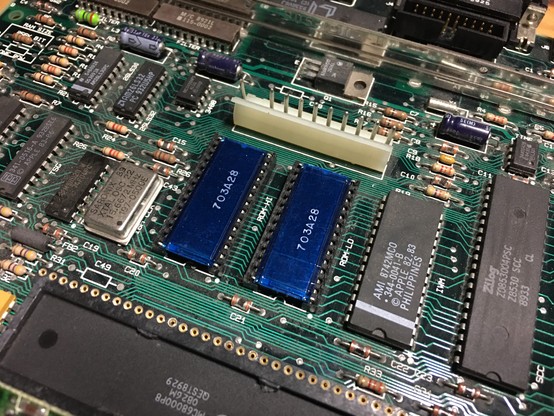
With the Brainstorm installed, each of the Plus's two ROM chips has a blue... support?... board underneath it sharing pins 1, 14, 15, and 28. I'm not sure what the purpose of these boards is-- none of their pins have any continuity, and removing them has no effect on the Sad Mac I get.
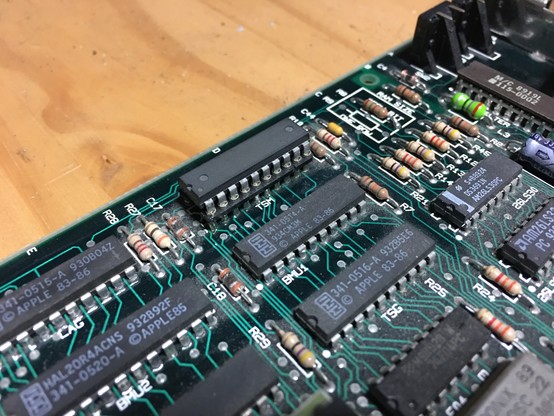
Elsewhere on the Mac Plus logic board, the TSM-- a PAL16R4A-- is replaced by its unlabeled Brainstorm equivalent. This chip controls the frequency of DRAM refresh and its timing is coupled to that of the CPU. (I tried running my Plus with this replacement TSM but without the Brainstorm board, and while the Plus did attempt to start, its chime was razzy and the video display was unrecognizably scrambled.)
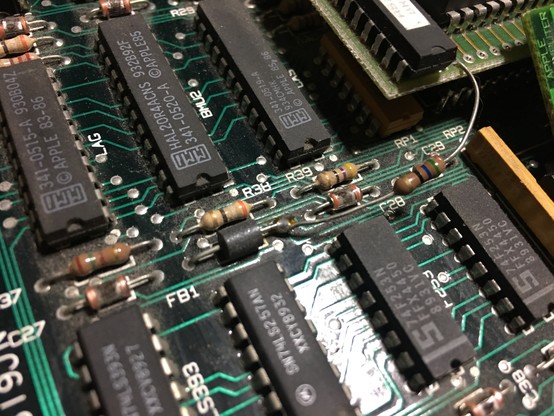
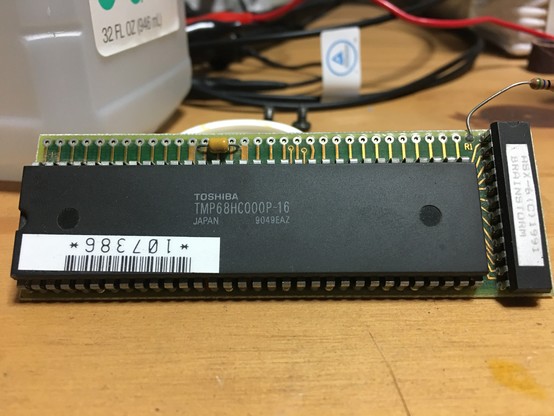
As I mentioned, the main board of the Brainstorm clips to a socket that straddles the original 68000 CPU. A 56ohm resistor connects the R1 pad of the Brainstorm board to the near lead of the ferrite bead FB1 on the Plus logic board.
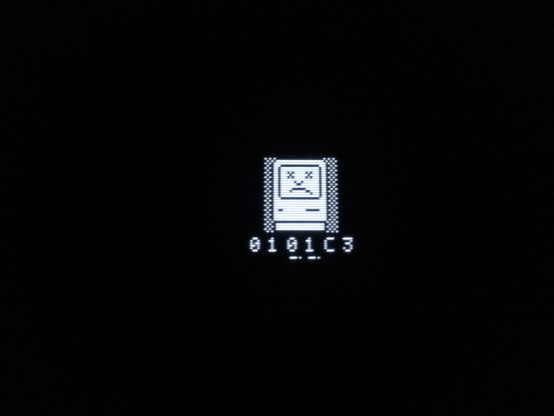
My Brainstorm Plus chirps out the signature "boot beep" at startup, but then during POST immediately produces a Sad Mac with error code 0101C3. The leading "01" signifies which test failed; in my case a ROM checksum failure, suggesting some kind of ROM corruption. The remaining digits are largely useless, based on the (incorrect) result of the checksum algorithm.
This is the Brainstorm accelerator for the Mac Plus. It plugs into a socket clipped to the top of the Plus's standard 68000 CPU. Providing its own replacement 68HC000P16 and combined with a couple of helper chips, the Brainstorm gives the Mac Plus a significant speed boost, jumping from ~8MHz to ~16Mhz. Benchmarks on LEM as proof: https://lowendmac.com/2000/mac-plus-with-16-mhz-brainstorm-upgrade-benchmarked/
Mac Plus with 16 MHz Brainstorm Upgrade Benchmarked | Low End Mac