
169 Followers
196 Following
35 Posts
PI Emerging Pathogen Serology group at UKHSA Porton | Zoonoses, diagnostics & tech πŸ¦‡πŸ‘¨β€πŸ”¬πŸ’» | Views my own πŸ³οΈβ€πŸŒˆπŸŒ

Looking at antibody levels of infection naive individuals, we see continued waning in younger age groups* but increases in antibody levels in those aged >50 due to winter booster/4th dose.

With a similar trend seen in previously infected individuals, more noticeable in older age groups where the majority of individuals have antibodies >25,000!

We might need a new category to break up those >25,000....

* - some younger individuals will have boosting due to 4th dose eligibility, e.g. HCWs

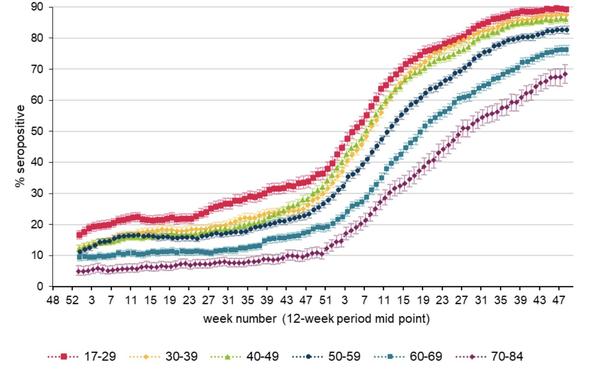
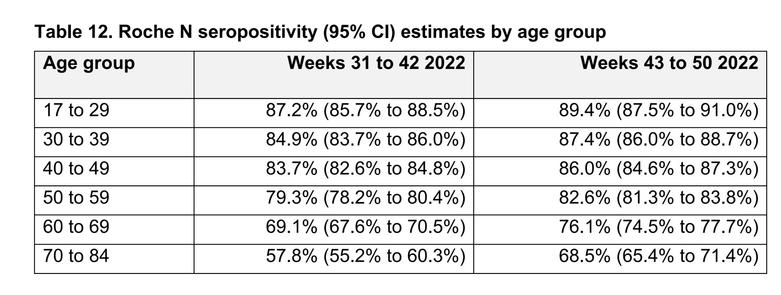
The 17-29 age group have had the consistently highest seropositivity at 89.4% (c/f 87.2%), but big changes in the 70-84 age group, with >10% increase to 68.5%
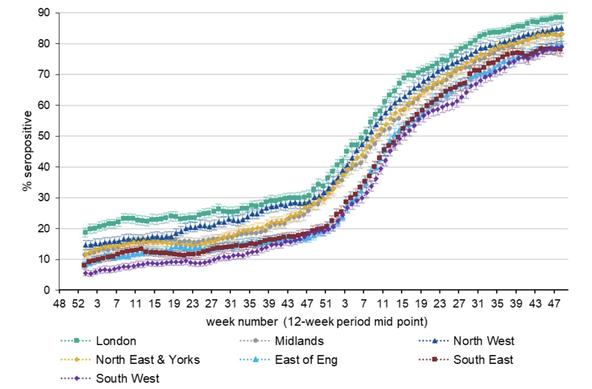
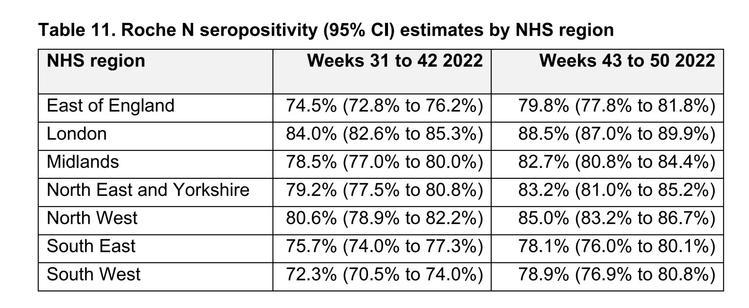
London still holds the crown πŸ‘‘ for highest seropositive region at a whopping 88.5%, but all regions showing increases and likely to go higher after Christmas increase

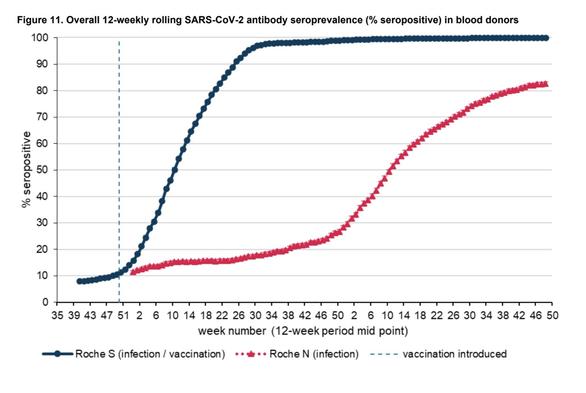
Our latest SARS-CoV-2 serosurveillance data for England with @NHSBT (Oct-Dec 2022) is now out in the @UKHSA vaccine surveillance report.

Anti-nucleocapsid seropositivity: 82.5 % (c/f 78.2%)
Anti-spike seropositivity: 99.9% (c/f 99.8%)

https://www.gov.uk/government/publications/covid-19-vaccine-weekly-surveillance-reports
2022 was epic. Eternally grateful to work with a brilliant team and colleagues in UKHSA and our collaborators, doing some fun and exciting science along the way πŸ‘©β€πŸ”¬πŸ‘¨β€πŸ”¬

Wishing you all a happy new year. Here's to 2023! πŸŽ‰

..and this pool gives some excellent sensitivity (97.14%) and specificity (98.23%), better than individual antigens (some being ~50% sens)

Using this assay we can also perform endpoint titrations to allow quantification of responses to Smallpox vaccine or MPOX infection πŸ‘‡

But also then see a potentiation in responses when using the pool antigens (e.g. more antigens present for Abs to bind) compared to individual antigens:

Using this data together we also developed a pooled Ag ELISA using commercially available antigens to study poxvirus/vax antibody responses, rather than needing whole MVA

When we looked at antigen responses over time, only some show reactivity, dropping off after dose 1 or 2.

So we made an ELISA using 5 recombinant antigens all pooled together: MPXV antigens B6, B2, E8L and A35, and one VACV antigen B5 (homologue of B6) We see it mirrors the strong antigens when tested individually:

This reinforced that there are analogous antibody responses between vaccinated/MPOX infected, but definitely subtle differences in immunology responses/Ab binding

This was similarly confirmed for neuts by Luca Zaeck & colleagues in their great paper:

https://www.nature.com/articles/s41591-022-02090-w

Low levels of monkeypox virus-neutralizing antibodies after MVA-BN vaccination in healthy individuals - Nature Medicine

Historic smallpox vaccination and monkeypox virus (MPXV) infection elicit MPXV-neutralizing antibodies, but MPXV-neutralizing antibodies are less frequent and of lower magnitude after vaccination with MVA-BNβ€”the vaccine approved and in use for protection against MPXV and smallpox.

Nature
In addition to specific antigens being reactive in vaccinated or MPOX infected, we see that there is definitely some preferential binding Using homologous VACV/MPXV proteins, we see MPOX infected marginally bind MPXV antigens better than VACV Ag, whilst Vaccinated are opposite!