 Ash Otter
Delighted to say our #Monkeypox/#MPOX paper is now out as a preprint:
https://www.medrxiv.org/content/10.1101/2022.12.22.22283648v1
It's a bit of a beast, but a thread of the results we've found...🧵
Delighted to say our #Monkeypox/#MPOX paper is now out as a preprint:
https://www.medrxiv.org/content/10.1101/2022.12.22.22283648v1
It's a bit of a beast, but a thread of the results we've found...🧵
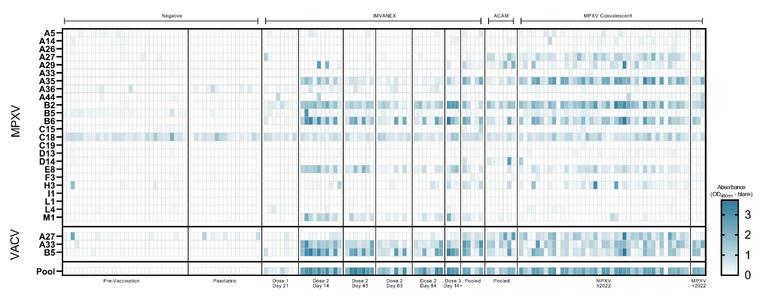
We decided to look at individual recombinant antigens to see if antibodies induced were different between smallpox vax & MPOX infection
So we used 24 MPXV & 3 VACV antigens, with all 3 VACV being homologues of some of the MPXV antigens...the importance of that is later!
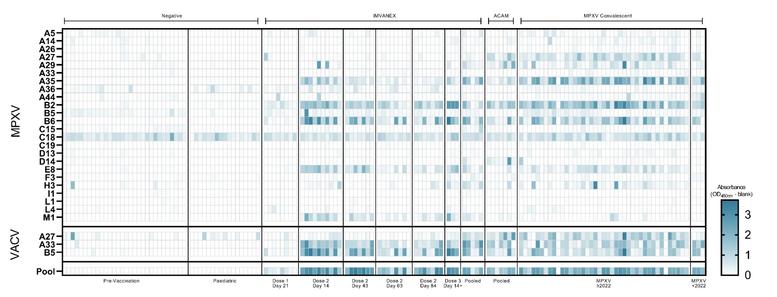
This way we could see which antigens were useful and different at multiple timepoints after vaccination, but more importantly which ones were different between vaccinated and MPOX infected.
A lot of the antigens we used had minimal antibody binding 👇
Whilst we do see low antibody responses in dose 1 vaccinated, this doesn't mean there isn't protection, as two other papers have demonstrated a robust cellular response:
https://www.cell.com/cell-host-microbe/fulltext/S1931-3128(22)00559-5
https://www.thelancet.com/journals/laninf/article/PIIS1473-3099(22)00662-4/fulltext
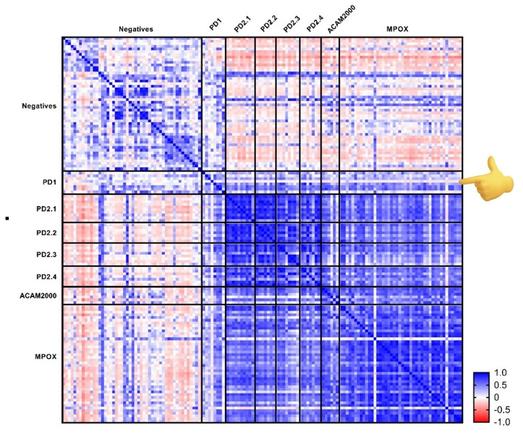
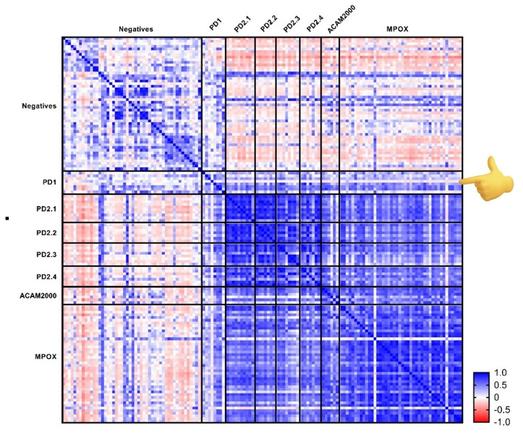
Whilst Pearson correlation showed that there was correlation between Smallpox vaccinated and MPOX infected, we used principal component analysis to see if we could see more of a distinctive grouping between these two groups, which we did - but there was overlap
Interestingly, the ACAM2000 vaccinated people are grouped in with the MPOX convalescent as well...but more on this later...
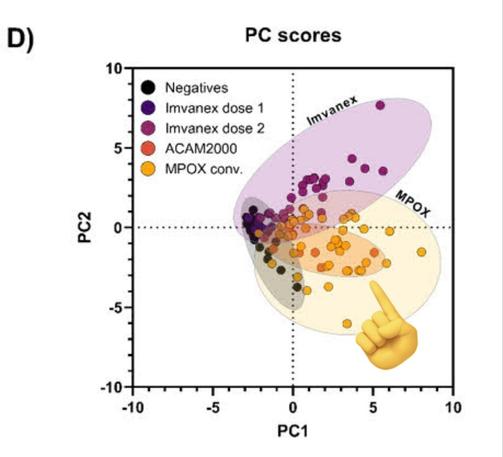
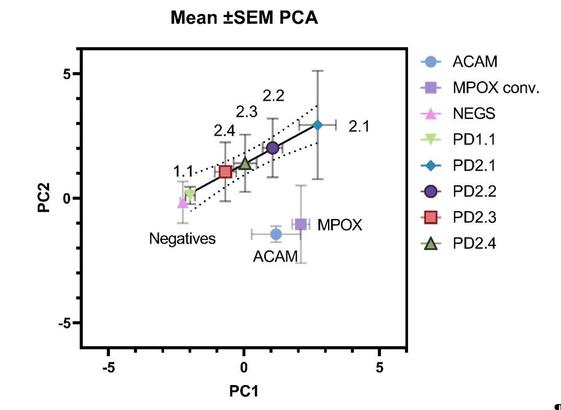
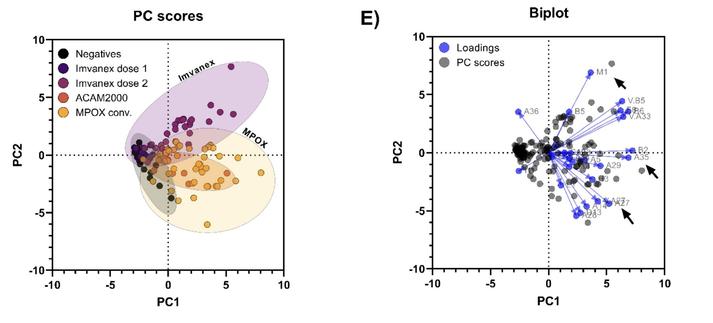
Thankfully PCA tells you factors that contribute to a particular grouping, whereby the variables & the impact of each of those variables on the grouping can be plotted...
Here we see that a number of antigens are skewed towards the MPOX group like A27L & M1R towards vaccinated:
Using these antigens individually, we find that the MPXV antigen A27 can discriminate between IMVANEX vaccinated and MPOX infected
But ACAM2000 vaccine throws a spanner in the works, as they also show antibody binding to this antigen as A27 is missing from the MVA-BN strain (used in the IMVANEX vaccine) but present in the MVA ACAM2000 strain and also MPOX MPXV M1R antigen may also provide us with a way to determine if people have recent IMVANEX vaccination, but we're not sure why...more soon...
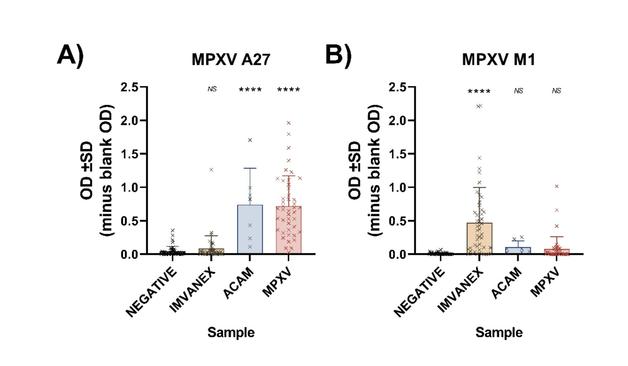
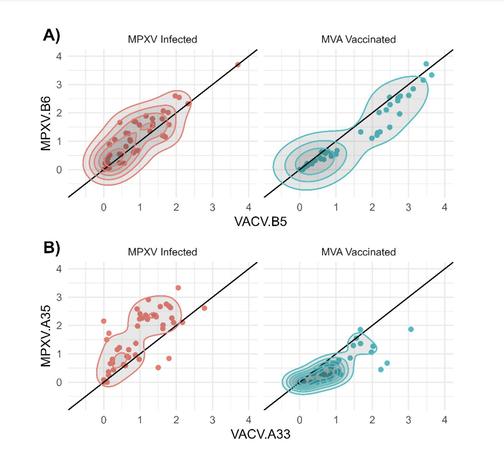
This reinforced that there are analogous antibody responses between vaccinated/MPOX infected, but definitely subtle differences in immunology responses/Ab binding
This was similarly confirmed for neuts by Luca Zaeck & colleagues in their great paper:
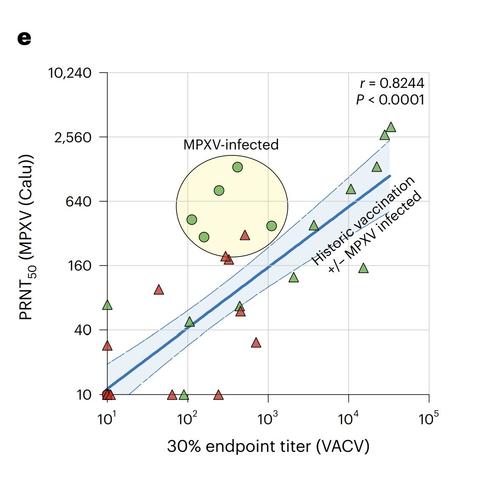

Historic smallpox vaccination and monkeypox virus (MPXV) infection elicit MPXV-neutralizing antibodies, but MPXV-neutralizing antibodies are less frequent and of lower magnitude after vaccination with MVA-BN—the vaccine approved and in use for protection against MPXV and smallpox.
Using this data together we also developed a pooled Ag ELISA using commercially available antigens to study poxvirus/vax antibody responses, rather than needing whole MVA
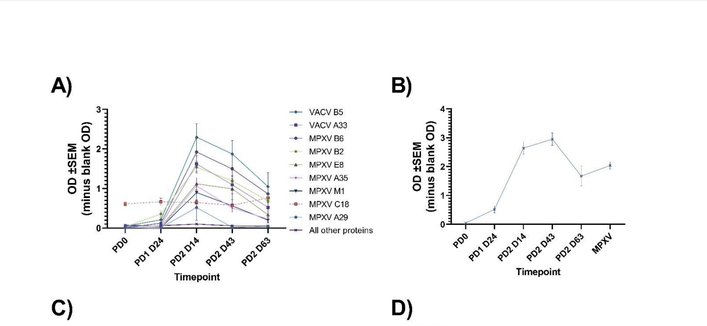
When we looked at antigen responses over time, only some show reactivity, dropping off after dose 1 or 2.
So we made an ELISA using 5 recombinant antigens all pooled together: MPXV antigens B6, B2, E8L and A35, and one VACV antigen B5 (homologue of B6) We see it mirrors the strong antigens when tested individually:
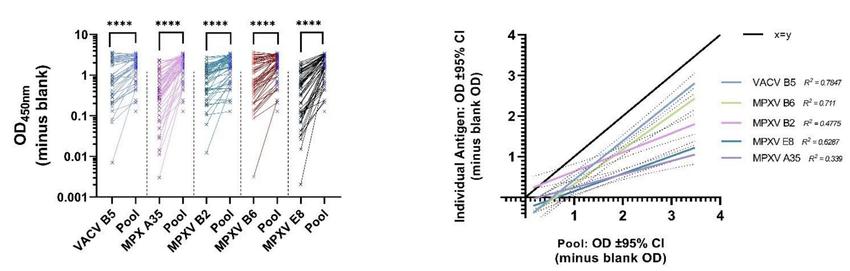
..and this pool gives some excellent sensitivity (97.14%) and specificity (98.23%), better than individual antigens (some being ~50% sens)
Using this assay we can also perform endpoint titrations to allow quantification of responses to Smallpox vaccine or MPOX infection 👇

We're now looking in further detail into Ab/Ag binding in MPOX, with comparisons to Smallpox-vaccinated, as a way to understand these subtle differences but also what these mean for pan-pox immunity.. Hopefully more soon!
This was a massive collaborative piece of work, with thanks to colleagues across @UKHSA, @EPS_Porton, @RIPL_Porton, @CDCgov, @ImperialNHS & @ChelwestFT!
@asherichia well, in a way each message merits to stand on its own feet, so not that spammy. I enjoyed the thread.
I guess a solution is to pack more into each message (default limit is 500 characters, but apparently some instances go even higher!)
 Gabriele Pollara
 Dr Pieter Peach