 Unknow
Milano parco Sempione oggi


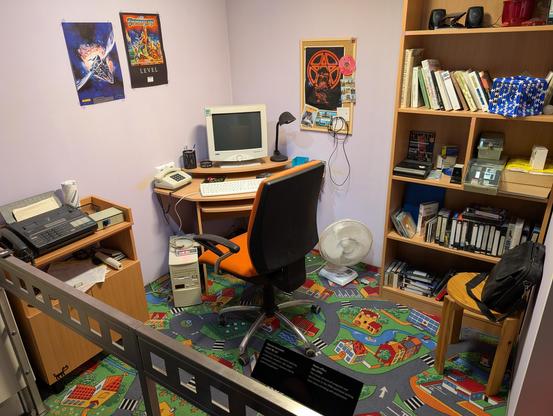
Hey, 90s kids! Your bedroom is now in a museum!
(Prague's National Museum, if you want to make a complaint.)

finally reasonable CAPTCHA
When I was a PhD student, I attended a talk by the late Robin Milner where he said two things that have stuck with me.
The first, I repeat quite often. He argued that credit for an invention did not belong to the first person to invent something but to the first person to explain it well enough that no one needed to invent it again. His first historical example was Leibniz publishing calculus and then Newton claiming he invented it first: it didn’t matter if he did or not, he failed to explain it to anyone and so the fact that Leibniz needed to independently invent it was Newton’s failure.
The second thing, which is a lot more relevant now than at the time, was that AI should stand for Augmented Intelligence not Artificial Intelligence if you want to build things that are actually useful. Striving to replace human intelligence is not a useful pursuit because there is an abundant supply of humans and you can improve the supply of intelligent humans by removing food poverty, improving access to education, and eliminating other barriers that prevent vast numbers of intelligent humans from being able to devote time to using their intelligence. The valuable tools are ones that do things humans are bad at. Pocket calculators changed the world because being able to add ten-digit numbers together orders of magnitude faster allowed humans to use their intelligence for things that were not the tedious, repetitive, tasks (and get higher accuracy for those tasks). If you want to change the world, build tools that allow humans to do more by offloading things humans are bad at and allowing them to spend more time on things humans are good at.
The 'This is fine' meme is way older than anyone had expected.
This 14th-century manuscript illustration shows the legendary 5th-century British king Vortigern in his burning castle.
More on the illustration here:
https://thehistorianshut.com/2020/10/14/illustration-depicting-the-demise-of-vortigern-from-a-14th-century-manuscript/
British Library royal ms 20 a ii f3r


This illustration, from a 14th-century manuscript (labeled BL Royal 20 A II, f. 3 in The British Library) depicts a scene from British legend. Atop the burning castle is Vortigern, a legendary figure from the 5th century who is credited with inviting Saxons into Britain, setting in motion the eventual Anglo-Saxon domination of England that […]
Fascinating article about the as yet unpredictable changes AI brings to complex knowledge work. Here the case of radiology. The early predictions of displacement of humans by machines have not come to pass (though, as always, they have simply been pushed into the future).
For me, this is the most interesting part, and one that I think applies quite generally.
"Still, I have reservations about AI in radiology, particularly when it comes to education. One of the main promises of AI is that it will handle the “easy” scans, freeing radiologists to concentrate on the “harder” stuff. I bristle at this forecast, since the “easy” cases are only so after we read thousands of them during our training—and for me they’re still not so easy! The only reason my mentors are able to interpret more advanced imaging is that they have an immense grounding in these fundamentals."
If you automate the easy stuff, it's much harder to gain experience necessary to do the harder stuff, This applies to any craft and all creative/knowledge work as an important element of craft to it.
https://newrepublic.com/article/187203/ai-radiology-geoffrey-hinton-nobel-prediction
also, libraries aren't a charity, they're a public service
the anti-IA people say the IA allows anybody to borrow while "real" libraries exist for the poor but that's not the purpose of a library & RL libraries don't just exist as charity for the poor
we as a society have lost the concept of what a public service is, we only see things in terms of profit and charity
public libraries exist b/c our societies decided that access to culture, to information, to knowledge, and to a public space that preserves those things is a public good, it's something everybody should have
public libraries are not and should not be a charity that we only minimally fund b/c some people are too poor to partake in capitalism and therefore need a little handout so they can get smarter to partake in capitalism
We're aware of reports that access to Signal has been blocked in some countries. As a reminder, Signal's built-in censorship circumvention feature might be able to help if your connection is affected:
Signal Settings > Privacy > Advanced > Censorship circumvention (on)
 Terence Eden
 Mark Holtom (aka Kingbeard)
 David Heidelberg
 David Chisnall (*Now with 50% more sarcasm!*)
 Magpieblog
 felix stalder
 Ami Angelwings
 invernomut0
 Signal