 Brecht
What a week! A fantastic @btconf conference. Great speakers, atmosphere, got to meet so many nice people as well. I hearty recommend this conference! It is the perfect size and the vibe is really something else (In a good way) wasn't able to talk a lot to @marcthiele about it, but I'm sure he got the message from the audience, we loved it. Yesterday I got to top it off with a little presentation at @engkiosk and ended with a nice performance talk by @moonglum and @alaaReuschenbach

Alaa Reuschenbach
@alaaReuschenbach
- 19 Followers
- 52 Following
- 6 Posts
IT Consultant / Software Engineer at SWAGLab.
 Lucas Dohmen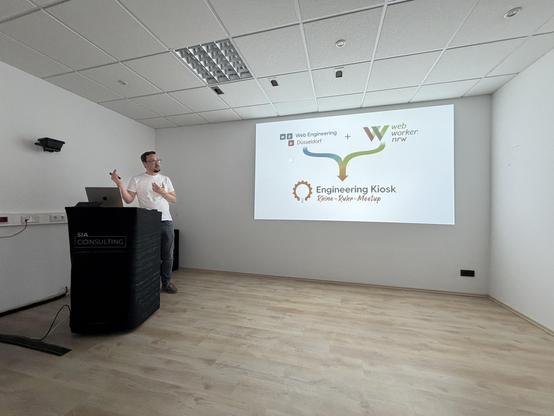
Looking forward to April 29! 🙂
@moonglum and I will be talking about Web Performance at @engkiosk
@utilitybend will share insights on CSS as a state machine
See you there! https://engineeringkiosk.dev/meetup/rhine-ruhr/

Local Tech Meetup Rhine-Ruhr on June 10, 2026 - Engineering Kiosk
Next Engineering Kiosk Rhine-Ruhr meetup on June 10, 2026 in the Rhine-Ruhr region. Talks: "For the Love of Programming" by Matthias Endler, "Navigating Tech Decisions - A Startup Survival Guide" by Tobias Schlitt. Free in-person community event for software engineers and developers.
On April 29, @alaaReuschenbach and I will give a talk about Web Performance at @engkiosk Rhine-Ruhr 😀 @utilitybend will talk about how CSS became a state machine. See you there?
https://engineeringkiosk.dev/meetup/rhine-ruhr/
https://engineeringkiosk.dev/meetup/rhine-ruhr/
Local Tech Meetup Rhine-Ruhr on June 10, 2026 - Engineering Kiosk
Next Engineering Kiosk Rhine-Ruhr meetup on June 10, 2026 in the Rhine-Ruhr region. Talks: "For the Love of Programming" by Matthias Endler, "Navigating Tech Decisions - A Startup Survival Guide" by Tobias Schlitt. Free in-person community event for software engineers and developers.
 Signalrauschen
⚖️ Historisch: Internationaler Strafgerichtshof wechselt zu #OpenDesk!
1800 Arbeitsplätze werden von Microsoft zu deutscher Open-Source-Lösung migriert.
Grund: US-Sanktionen & Sperrung von Chefankläger Khans E-Mail-Zugang durch Microsoft.
"Wir müssen Abhängigkeiten reduzieren und technologische Autonomie stärken" - IStGH-Registrar Zavala Giler
Erste internationale Institution außerhalb DE mit OpenDesk!

Sorge vor US-Sanktionen: Internationaler Strafgerichtshof kickt Microsoft aus seiner Verwaltung
Der Internationale Gerichtshof will sich von Microsoft unabhängig machen und schwenkt auf openDesk um, die Open-Source-Bürosoftware des Zentrums für Digitale Souveränität. Die Bundesregierung könnte sich daran ein Beispiel nehmen. Denn während openDesk bei europäischen Nachbarn gefragt ist, fremdelt die Bundesverwaltung noch immer damit.
 Eberhard Wolff
Are developers slower using AI?
Pro Tip: Read the discussion. p10f
Yes, slower for experienced developers and a well known code base. Greenfield or less experience are a different story. And things will probably improve.
https://arxiv.org/abs/2507.09089
Pro Tip: Read the discussion. p10f
Yes, slower for experienced developers and a well known code base. Greenfield or less experience are a different story. And things will probably improve.
https://arxiv.org/abs/2507.09089

Measuring the Impact of Early-2025 AI on Experienced Open-Source Developer Productivity
Despite widespread adoption, the impact of AI tools on software development in the wild remains understudied. We conduct a randomized controlled trial (RCT) to understand how AI tools at the February-June 2025 frontier affect the productivity of experienced open-source developers. 16 developers with moderate AI experience complete 246 tasks in mature projects on which they have an average of 5 years of prior experience. Each task is randomly assigned to allow or disallow usage of early 2025 AI tools. When AI tools are allowed, developers primarily use Cursor Pro, a popular code editor, and Claude 3.5/3.7 Sonnet. Before starting tasks, developers forecast that allowing AI will reduce completion time by 24%. After completing the study, developers estimate that allowing AI reduced completion time by 20%. Surprisingly, we find that allowing AI actually increases completion time by 19%--AI tooling slowed developers down. This slowdown also contradicts predictions from experts in economics (39% shorter) and ML (38% shorter). To understand this result, we collect and evaluate evidence for 20 properties of our setting that a priori could contribute to the observed slowdown effect--for example, the size and quality standards of projects, or prior developer experience with AI tooling. Although the influence of experimental artifacts cannot be entirely ruled out, the robustness of the slowdown effect across our analyses suggests it is unlikely to primarily be a function of our experimental design.