
Zuzanna Brunarska

52 Followers
50 Following
44 Posts
Assistant Professor at the Centre of Migration Research, University of Warsaw
Researching: determinants of #attitudes towards imm/emigration, #migration decision-making, contextual effects of migration, inter-ethnic relations and migration in #Russia
websitehttps://www.migracje.uw.edu.pl/zespol/zuzanna-brunarska-2/
Google Scholarhttps://scholar.google.pl/citations?user=-ZVsLiAAAAAJ&hl=pl
ORCiDhttps://orcid.org/0000-0001-6804-6716
ResearchGatehttps://www.researchgate.net/profile/Zuzanna-Brunarska
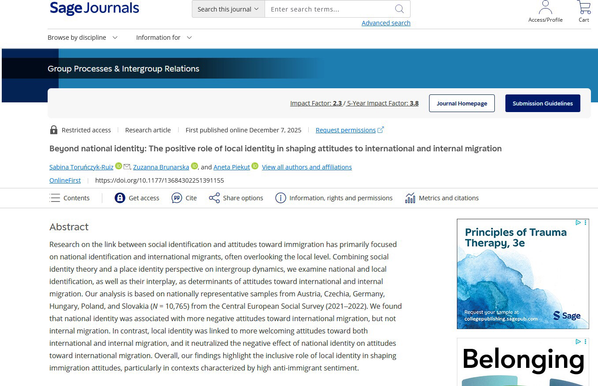
… determine whether group boundaries at the local and national levels matter for opposition to the different types of immigration in the local community. Our analysis was based on nationally representative samples from AT, CZ, DE, HU, PL & SK from the 1st wave of Central European Social Survey (CESS).
… local identity was linked to more welcoming attitudes to both international and internal migration, and it neutralized the negative effect of national identity on attitudes to international migration. We focus on immigration attitudes in the local environment rather than in the country. By simultaneously examining attitudes to both internal and international migration and considering both national and local identity, were able to …
In our new paper w/ Sabina Toruńczyk-Ruiz & @anetapiekut published in Group Processes & Intergroup Relations, we examine national and local identification, as well as their interplay, as determinants of attitudes to international & internal migration. We found that national identity was associated w/ more negative attitudes to international migration, but not internal migration. In contrast, … 1/ @sociology doi.org/10.1177/13684302251391155
📢 #jobalert #hiring
#Postdoc opportunity for a qualitative scholar for 14.5 mo (fte) at the Centre of Migration Research, University of Warsaw to work on the political impact of new Russian emigrants on host countries and the RF in the DemEx project. Details and application instructions available under the following link: https://www.migracje.uw.edu.pl/wp-content/uploads/2025/09/Ogloszenie-o-konkursie_DemExII_OBM_ENG-JL-1.pdf
Image by geralt/pixabay
…restrictions imposed on emigration by their own state. To this end, I use family accounts of unrealized emigration from two emigration-restrictive contexts: communist Poland and the USSR. By providing an empirical case on immobility that does not easily fit into the voluntary/involuntary dichotomy, I argue for the need to look at the immobility outcome through the lens of a continuum of (in)voluntariness, rather than the involuntary-voluntary binary.
In my new paper in Nationalities Papers, I address the question of the distinction between voluntary and involuntary immobility under emigration restrictions. I show how the critique of the voluntary-involuntary binary expands to the study of immobility as an outcome of the migration decision-making process. I do so by considering a specific case where people’s aspirations and capabilities are subject to… 1/ doi.org/10.1017/nps.2025.10088
📣 #jobalert #hiring
#Postdoc opportunity for a qualitative scholar for 2y (fte) at the Centre of #migration Research, University of Warsaw to work on the political impact of new Russian emigrants on host countries and the RF in the DemEx project. Details and application instructions available under the following link: https://www.migracje.uw.edu.pl/wp-content/uploads/2024/10/OBM-NA-P-T-APDemEX-2.12024_ENG.pdf
Image by Gerd Altmann from Pixabay
... 2) factors influencing stories and their reception, including post-hoc rationalisation; childhood memories; compensatory mobility; contact with those who left; everyday times, individual lifetimes, and institutional times.
I shed light on 1) the mechanisms that may underlie the potential influence of the experience over migration-related attitudes, norms, #aspirations of the non-migrants’ #descendants, including directly persuasive normatively loaded, migration-encouraging #narratives and neutral or migration-discouraging #stories though contributing to the perception of mobility as a social norm and leading to greater sensitivity to the subject, and ... 2/