We are expanding (again!)
PAID research assistant / MSc positions!
Flexible research on
#cooperation / #communication / #animal_behaviour
/ #cognition / #human_evolution
/ #philosophy_of_biology
Residency in Leipzig /Konstanz is a big + !
Must be enrolled on a German university!
[email protected]

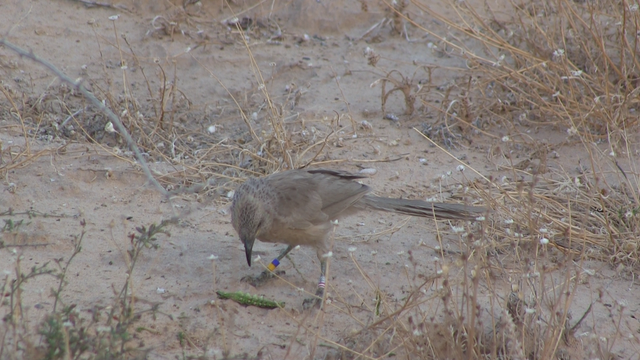
Birds’ Preparation Methods Vary with the Meal
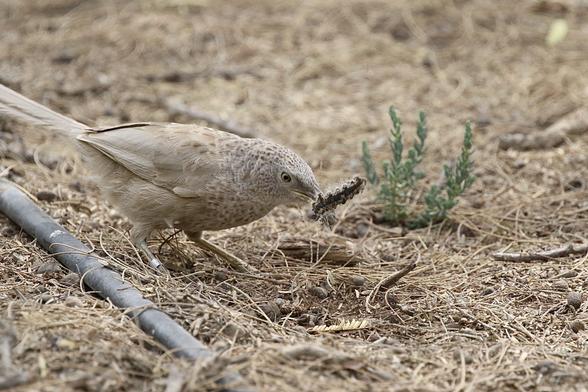
Arabian babblers show cognitive flexibility when prepping meals, depending on how they need to be processed for eating.
9/9 We dedicated this paper to the memory of Christophe Boesch, whose research on chimpanzees’ material culture and commitment to their conservation continue to inspire ethologists worldwide.
https://www.eva.mpg.de/primatology/staff/boesch/Christophe Boesch - Max Planck Institute for Evolutionary Anthropology
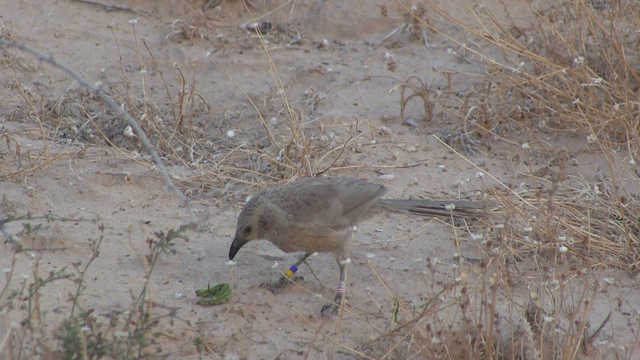
8/9 Do Arabian babblers learn food processing skills from each other? Are there different processing “traditions” across populations? More exciting questions to be addressed soon… ( an Arabian babbler from a different population handles a caterpillar) 📸 @krista_natasha
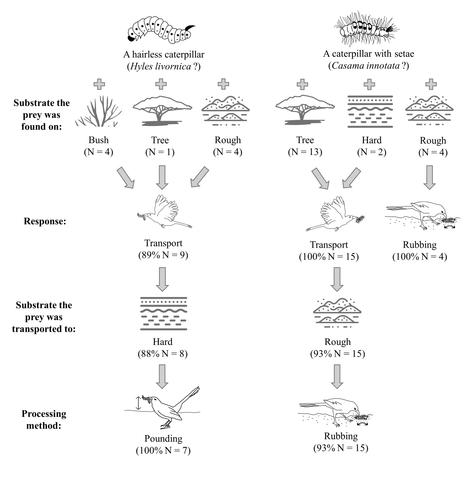
7/9 The birds selectively transported the prey to a proper substrate if the original one didn’t fit the right caterpillar manipulation. In this way, Arabian babblers can achieve higher efficiency in processing their food.
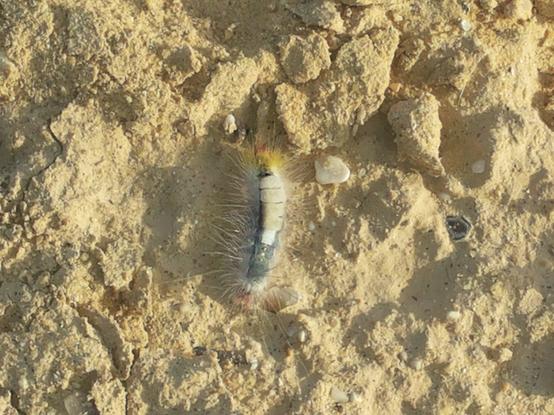
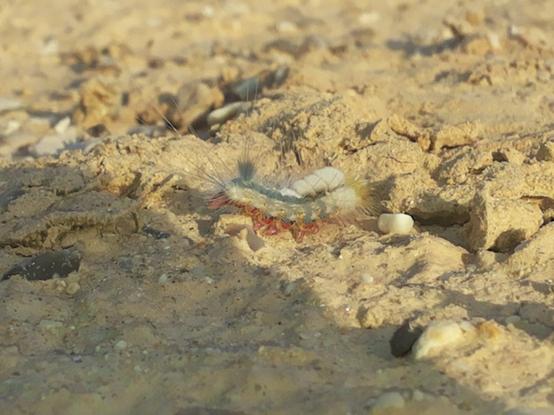
6/9 Other caterpillar species (Hyles) are strongly pounded against a hard substrate until their gut, hypothesized to be parasitized or toxic, is expelled. Consequently, the birds consume only the outer part of the prey.
5/9 Moth caterpillars (Casama) with long toxic hairs are being carefully rubbed against sandy substrates. This way, the hairs are removed, and the entire caterpillar can be eaten.
4/9 We found that Arabian babblers fit the right processing methods and substrates to overcome different protective mechanisms of their prey. Such flexibility seems to be essential to survive in a resource-scarce environment.
3/9 Arabian babblers live in extreme deserts and feed on diverse invertebrate species. These prey developed defensive mechanisms such as toxic hairs or hard cuticles. Hence, before gaining the joy of eating, babblers must manipulate the prey, and they know how to do it.
2/9 Arabian babblers use tools (i.e. present objects) as a communicative means to invite conspecifics for copulation (
https://www.frontiersin.org/articles/10.3389/fevo.2019.00087/full) and play (
https://brill.com/view/journals/beh/141/4/article-p425_3.xml?language=en). But it’s the first time their use of environmental features for foraging is described.


Intentional Presentation of Objects in Cooperatively Breeding Arabian Babblers (Turdoides squamiceps)
The emergence of intentional communication and the intentional presentation of objects have been highlighted as important steps in the ontogeny of cooperative communication in humans. Furthermore, intentional object presentation has been suggested as an extremely rare form of communication evolutionarily. Research on comparable means of communication in non-human species may therefore shed light on the selection pressures that acted upon components of human communication. However, the functions and cognitive mechanisms that underlie object presentation in animals are poorly understood. Here, we addressed these issues by investigating object presentations in wild, cooperative breeding Arabian babblers (Aves: Turdoides squamiceps). Our results showed that individuals presented objects to specific recipients. The recipients most often responded by approaching the signaler and the dyad then moveed jointly to copulate at a hidden location. We provide evidence that object presentations by Arabian babblers (i) do not represent a costly signal, as objects were not costly to acquire; (ii) were not used to trade food for sex, as the presentation of food was not more likely to result in copulation; and (iii) possessed hallmarks of first-order intentionality. These results show that intentional presentation of objects is not restricted to the primate linage and may suggest that the need to engage in cooperative interactions facilitates elaborate socio-cognitive performances.